Polyglot Persistence: When Multiple Databases Earn Their Cost
Polyglot persistence is an operational multiplier — each additional database paradigm adds backup, monitoring, failover, and expertise overhead. This article quantifies the cost model, explains Change Data Capture with Debezium as the correct alternative to dual-write, and shows when Postgres extensions eliminate entire database tiers.
Polyglot Persistence: When Multiple Databases Earn Their Cost
Selecting the right database is a foundational architectural decision; data gravity ultimately dictates the scalability and resilience of an application — choose the paradigm first, the product second. The broken pattern in polyglot persistence is adding a second database to solve a problem the first database could have solved with the right extension or configuration. This article forces the question: does the performance delta of that specialized store, at your current scale, justify the fully-loaded operational cost of running it? For most teams below 10M records, the answer is no. For teams above that threshold, this article shows you the correct architecture for keeping multiple stores synchronized.
1. The Operational Cost Model
Every database you add to your stack multiplies your operational surface. The cost is not just the cloud invoice:
Before adding a second database, calculate: is the performance delta of the specialized store worth 1–2 engineer-days per month of ongoing overhead? For a 5-person team, that is 10–20% of engineering capacity consumed by operational maintenance. The answer must be yes before you commit.
| Team Size | Max Defensible Stores | Rationale |
|---|---|---|
| 1–3 engineers | 1 | Ops burden consumes team; one Postgres + extensions |
| 4–8 engineers | 2 | Primary + one cache/session store (Redis) |
| 9–20 engineers | 3 | Primary + Redis + Elasticsearch (if search is core) |
| > 20 engineers | 4+ | Dedicated platform team absorbs ops burden |
2. The Canonical Reference Architecture
When polyglot persistence is justified, this quad-store pattern is the most common defensible configuration:
| Storage Engine | Architectural Role | Sync / Ingestion Path | Primary Workload & Capabilities |
|---|---|---|---|
| PostgreSQL | Primary Source of Truth | Origin (Authoritative) | ACID transactions, Foreign Keys, pgvector, JSONB, PostGIS |
| Redis | In-Memory Accelerator | CDC Event Stream / App | Hot entity caching, session management, sliding-window rate limiting |
| Elasticsearch | Search & Analytics Index | CDC Stream (Debezium/Kafka) | Multi-field full-text search, tokenized queries, log aggregation |
| S3 / Object Storage | Blob & Immutable Storage | Direct / Async Worker | Media assets, report exports, immutable automated backups |
When this quad is justified:
- Postgres primary + Redis: when session/cache reads must be sub-millisecond and Postgres cannot serve them at that latency
-
- Elasticsearch: when full-text search with relevance ranking, faceting, or fuzzy matching is a core product feature
-
- S3: always — object storage for media, static assets, and database backups is a universal requirement
3. Change Data Capture with Debezium
The Dual-Write Anti-Pattern
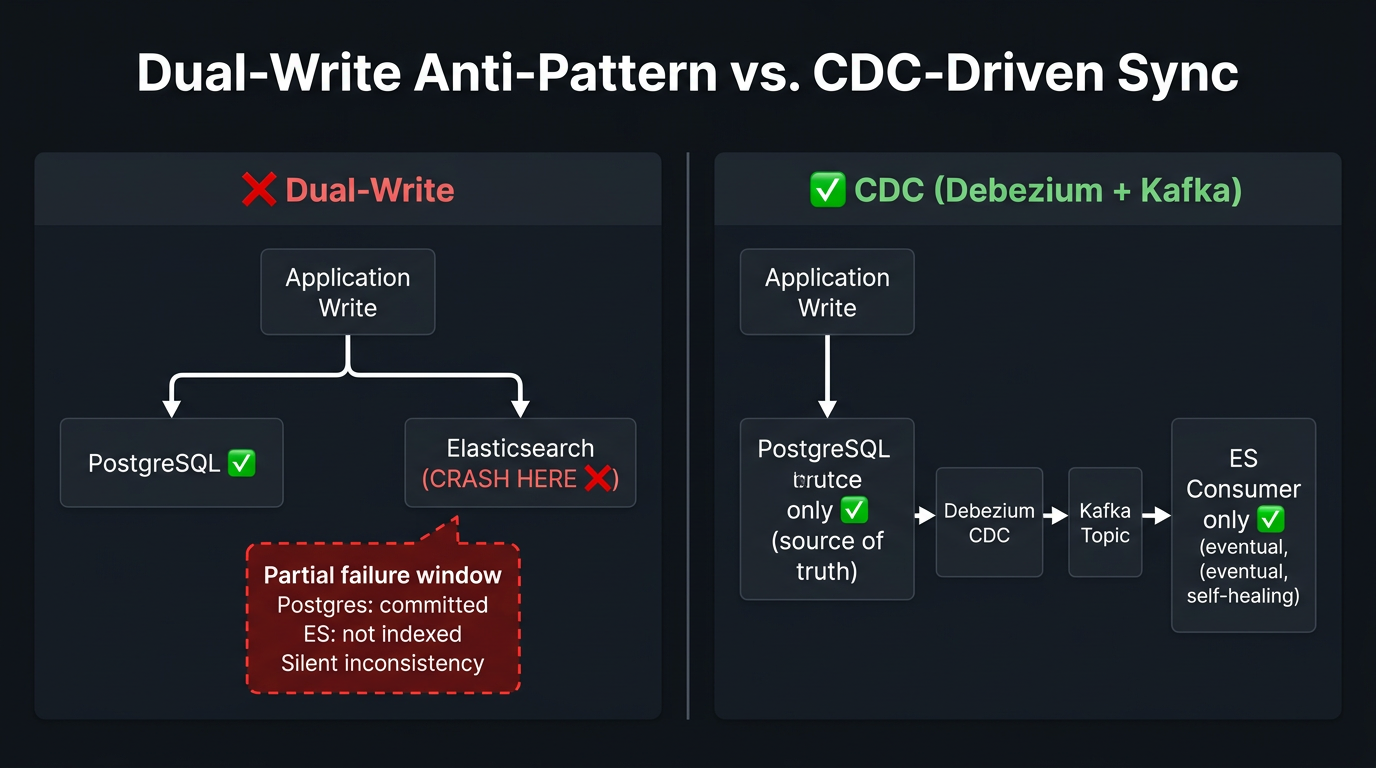
CDC with Debezium — The Correct Pattern
The outbox pattern combined with Debezium gives you exactly-once delivery semantics: the application writes a row to an outbox table inside the same Postgres transaction as the domain write. Debezium reads the outbox table via CDC. If the application server crashes after the Postgres commit but before publishing to Kafka, Debezium will re-read and re-publish the outbox row on restart — no data loss.
4. Eventual Consistency Management
Read-After-Write Consistency
Cache Stampede Prevention
5. When to Consolidate — Postgres Extensions vs. Second Store
| Use Case | Second Store | Postgres Alternative | Consolidate If |
|---|---|---|---|
| Full-text search | Elasticsearch | tsvector + GIN + pg_search / ParadeDB |
< 5M documents, no fuzzy, no faceting |
| Vector similarity | Pinecone / Qdrant | pgvector (HNSW) | < 10M vectors, P99 < 100ms acceptable |
| Session / cache | Redis | pg_sessions + connection pooling |
< 10K sessions/sec, latency > 5ms acceptable |
| Geospatial | PostGIS (separate) | PostGIS extension on primary | Always — PostGIS IS the Postgres extension |
ParadeDB (pg_search extension) brings BM25 full-text search with relevance scoring directly to PostgreSQL. As of 2026, it covers 80% of Elasticsearch use cases for teams under 5M documents — at zero additional infrastructure cost. Evaluate it before provisioning an Elasticsearch cluster.
6. Data Gravity and Exit Costs
[!CAUTION] Data gravity is why database selection is a foundational decision. Choosing MongoDB for convenience at 10K users means a 14-week migration project at 10M users. Choose your primary store based on your 3-year data model, not your current week's feature request.
7. Security — CDC Credential Management
Summary
| Concept | Rule |
|---|---|
| O(n) operational burden | Each additional database paradigm adds O(n) operational burden — measure the performance delta before accepting the cost. |
| Dual-write is an anti-pattern | Dual-write to multiple databases is an anti-pattern: partial writes under failure create irreconcilable inconsistency. Use CDC from a single source of truth. |
| Consolidate with extensions | Postgres with pgvector + pg_search eliminates a dedicated vector DB and Elasticsearch tier for teams under 10M documents/vectors. |
| Cache stampede | Cache stampede under Redis failure requires probabilistic early expiry or a distributed lock on cache population — TTL configuration alone does not prevent it. |
| Data gravity | Data gravity is real: design your primary store with exit costs in mind from day one. |
Related: Database Foundations Series — Polyglot persistence is the production pattern of anchoring invariants in ACID stores and projecting read models into BASE stores. For the formal properties of each paradigm — see ACID Database Properties: Atomicity, Consistency, Isolation & Durability in Practice and BASE Database Properties: Basically Available, Soft State & Eventual Consistency.
What's Next
In Part 7, we synthesize everything into a decision playbook — the 5-step elimination framework applied to every paradigm in the series, with worked system design interview examples for Twitter, Uber, and a RAG chatbot.
This article was developed with AI-assisted deep search, specification cross-referencing, and technical research synthesis.