The Database Selection Playbook: From Workload to Production Decision
A production database selection is a structured elimination process — not a feature race. This article applies the 5-step elimination framework (workload → consistency → scale → expertise → cost) to every paradigm in the series, with worked system design interview examples for Twitter, Uber, and a RAG chatbot.
Modern Database Paradigms
The Database Selection Playbook: From Workload to Production Decision
Selecting the right database is a foundational architectural decision; data gravity ultimately dictates the scalability and resilience of an application — choose the paradigm first, the product second. The broken pattern in database selection is starting with a product name: "Should we use Mongo or Postgres?" This question has no correct answer without knowing the workload shape, consistency requirement, scale horizon, team expertise, and cost constraint. This article gives you the structured elimination process that makes the answer objective — and shows you how to apply it in production architectural reviews and system design interviews.
1. The 5-Step Elimination Process
The goal of each step is to eliminate paradigms that cannot serve your workload, not to rank the remaining ones. By Step 5, you should have a shortlist of 1–3 products.
Step 1 — Classify the Workload
From Part 1's taxonomy: OLTP, Search, Graph, Cache/Session, Vector, or Time-Series? Most production systems have a dominant workload class and secondary access patterns. Optimize for the dominant class — serve the secondaries with extensions or a second store only if the primary paradigm cannot.
Step 2 — Determine the Minimum Acceptable Consistency
| Scenario | Required Consistency | Why |
|---|---|---|
| Payment processing, inventory reservation | Strong (serializable) | Double-spend, oversell impossible |
| User profile updates | Read-your-own-writes | User must see their own change |
| Social feed, notifications | Eventual | Lag of seconds is acceptable |
| Search index, analytics | Eventual | Stale by design — indexing lag expected |
| Rate limiting, counters | Eventual with atomic ops | Redis INCR is atomic, not transactional |
Step 3 — Project the Scale Horizon (12 months)
Step 4 — Account for Team Expertise
A team of MySQL experts choosing CockroachDB for a new service adds 8–12 weeks of operational ramp before they can safely respond to production incidents. If the business timeline doesn't accommodate this, the correct choice is the paradigm the team already operates well — even if it is theoretically suboptimal.
Step 5 — Calculate Total Cost of Ownership
| Store | $0–$500/mo range | $500–$5K/mo range | > $5K/mo range |
|---|---|---|---|
| PostgreSQL (managed — Supabase/RDS) | t3.medium: ~$25/mo | db.r6g.xlarge: ~$400/mo | Multi-AZ + replicas: $1K–$5K |
| MongoDB Atlas | M10: ~$60/mo | M40: ~$420/mo | M80+: ~$2K+/mo |
| DynamoDB (on-demand) | < 5M ops/day: < $100/mo | 50M ops/day: ~$1K/mo | 500M ops/day: ~$10K/mo |
| CockroachDB (Dedicated) | 3-node 2vCPU: ~$450/mo | 3-node 8vCPU: ~$1.8K/mo | Multi-region: $5K–$15K |
| Elasticsearch (managed) | t3.small.search: ~$50/mo | r6g.large.search: ~$600/mo | r6g.4xlarge: ~$3K+/mo |
| Redis (ElastiCache) | cache.t3.micro: ~$12/mo | cache.r6g.large: ~$120/mo | cache.r6g.4xlarge: ~$1K+/mo |
2. Full Paradigm Decision Table
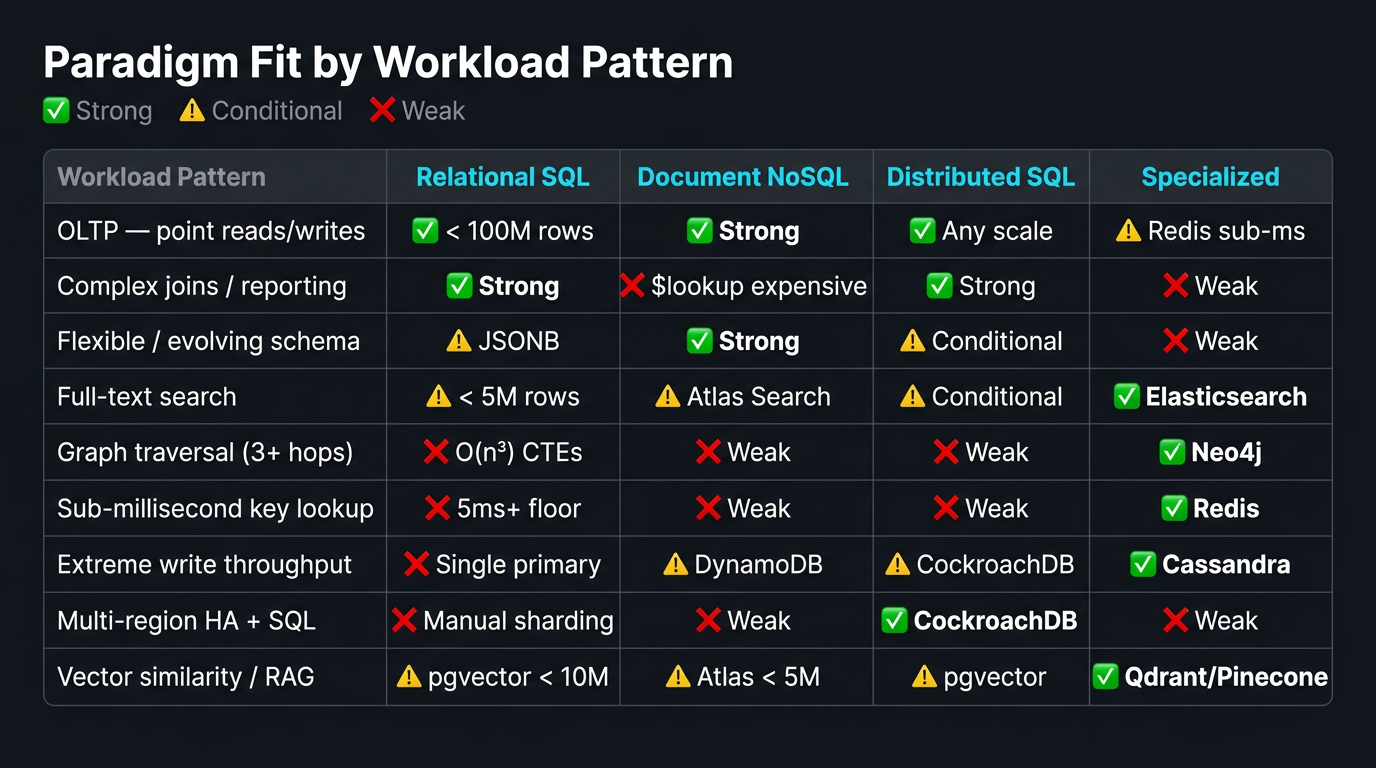
| Workload Pattern | Relational SQL | Document NoSQL | Distributed SQL | Specialized Store |
|---|---|---|---|---|
| Point reads/writes (OLTP) | ✅ Strong (< 100M rows) | ✅ Strong | ✅ Strong (any scale) | ⚠️ Redis (sub-ms) |
| Complex joins / reporting | ✅ Strong | ❌ Weak ($lookup expensive) |
✅ Strong | ❌ Weak |
| Flexible/evolving schema | ⚠️ Conditional (JSONB) | ✅ Strong | ⚠️ Conditional | ❌ Weak |
| Full-text search | ⚠️ Conditional (tsvector, < 5M) |
⚠️ Atlas Search | ⚠️ Conditional | ✅ Elasticsearch |
| Graph traversal (3+ hops) | ❌ Weak (recursive CTE, O(n³)) | ❌ Weak | ❌ Weak | ✅ Neo4j |
| Sub-millisecond key lookup | ❌ Weak (5ms+ overhead) | ❌ Weak | ❌ Weak | ✅ Redis |
| Extreme write throughput (> 100K/s) | ❌ Weak | ⚠️ DynamoDB | ⚠️ CockroachDB | ✅ Cassandra |
| Multi-region HA + SQL | ❌ (manual sharding) | ❌ | ✅ Strong (CockroachDB) | ❌ |
| Vector similarity / RAG | ⚠️ pgvector (< 10M) | ⚠️ Atlas (< 5M) | ⚠️ pgvector | ✅ Qdrant / Pinecone |
3. System Design Interview Application
The pattern that earns architectural credit in a system design interview: Access Pattern → Paradigm → Product → Scale Justification. Never open with a product name.
"Design Twitter / X" — Database Narration
"Design a RAG Chatbot" — Database Narration
"Design Uber" — Database Narration
4. Anti-Pattern Catalog
5. Managed vs. Self-Hosted Decision
| Factor | Managed (Atlas, DynamoDB, CRDB Cloud) | Self-Hosted (Postgres, Qdrant, Cassandra) |
|---|---|---|
| Ops burden | Near-zero (patching, failover, backups automated) | 1–2 engineer-days/month per store |
| Cost premium | 30–60% above compute cost | Compute only |
| When justified | Teams < 5 engineers, early stage | Ops expertise on team, cost-optimized |
| Lock-in risk | High (vendor-specific features) | Low (self-host anywhere) |
| Compliance | Vendor manages (check SOC2/HIPAA certs) | Team manages (more control, more responsibility) |
Summary
| Concept | Rule |
|---|---|
| 5-step elimination | Use the 5-step elimination process; never open a database selection conversation with a product name. |
| Strong consistency | Strong consistency is required for financial transactions, inventory, and any workflow where two concurrent users must not see conflicting state. |
| Managed vs. self-hosted | Managed cloud services trade 30–60% cost premium for zero ops burden — justified for teams under ~5 engineers; self-host when ops expertise is present. |
| Interview narration | In system design interviews, justify the database with the access pattern and scale threshold — not the brand. |
| Anti-pattern catalog | Anti-patterns are architectural debt; Elasticsearch as primary and Redis without AOF are the two highest-frequency production failure patterns in this domain. |
What's Next
In Part 8, we ground the entire series in production reality — the canonical failure modes for every paradigm we've covered, with per-database recovery playbooks and GDPR compliance failure modes that appear reliably at scale.
This article was developed with AI-assisted deep search, specification cross-referencing, and technical research synthesis.