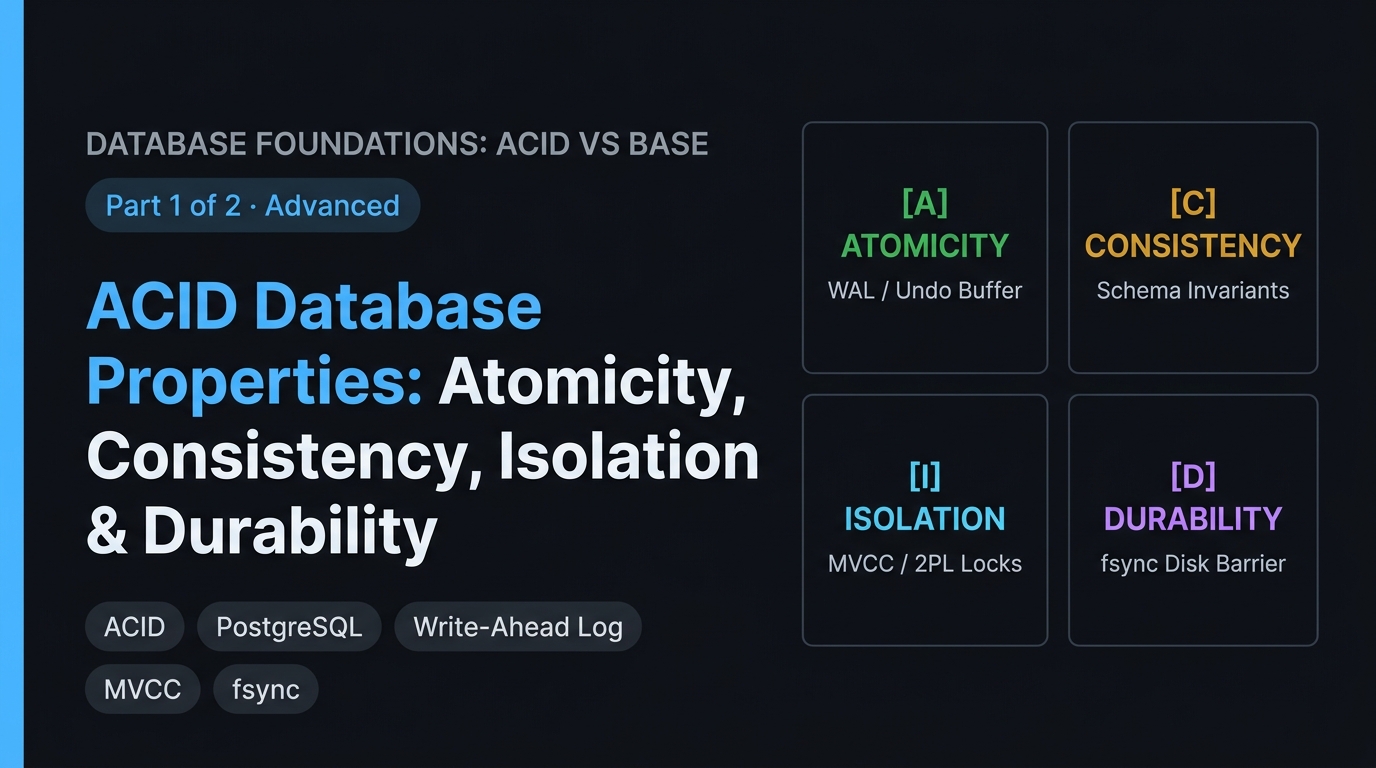
ACID Database Properties: Atomicity, Consistency, Isolation & Durability in Practice
ACID is not a binary badge or marketing term — it is a formal contractual guarantee across write paths, concurrency anomalies, and crash recovery. This article breaks down the exact mechanics of Atomicity (WAL & undo logs), Consistency (invariants vs transactions), Isolation (anomalies, 2PL, MVCC, and SSI), and Durability (fsync, checkpoints, and group commit), showing how to enforce ACID guarantees without crippling throughput.
Database Foundations: ACID vs BASE
ACID Database Properties: Atomicity, Consistency, Isolation & Durability in Practice
Series Mindset: "A database transaction is not magic syntax — it is a physical contract between the storage engine's write-ahead log and your application's tolerance for concurrency anomalies, whereas BASE is the explicit acknowledgment that under distributed scale, availability and convergence supersede global locks."
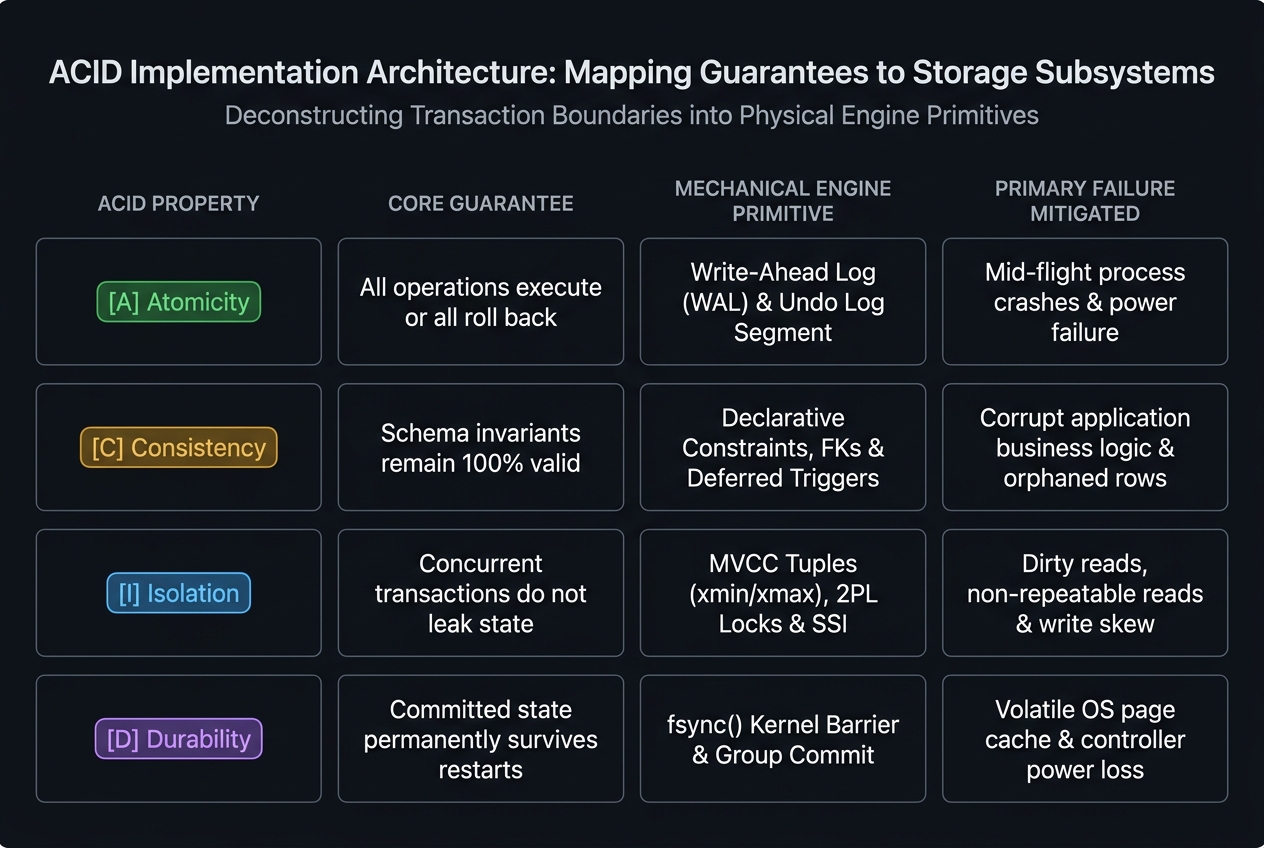
The broken pattern: teams wrap complex domain operations in a BEGIN ... COMMIT block, check off "ACID compliant" on their architecture review, and assume their data layer is immune to corruption. In production, wrapping queries in a transaction provides zero safety against write skew under default isolation levels, does not prevent partial state leaks across microservices, and will happily discard committed records if the underlying disk controller's volatile write cache loses power before an fsync barrier. ACID is not a binary badge — it is a strict mechanical contract with four distinct properties, each enforced by a different storage subsystem.
1. Atomicity: The All-or-Nothing Primitive
Atomicity guarantees that a series of database operations either execute entirely or leave the database state completely unmodified. It is a crash-resilience property, not a concurrency property — two transactions can both be perfectly atomic while still corrupting shared state by interleaving their writes.
1.1 The Broken Pattern: Unprotected Multi-Step Mutations
This pattern appears throughout codebase history as "two separate API calls that should both succeed." In microservices, the equivalent is calling Service A's REST endpoint, receiving HTTP 200, then calling Service B and receiving a network timeout. Without a distributed rollback mechanism, the data is now permanently inconsistent — Service A's state changed but Service B's did not.
1.2 The Mechanical Fix: Write-Ahead Logging (WAL) & Undo Buffers
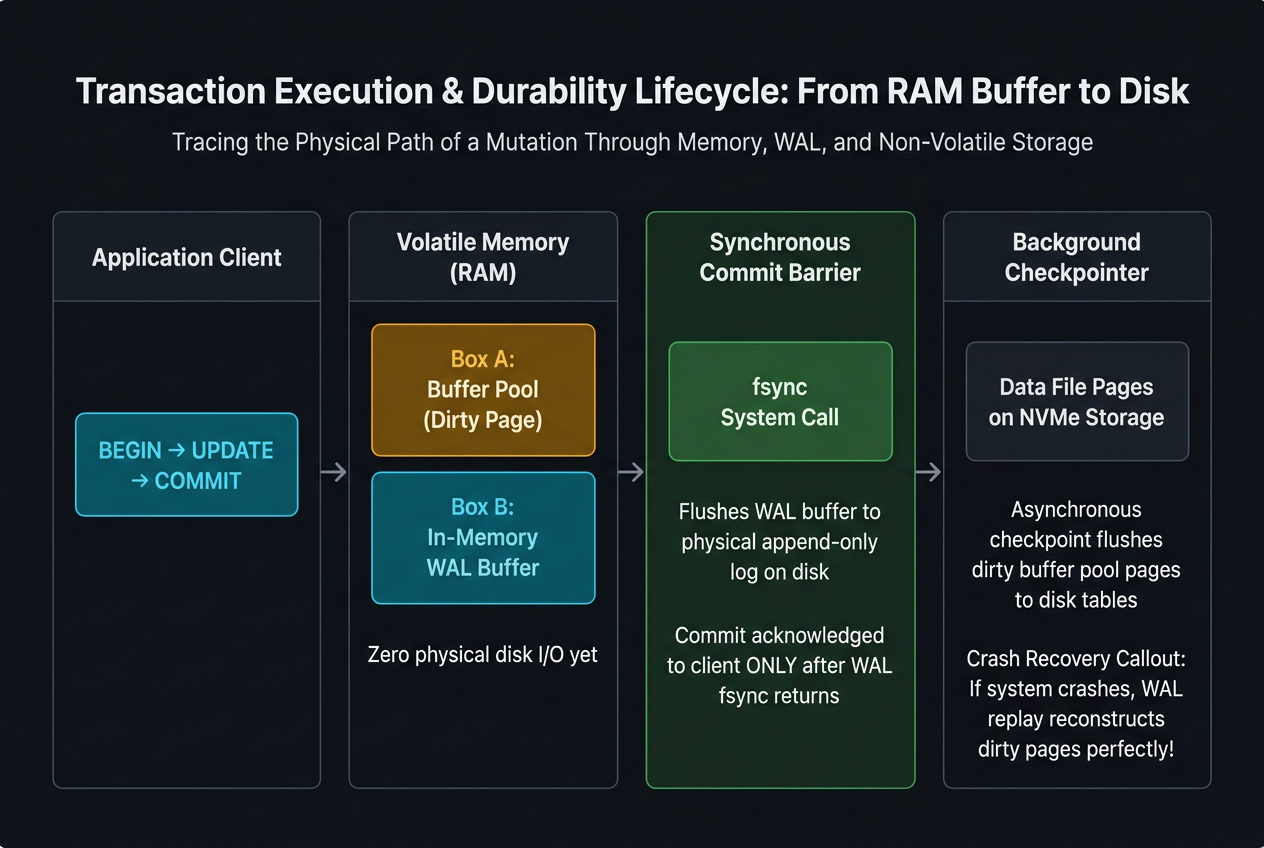
Databases do not write directly to data table pages on disk during a transaction. Instead, every mutation appends a sequential change record to an append-only Write-Ahead Log (WAL). If the process crashes mid-transaction, recovery replays the WAL forward and uses undo records to roll back uncommitted changes.
Atomicity does not protect against concurrent read interleaving. A transaction can be perfectly atomic (either all statements commit or all abort) while completely failing to isolate its intermediate states from concurrent transactions. Isolation is an entirely separate property with its own enforcement mechanism.
The WAL's sequential write pattern is intentional: sequential disk I/O is 10–100× faster than random page writes. The data pages on disk can be updated lazily at checkpoint time because the WAL already contains the full audit trail needed for crash recovery.
For background on exactly how the WAL, buffer pool, B-Tree pages, and checkpoint flushes interact at the I/O layer, see Database Internals: What Happens Below the Query.
2. Consistency: Application Invariants vs CAP Linearizability
The letter "C" is the most misunderstood property in database theory because it means entirely different things in ACID and CAP:
| Dimension | ACID Consistency ("C") | CAP Consistency ("C") |
|---|---|---|
| Formal Definition | Preservation of declared domain invariants and relational constraints. | Linearizability: Global recency guarantee where all reads return the latest write. |
| Enforcement Layer | Application schema, foreign keys, CHECK constraints, unique indexes. |
Distributed consensus protocol (Raft, Paxos, synchronous replication). |
| Failure State | Transaction aborts if a constraint (balance >= 0) is breached. |
Request blocks or fails if a network partition prevents replica quorum. |
| Scope | Single database transaction boundary. | Multi-node distributed system across time. |
| Who Defines It | Schema designer and application developer. | Distributed systems protocol implementer. |
ACID's "C" is your responsibility — it is enforced by constraints you declare and application logic you write. CAP's "C" is the distributed protocol's responsibility — it is enforced by Raft consensus elections and synchronous replica acknowledgment. Conflating the two leads to architects believing that switching to a "CP system" eliminates the need for foreign keys and check constraints. It does not.
2.1 Invariant Protection in SQL
Each constraint type protects a different class of invariant:
REFERENCES ... ON DELETE RESTRICT— referential integrity (orphan prevention)CHECK (balance >= 0.00)— domain invariant (business rule enforcement)UNIQUE (user_id, currency)— uniqueness invariant (duplicate prevention at the storage layer, not just application code)
2.2 The Invariant the Schema Cannot Enforce: Cross-Row Checks
Schema-level constraints validate single-row conditions atomically. Multi-row business rules — like "a user's total balance across all currencies must not exceed their credit limit" — require either a trigger, a deferred constraint, or an application-level read-check inside the transaction:
3. Isolation: The Spectrum of Concurrency Anomalies
Isolation dictates the degree to which concurrently executing transactions are invisible to one another. Full isolation (SERIALIZABLE) is equivalent to sequential, one-by-one serial execution — safe but expensive. The SQL standard defines a progression of weaker guarantees, each permitting specific classes of anomalies in exchange for higher throughput.
For an exhaustive breakdown of each anomaly class — dirty reads, non-repeatable reads, phantom reads, and write skew — including the exact MVCC snapshot timestamps at which each anomaly manifests, see Isolation & Concurrency Control: The Anomaly You Are Allowing Right Now.
3.1 The Hidden Trap: Write Skew Under Repeatable Read
REPEATABLE READ is the most dangerous isolation level because its safety feels intuitively complete. It sounds like "I can repeat my reads safely." What it actually means is "my individual row reads are stable, but concurrent transactions can perform conflicting writes based on the same stable snapshot without blocking each other."
The fix requires either SERIALIZABLE isolation or an explicit SELECT ... FOR UPDATE on the aggregate guard row:
3.2 MVCC: How PostgreSQL Isolates Without Blocking
PostgreSQL's Multi-Version Concurrency Control (MVCC) allows reads to never block writes and writes to never block reads by maintaining multiple physical versions of each row. Every row carries two hidden system columns:
| Hidden Column | Meaning |
|---|---|
xmin |
Transaction ID of the INSERT or UPDATE that created this row version |
xmax |
Transaction ID of the DELETE or UPDATE that invalidated this row version (0 if still live) |
When a SELECT executes at isolation level READ COMMITTED, it sees only rows where xmin is committed and xmax is either 0 or belongs to an aborted transaction. At REPEATABLE READ, the snapshot is fixed to a single transaction start timestamp, hiding all commits that occurred after BEGIN. For more detail on xmin/xmax mechanics and vacuum's role in cleaning dead tuples, see Relational Databases: PostgreSQL & MySQL.
4. Durability: The Physical Reality of Disk Flushing
Durability guarantees that once a transaction commits, its effects survive power outages, operating system panics, and process crashes. Achieving true durability requires understanding the I/O stack between application code and physical non-volatile media.
An operating system write() call does NOT write to physical media — it writes to the OS kernel page cache (volatile DRAM). If power is cut before the kernel flushes to non-volatile storage, the "committed" data is permanently lost. Durability requires a blocking fsync() system call that forces the kernel to drain its page cache to the storage controller.
Each arrow in the chain represents a durability boundary where data can be permanently lost on power failure:
- write() → OS page cache: Data is in volatile DRAM. A kernel panic destroys it.
- OS page cache → disk controller buffer: Data is in the controller's volatile cache. A power failure without Battery-Backed Unit (BBU) destroys it.
- Disk controller → NAND/platter: Data is physically persisted. Survives power failure.
4.1 The fsync = off Trade-off
PostgreSQL's fsync = off setting disables the fsync() call on WAL writes, which can increase write throughput by 10–100× on HDD-based systems. It is tempting to use in high-throughput environments:
[!CAUTION]
fsync = offdoes not merely risk a single transaction's data — it risks database corruption. If the OS crashes withfsync = offactive, the on-disk data page files and the WAL can diverge, resulting in unrecoverable corruption thatpg_resetwalcannot fix. This setting is appropriate only for ephemeral test databases.
4.2 Group Commit: Durability at Scale
Executing fsync() on every individual transaction commit throttles write throughput to the storage device's physical seek-and-flush latency (~1–10ms per operation, or ~100–1,000 commits/second on HDDs). Modern ACID engines use Group Commit: bundling dozens of concurrently-committing transactions into a single batch fsync() call:
PostgreSQL's group commit is automatic and tunable via commit_delay and commit_siblings. It is what allows high-concurrency OLTP workloads (tens of thousands of commits per second) without sacrificing the fsync durability guarantee.
5. The Scaling Wall: Distributed ACID vs BASE
Single-node ACID is the gold standard for financial ledgers and relational correctness, but it hits a physical scaling ceiling:
- Vertical Limit: A single primary database can only scale as far as the host machine's NVMe write bandwidth and CPU lock bus permit. Past roughly 1M writes/second, you either shard or choose a different paradigm.
- Network Partitions: Spanning an ACID transaction across multiple geographic data centers via Two-Phase Commit (2PC) makes every transaction's latency equal to the slowest node's round-trip time. If any coordinator node becomes unreachable, all participant nodes hold locks indefinitely — a distributed deadlock.
For how distributed 2PC stalls and why the Transactional Outbox pattern is the production-safe alternative, see Distributed Transactions: Two-Phase Commit, Transactional Outbox & CDC.
For how modern distributed SQL databases like CockroachDB achieve true ACID transactions across geographic shards using Raft consensus and Hybrid Logical Clocks (HLC), see Cloud-Native & Distributed SQL: CockroachDB.
When business logic spans services and global ACID is prohibitive, SAGA patterns replace Isolation with explicit compensating transactions — trading the "I" in ACID for choreographed eventual consistency. This is examined in SAGA Pattern: Choreography & Orchestration.
This scaling threshold is where systems transition from ACID to BASE (Basically Available, Soft state, Eventual consistency), the distributed counterweight analyzed in Part 2.
Summary
| Property | Core Guarantee | Mechanical Implementation | Primary Concurrency/Failure Hazard |
|---|---|---|---|
| Atomicity | All operations succeed or all abort | Write-Ahead Log (WAL) & Undo Log | Mid-flight process crash or power loss |
| Consistency | Schema invariants remain valid | Database schema constraints & foreign keys | Unvalidated application writes & missing checks |
| Isolation | Concurrent transactions do not corrupt state | 2-Phase Locking (2PL), MVCC, SSI | Dirty reads, non-repeatable reads, write skew |
| Durability | Committed state survives crashes | fsync() barriers, battery-backed write caches |
Volatile OS write caching & disk controller loss |
Key Takeaways
- Atomicity is all-or-nothing execution enforced by Write-Ahead Logs (WAL) and undo buffers; it provides zero protection against concurrent interleaving without Isolation.
- The 'C' in ACID refers to application schema invariants (constraints, checks, foreign keys), which is fundamentally orthogonal to the 'C' (linearizability) in the CAP theorem.
- Isolation levels are a contractual menu of tolerable concurrency anomalies; picking the wrong level either invites silent write skew or incurs catastrophic lock serialization.
- Durability is physically dictated by the fsync barrier and disk controller write caches — without synchronous flushing, committed transactions remain vulnerable to power loss in the OS buffer cache.
- Single-node ACID guarantees do not scale across network partitions; attempting distributed 2-Phase Commit introduces coordinator blocking and extreme tail latency.
What's Next
In Part 2, we deconstruct the distributed counterweight to ACID: BASE Database Properties: Basically Available, Soft State & Eventual Consistency in Distributed Systems — detailing quorum mathematics, vector clocks, and CRDT convergence under network partitions.
This article was developed with AI-assisted deep search, specification cross-referencing, and technical research synthesis.