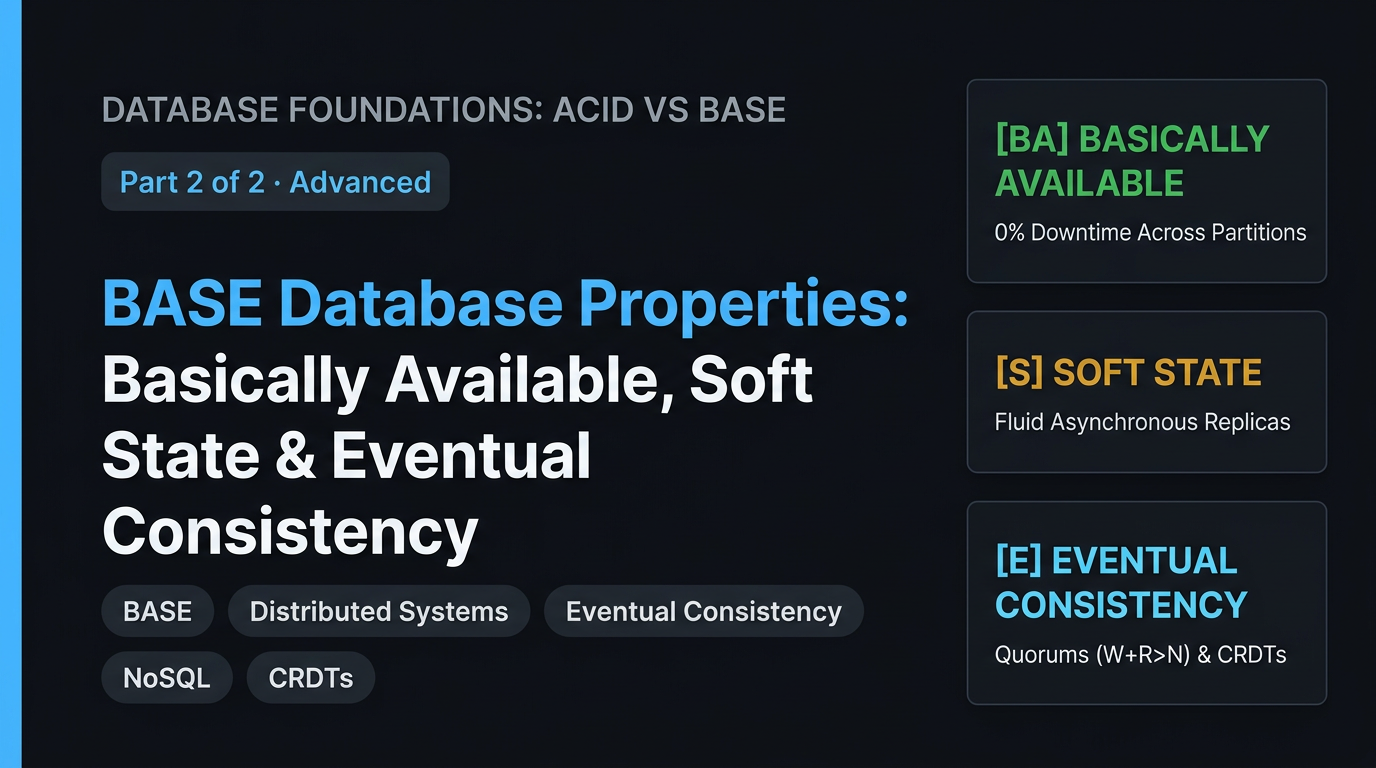
BASE Database Properties: Basically Available, Soft State & Eventual Consistency in Distributed Systems
When distributed scale makes global ACID locks mathematically prohibitive, distributed systems adopt the BASE model. This article deconstructs Basically Available (graceful degradation, partitioning, partition-aware routing), Soft State (state mutation without application interactions, gossip protocols, lease expiry), and Eventual Consistency (quorums, conflict resolution, CRDTs, and anti-entropy repair) into concrete operational patterns.
Database Foundations: ACID vs BASE
BASE Database Properties: Basically Available, Soft State & Eventual Consistency in Distributed Systems
Series Mindset: "A database transaction is not magic syntax — it is a physical contract between the storage engine's write-ahead log and your application's tolerance for concurrency anomalies, whereas BASE is the explicit acknowledgment that under distributed scale, availability and convergence supersede global locks."
The broken pattern: engineers design high-throughput distributed microservices or globally replicated data stores while implicitly expecting the immediate, synchronous linearizability of single-node ACID transactions. When a cross-datacenter WAN link experiences a 200ms latency spike or an AWS availability zone splits, the application layer either locks up awaiting synchronous consensus or silently serves stale data that permanently overwrites newer records via naive Last-Write-Wins timestamps. In distributed systems, global ACID is an availability bottleneck. BASE (Basically Available, Soft state, Eventual consistency) is not sloppy engineering — it is a mathematically grounded paradigm designed to survive physical network partitions while continuing to serve traffic.
1. Basically Available (BA): Resilience Under Network Partitions
Under the CAP theorem, when a physical network partition ($P$) occurs, a distributed system must choose between Consistency ($C$) or Availability ($A$).
- ACID-backed systems (CP): Refuse writes or block callers to prevent serving inconsistent state across the partition. Callers receive errors or timeouts during the partition window.
- BASE systems (AP): Accept writes and reads on both sides of the partition, guaranteeing basic service availability while deferring state synchronization until the network heals.
The CAP theorem does not say "choose two of three." It says: when a partition occurs, you must choose one of two responses. Before and after the partition, all three properties can hold. The architectural decision is about the partition response strategy, not a permanent trade-off.
For an exhaustive treatment of Linearizability, Causal Consistency, Monotonic Reads, and Read-Your-Writes — including the PACELC model that extends CAP to quantify latency trade-offs even in the absence of partitions — see Consistency Models & Distributed Coordination: What 'Consistent' Actually Means.
1.1 Graceful Degradation Patterns
"Basically Available" does not mean returning errors. It means delivering degraded but functional experiences:
| Degradation Strategy | Example Implementation | Appropriate For |
|---|---|---|
| Stale Read Fallback | Serve recommendation feed cached 5 minutes ago if real-time scoring engine is unreachable | Social feeds, product recommendations |
| Optimistic Local Ingestion | Append "Add to Cart" to a local durable queue, return HTTP 202 immediately | Shopping carts, event counters, likes |
| Feature Flag Degradation | Disable non-essential features (AI personalization) while keeping core purchase flow online | E-commerce checkout flows |
| Circuit Breaker Short-Circuit | Return cached last-known-good response instead of propagating errors | Any downstream dependency |
2. Soft State (S): State Mutation Without Client Interaction
In an ACID database, state transitions only occur when an explicit client query executes (UPDATE, INSERT, DELETE). In a BASE system, state is dynamic and fluid between mutations:
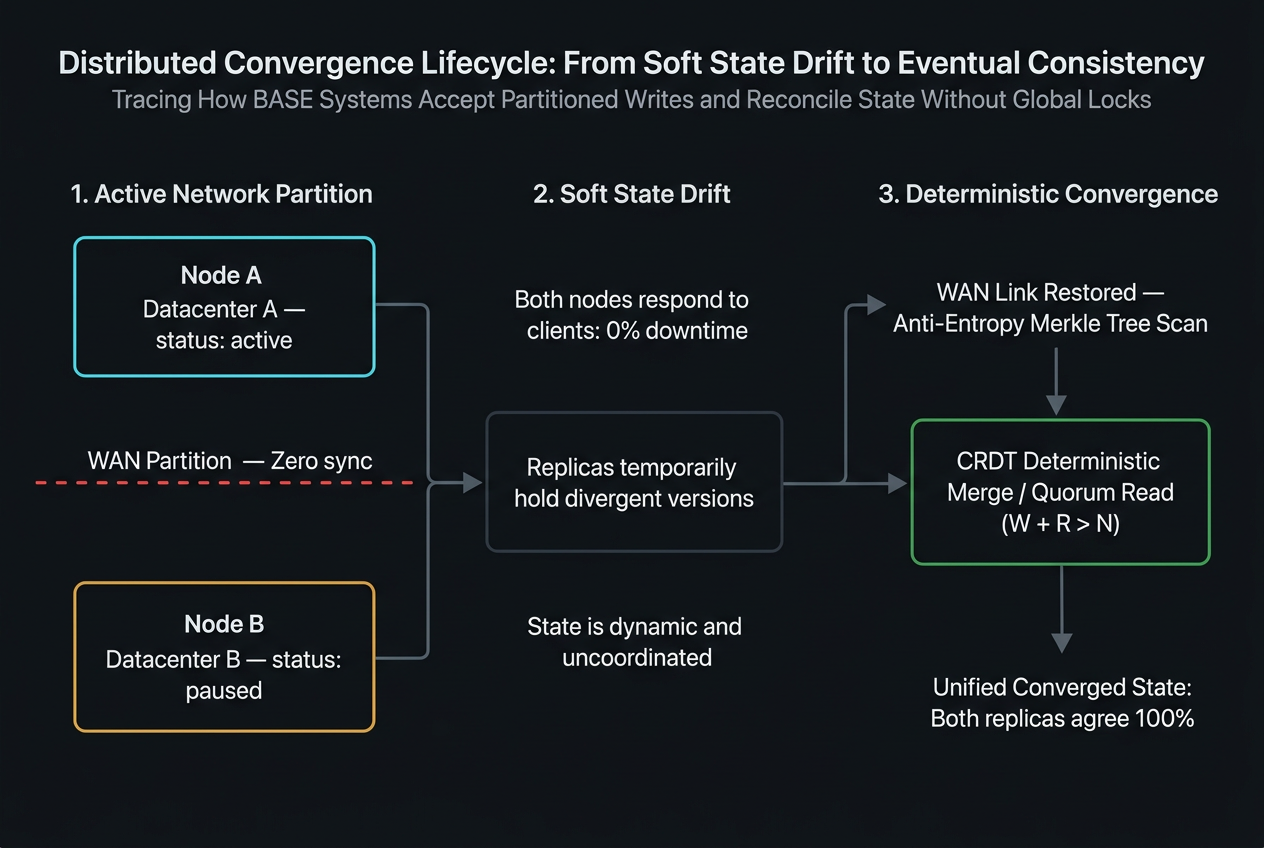
Soft State means data values inside replicas can change over time without any active application write. Background gossip heartbeats, lease timeouts, anti-entropy Merkle tree exchanges, and read-repair workers are constantly mutating node state in the background to drive convergence toward a consistent value.
This is a fundamental cognitive shift: in BASE systems, you cannot think of a node's state as a stable ledger entry. It is a current best approximation that is continuously being refined.
2.1 Anti-Entropy via Merkle Trees
Replicas detect divergence by comparing Merkle tree hashes over their data segments. If the root hashes differ, the trees are traversed to isolate which specific key ranges diverged, and only those ranges are synchronized:
2.2 Gossip Protocol Membership
Soft state also governs cluster membership in systems like Apache Cassandra. Each node periodically exchanges a "heartbeat" with a random subset of peers. Node failure is detected not by a central coordinator, but by epidemic dissemination: when a node misses enough heartbeats, peers mark it as "suspect" and then "down" via the Phi Accrual Failure Detector. This means the view of which nodes are alive is also soft state — it converges, but is never globally instantaneous.
For Cassandra's masterless replication ring, gossip-based membership, and tunable consistency levels (LOCAL_QUORUM, ONE, ALL), see Specialized Data Stores: Redis, Elasticsearch, Cassandra & Neo4j.
3. Eventual Consistency (E): Mathematical Convergence Without Global Locks
Eventual consistency guarantees that in the absence of new mutations, all replicas will eventually return identical values. It is a liveness guarantee, not a safety guarantee — it describes convergence over time, not the absence of temporary divergence.
3.1 Quorum Mathematics
Consistency is tunable via quorum overlap:
$$W + R > N$$
Where:
- $N$: Total number of replicas holding a copy of the data
- $W$: Minimum number of replicas that must acknowledge a write before the client receives success
- $R$: Minimum number of replicas that must be queried for a read to be returned
When $W + R > N$, the read quorum and write quorum are mathematically guaranteed to overlap on at least one replica containing the latest write — providing read-your-writes consistency.
For how the Dynamo-style leaderless replication ring, virtual nodes, and tunable quorum interact with consistent hashing and anti-entropy in production sharded systems, see Scaling Data: Partitioning, Sharding & Replication Strategies.
3.2 Read Repair: Inline Convergence
When a read coordinator queries multiple replicas and detects version divergence, it can repair the stale replicas inline as part of the read path — without a separate background job:
4. Conflict Resolution: LWW Hazards vs Vector Clocks & CRDTs
When multiple nodes accept concurrent writes during a partition, they produce conflicting versions of the same key. How the engine resolves conflicts determines whether convergence is correct or lossy.
4.1 The Silent Hazard: Last-Write-Wins (LWW) with Wall Clocks
This is the most dangerous failure mode in BASE systems: no exception is raised, no error is logged, and the wrong value wins deterministically based on non-monotonic wall-clock time. The solution is logical time.
4.2 Vector Clocks: Causal Ordering Without Global Locks
A vector clock assigns each node its own monotonically increasing counter. Each write carries the full vector of all node counters at the time of the write. Causality is established by comparing vector components:
4.3 Deterministic Convergence: Conflict-Free Replicated Data Types (CRDTs)
CRDTs are algebraic data structures designed to be replicated across multiple nodes, mutated concurrently without central coordination, and deterministically merged without conflicts. They achieve this by restricting operations to those that form a semilattice — merge is commutative, associative, and idempotent.
CRDTs are used in production by Redis (distributed counters), Riak (multi-value registers), and collaboration tools (Google Docs operational transformation is a CRDT variant).
5. BASE in Production: NoSQL Store Implementations
Understanding BASE theory is only valuable if you can map it to the specific knobs in production distributed stores.
5.1 Apache Cassandra: Masterless Tunable Consistency
Cassandra implements the Dynamo-style leaderless replication model: any node can accept reads and writes for any key. Consistency is controlled per-operation:
5.2 AWS DynamoDB: Single-Item ACID + Cross-Item BASE
DynamoDB provides single-item ACID transactions (via conditional writes and TransactWriteItems) while operating as a BASE distributed store across partitions:
For DynamoDB's single-table design patterns, partition key selection, and how MongoDB implements similar single-document atomicity, see Document Databases: MongoDB & DynamoDB.
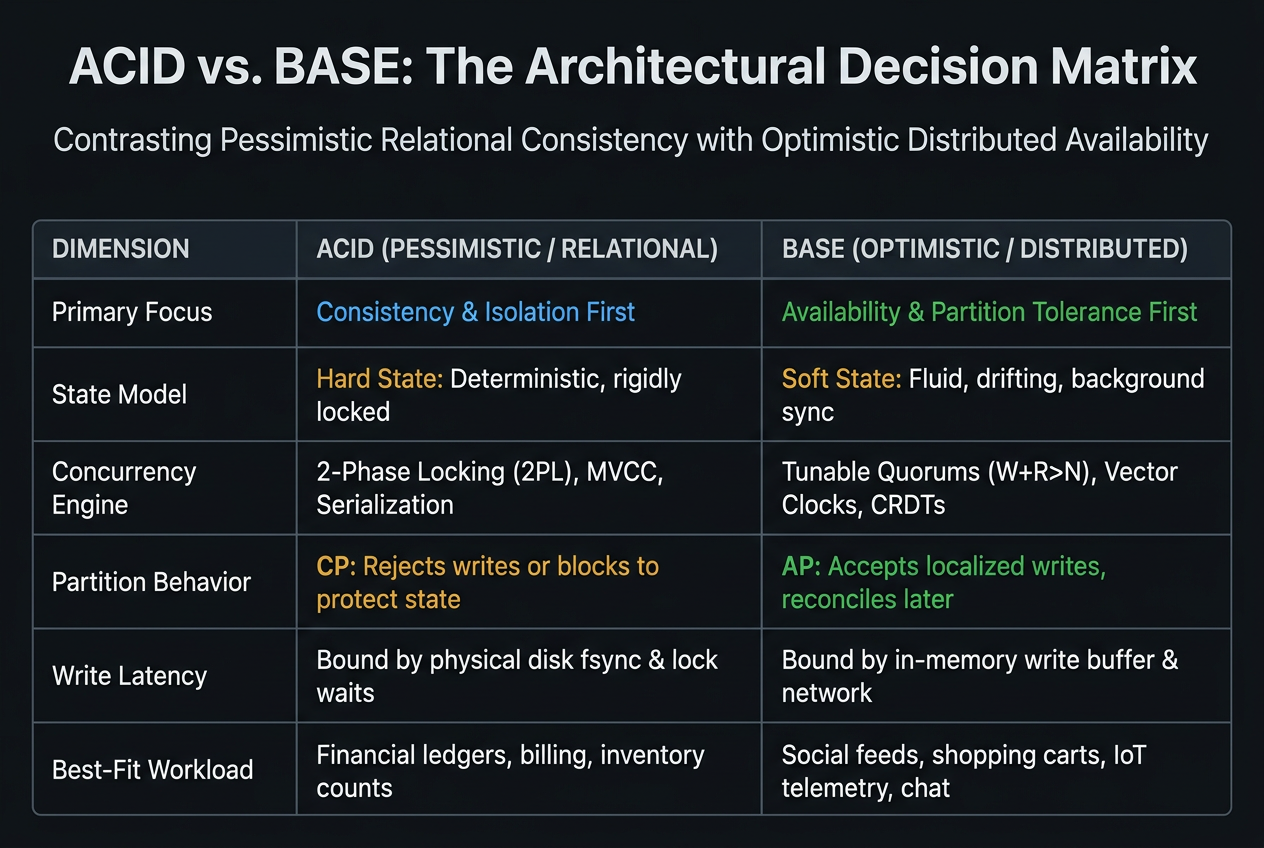
6. ACID vs BASE: The Architectural Decision Matrix
| Dimension | ACID (Pessimistic / Relational) | BASE (Optimistic / Distributed) |
|---|---|---|
| Primary Philosophy | Consistency & Isolation first | Availability & Scalability first |
| State Nature | Hard State (deterministic, rigid) | Soft State (fluid, eventually convergent) |
| Concurrency Mechanism | 2-Phase Locking (2PL), MVCC, SSI | Tunable Quorums ($W + R > N$), Vector Clocks, CRDTs |
| Partition Behavior (CAP) | CP: Rejects mutations or blocks to protect state | AP: Accepts mutations, reconciles asynchronously |
| Write Latency | Governed by disk fsync & cross-lock contention |
Governed by in-memory append & network transit |
| Scalability Ceiling | Vertical scaling bottleneck on primary write path | Horizontal scaling across hundreds of commodity nodes |
| Conflict Resolution | Database engine enforces serial order | LWW (dangerous), Vector Clocks, or CRDTs |
| Best-Fit Workloads | Financial ledgers, billing, inventory reservation | Social media feeds, IoT telemetry, shopping carts, chat |
Production systems rarely adopt pure ACID or pure BASE uniformly. The modern pattern is polyglot persistence: anchor transactional business invariants (payments, reservations, inventory mutations) in ACID stores, and project downstream read models and analytics into BASE stores via CDC streams.
For a systematic decision framework — mapping domain invariants, consistency requirements, and throughput profiles to specific database paradigms and products — see The Database Decision Framework and Database Selection Playbook.
Summary
| Concept | Rule |
|---|---|
| Basically Available | Keep the system answering queries with localized data or graceful degradation during partitions rather than halting. |
| Soft State | Acknowledge that replica state constantly drifts and reconciles via background gossip and anti-entropy routines. |
| Eventual Consistency | Enforce convergence using mathematical quorum overlap ($W + R > N$) or Conflict-Free Replicated Data Types (CRDTs). |
| Anti-Pattern (LWW) | Never rely on bare physical server wall-clock timestamps to resolve concurrent writes; use logical vector clocks or explicit merge rules. |
| Polyglot Design | Anchor transactional business invariants in ACID stores, and project downstream read models into BASE stores via CDC. |
Key Takeaways
- Basically Available guarantees that the distributed system remains operational during partial network partitions or node crashes, accepting degraded response modes over total downtime.
- Soft State recognizes that data values can mutate and drift across replicas without active application writes, driven by gossip synchronization, TTL expirations, and background reconciliation.
- Eventual Consistency is not an excuse for unpredictable reads; it is a formal convergence guarantee backed by tunable quorums (W + R > N), vector clocks, or Conflict-Free Replicated Data Types (CRDTs).
- The choice between ACID and BASE is driven by the CAP/PACELC trade-off: under network partitions, you either choose consistency (CP / ACID) and block, or choose availability (AP / BASE) and reconcile.
- Production systems rarely adopt pure ACID or pure BASE uniformly; modern architectures use polyglot patterns — ACID for transactional ledgers and BASE for horizontally scaled read models and social feeds.
Related Reading
Return to Part 1: ACID Database Properties: Atomicity, Consistency, Isolation & Durability in Practice to examine the single-node transactional guarantees that BASE deliberately relaxes under distributed scale.
This article was developed with AI-assisted deep search, specification cross-referencing, and technical research synthesis.