The Type System From First Principles
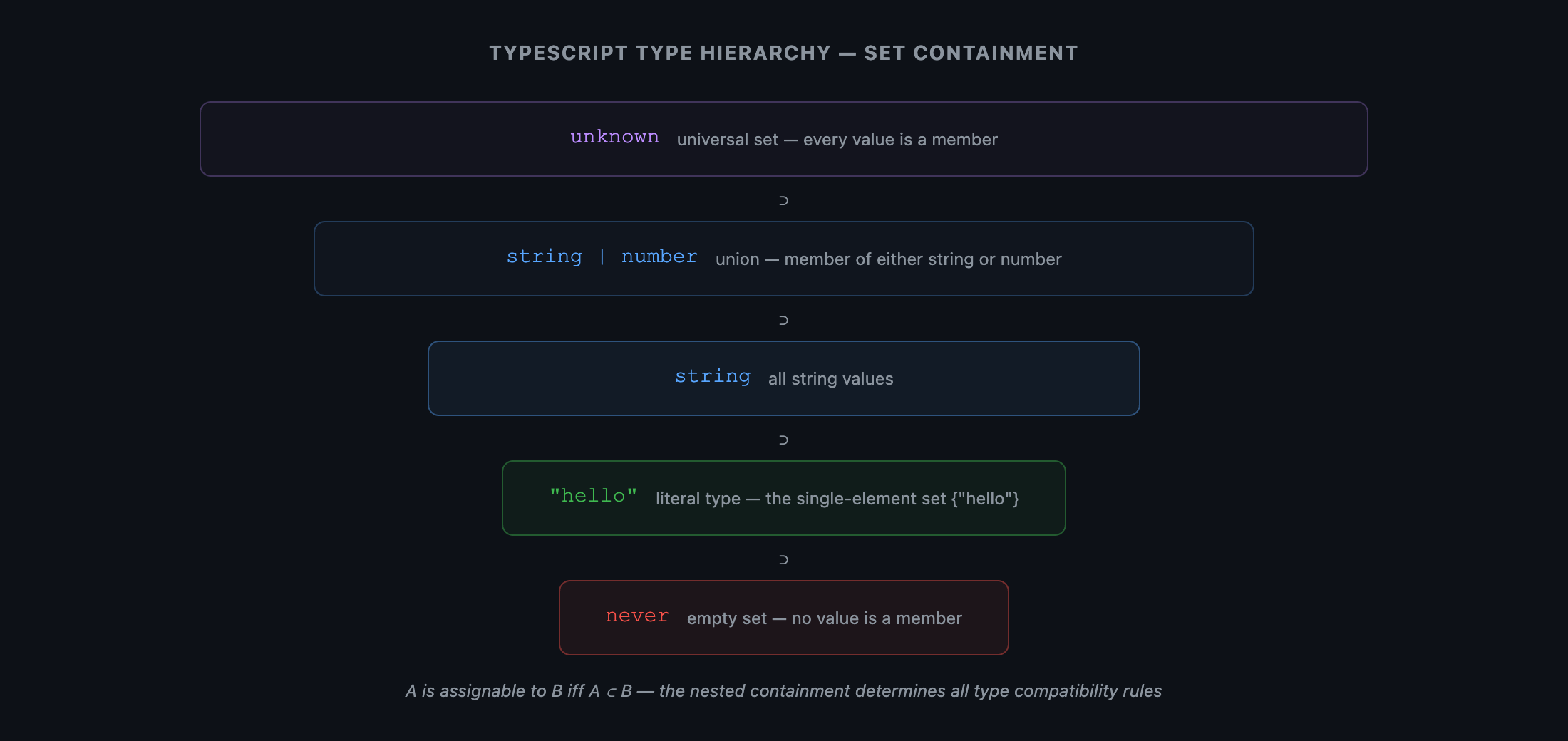
TypeScript's type system is a set theory engine — types are sets of values. Understanding this single model makes every assignability rule, every structural typing quirk, and every edge case predictable from first principles.
TypeScript Mastery
The Type System From First Principles
Types are a specification language — not an annotation layer. That is the discipline this series enforces. Before you can use TypeScript to make illegal states unrepresentable, you need a precise mechanical model of what the type system actually is. Not the syntax. The engine. This article builds that model from scratch, starting with a single insight that makes every TypeScript edge case predictable: types are sets of values.
1. Types as Sets
Every TypeScript type is a set of values. That mental model — borrowed directly from set theory — is not a metaphor. It is the actual semantics the compiler operates on.
1.1 Primitive Types as Infinite Sets
The type string does not describe a single value — it describes membership in an infinite collection. A value "hello" is in the set string. A value 42 is not.
1.2 never — The Empty Set
never is the empty set. No value can be a member of the empty set, so no value can be assigned to type never. A function typed as returning never must never complete normally — it either throws unconditionally or loops forever.
If never is the empty set, then a variable of type never cannot exist at runtime. Any code path that produces never is provably unreachable. This is what makes it the perfect exhaustiveness tool.
1.3 unknown — The Universal Set
unknown is the top type — the set of all possible values. Every value is assignable to unknown. But unlike any, unknown forces you to narrow the type before using it in any meaningful way.
any is not "the universal set" — it is a special escape hatch that opts out of the type system entirely in both directions. unknown participates in the type system and requires proof before use. Always reach for unknown over any at trust boundaries.
1.4 Assignability as Subset Relationship
When TypeScript checks if type A is assignable to type B, it is asking: "Is every member of set A also a member of set B?" If yes — A is a subset of B — assignment is valid.
2. Structural Typing
TypeScript uses structural typing — two types are compatible if they have compatible structures, regardless of their declared names.
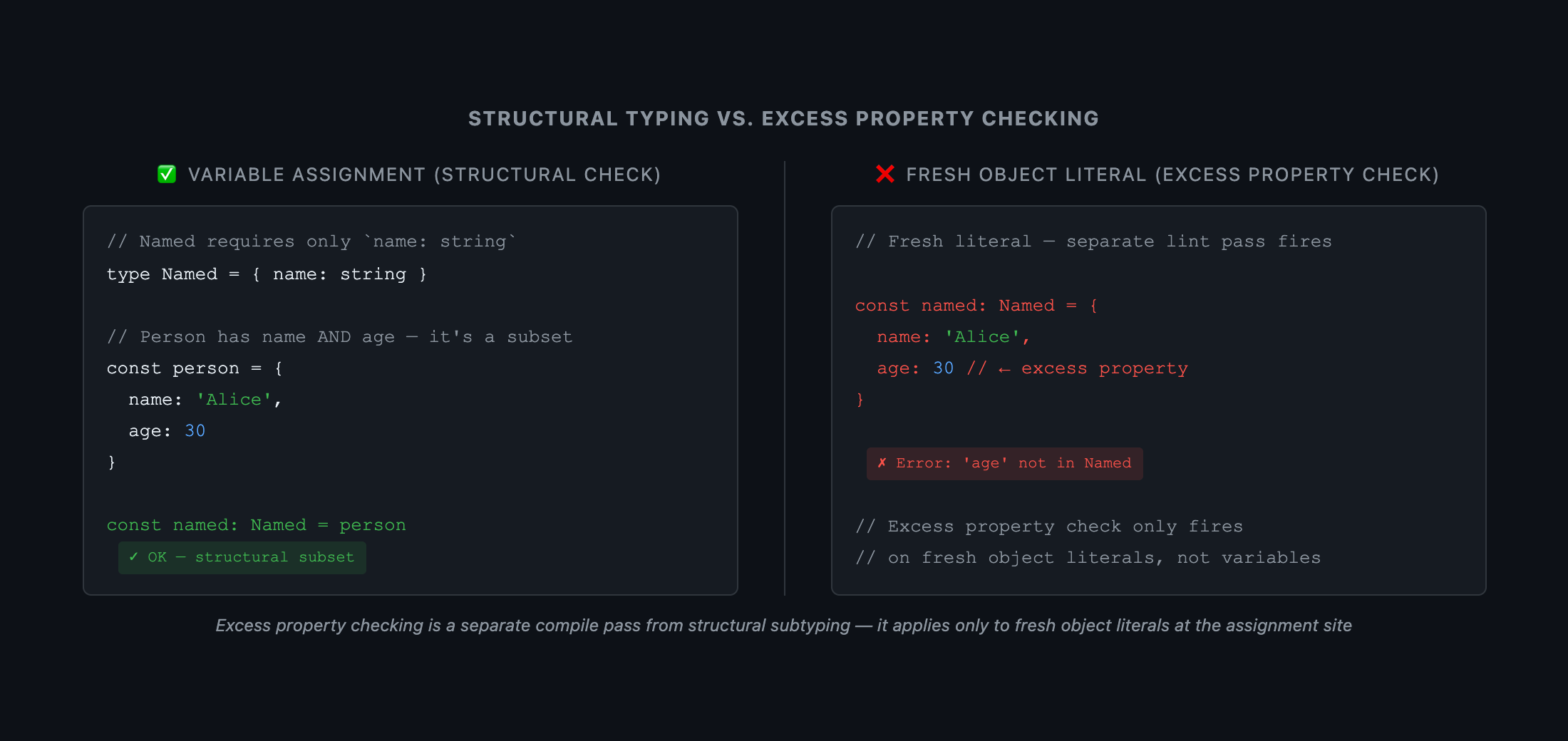
2.1 Why { name: string; age: number } Assigns to { name: string }
Person has all the members of Named and more. In set terms, every Person value satisfies the Named constraint. So Person ⊂ Named — the assignment is valid.
2.2 Excess Property Checking — The Special Rule for Object Literals
Structural typing would logically allow you to pass { name: 'Alice', age: 30 } directly to a parameter expecting Named. TypeScript does allow this in most positions — but not for fresh object literals assigned directly to a typed variable or passed directly as an argument.
Excess property checking is a separate lint-like pass applied only to fresh object literals. It catches typos in configuration objects and option bags. It is not part of the structural subtype check — the underlying structural rule still applies in all other contexts.
3. Type Widening and as const
TypeScript infers the narrowest useful type for const declarations and a wider type for let declarations.
3.1 How Widening Works
3.2 as const — Preventing Widening
as const pins the entire expression to its narrowest literal type, recursively:
Use as const for configuration objects, lookup tables, and any array that represents a fixed set of options. It is the correct way to produce literal union types from array values: type Method = typeof config2.methods[number] produces "GET" | "POST".
4. Nominal Typing via Branding
TypeScript's structural system means type UserId = string and type OrderId = string are identical — you can pass an OrderId where a UserId is expected. When these are semantically distinct, that silent assignability is a bug.
4.1 The Brand Pattern
The __brand property exists only at the type level — it is never present at runtime. raw as UserId is the only cast needed, and it is safely contained inside the smart constructor, not scattered across the codebase.
Summary
| Concept | Rule |
|---|---|
never |
Empty set — no value is assignable to it; signals unreachable code |
unknown |
Universal set — every value is assignable to it; forces narrowing before use |
any |
Type system exit hatch — not a set; bypasses all checks in both directions |
| Assignability | A is assignable to B iff A ⊂ B (every A value satisfies B's constraints) |
| Structural typing | Compatibility is determined by shape, not name |
| Excess property check | Extra properties are rejected on fresh object literals only |
let widening |
let x = "hello" → string; use as const to prevent widening |
const narrowing |
const x = "hello" → "hello" (literal type) |
| Branded types | type UserId = string & { __brand: 'UserId' } prevents structural mix-up |
What's Next
In Part 2, we cover Narrowing & Control Flow Analysis — the engine that makes TypeScript aware of your
if/switch/whilebranches and narrows types at each node. Understanding CFA is what lets you eliminate everyascast from application code.
This article was developed with AI-assisted deep search, specification cross-referencing, and technical research synthesis.