`tsconfig` as Architecture: Strict Mode & Beyond
`tsconfig.json` is not a build config file — it is a type-level constraint specification. Every flag is a design decision with direct runtime safety implications. This article decodes the flags that matter most, from `strict`'s seven sub-flags to the modern `verbatimModuleSyntax` and project references.
TypeScript Mastery
tsconfig as Architecture: Strict Mode & Beyond
Types are a specification language — not an annotation layer. tsconfig.json is where that language's safety guarantees are set. Every flag is a design decision with direct runtime safety implications. Treating tsconfig.json as a build config file — adjusting it until errors go away — is the compiler equivalent of ignoring test failures. This article decodes the flags that matter, explains why each exists, and gives you the right default for a production codebase.
1. The strict Flag — Seven Guarantees in One
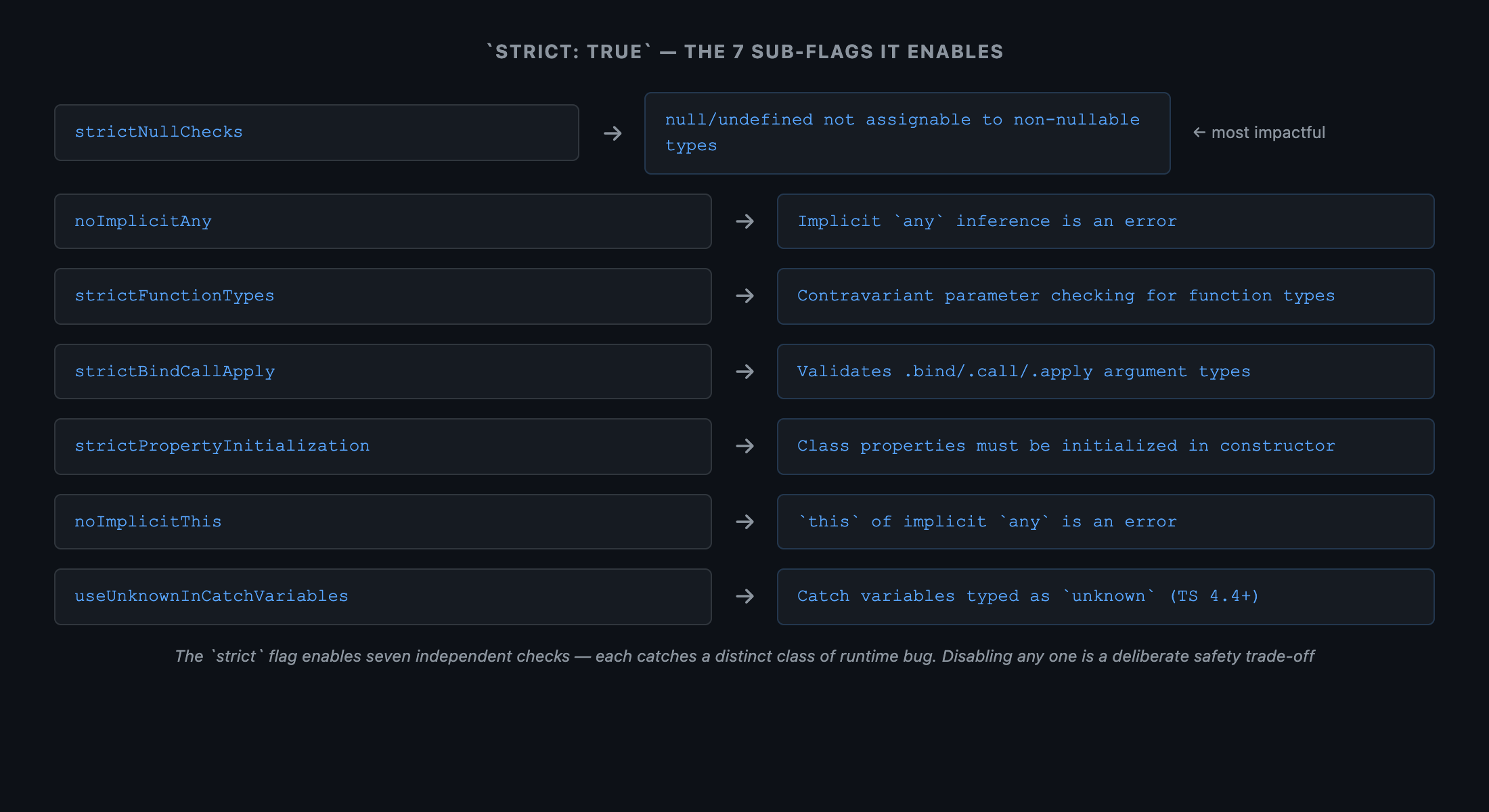
"strict": true is a shorthand that enables seven distinct checks. Each one catches a different class of runtime bug at compile time:
| Sub-flag | What It Catches |
|---|---|
strictNullChecks |
null and undefined are not assignable to non-nullable types — eliminates the most common class of runtime crashes |
strictFunctionTypes |
Functions in non-method positions are checked contravariantly — catches unsafe handler substitution (Part 10) |
strictBindCallApply |
Validates argument types of .bind(), .call(), and .apply() |
strictPropertyInitialization |
Class properties must be initialized in the constructor or declared with ! — prevents uninitialized property reads |
noImplicitAny |
Implicit any inference is an error — forces you to be explicit about unknown or a concrete type |
noImplicitThis |
this of implicit any type is an error — prevents context confusion in callbacks |
useUnknownInCatchVariables |
Catch clause variables are typed as unknown instead of any (TS 4.4+) — forces narrowing before use |
2. Beyond strict — The Flags That Matter
strict: true is the baseline. These additional flags provide meaningful safety guarantees beyond it:
2.1 exactOptionalPropertyTypes
Without this flag, { x?: string } accepts { x: undefined } — that is, explicitly passing undefined as the value of an optional property is allowed. This is often not what you intend:
2.2 noUncheckedIndexedAccess
Without this flag, arr[0] is typed as T (the element type). But any array index access can return undefined. With noUncheckedIndexedAccess, TypeScript adds | undefined to all indexed access results:
![Side-by-side diagram. Left panel labeled 'Without noUncheckedIndexedAccess': array [1, 2, 3], index access arr[0] shows type number (green). Access arr[99] also shows type number (green) — misleading. Right panel labeled 'With noUncheckedIndexedAccess': same array, arr[0] shows type number | undefined (amber). arr[99] shows number | undefined (amber). A label: 'Both correctly reflect that any index access can produce undefined'. Caption: 'noUncheckedIndexedAccess makes index access types honest — arr[n] returns T | undefined, matching the actual runtime behavior for out-of-bounds indices'.](https://pub-74778554195b4df89d82f0d61988355a.r2.dev/assets/blog/frontend/typescript-tsconfig-strict-architecture/fig-02.png)
2.3 noImplicitOverride
When a subclass method has the same name as a parent method, TypeScript can now require the override keyword to make the relationship explicit:
3. Module System Flags
3.1 isolatedModules
Vite, SWC, and esbuild transpile TypeScript files one at a time — they do not have access to the full type graph. This means they cannot emit correct JavaScript for constructs that require type information from other files. isolatedModules: true flags these constructs:
3.2 verbatimModuleSyntax (TypeScript 5.0)
verbatimModuleSyntax supersedes the older importsNotUsedAsValues flag. It requires that import/export statements are written exactly as they will be emitted — no automatic type-only elision:
4. The satisfies Operator (TypeScript 4.9)
satisfies validates that a value matches a type without widening the inferred type. This is the correct tool for typed configuration objects and lookup maps:
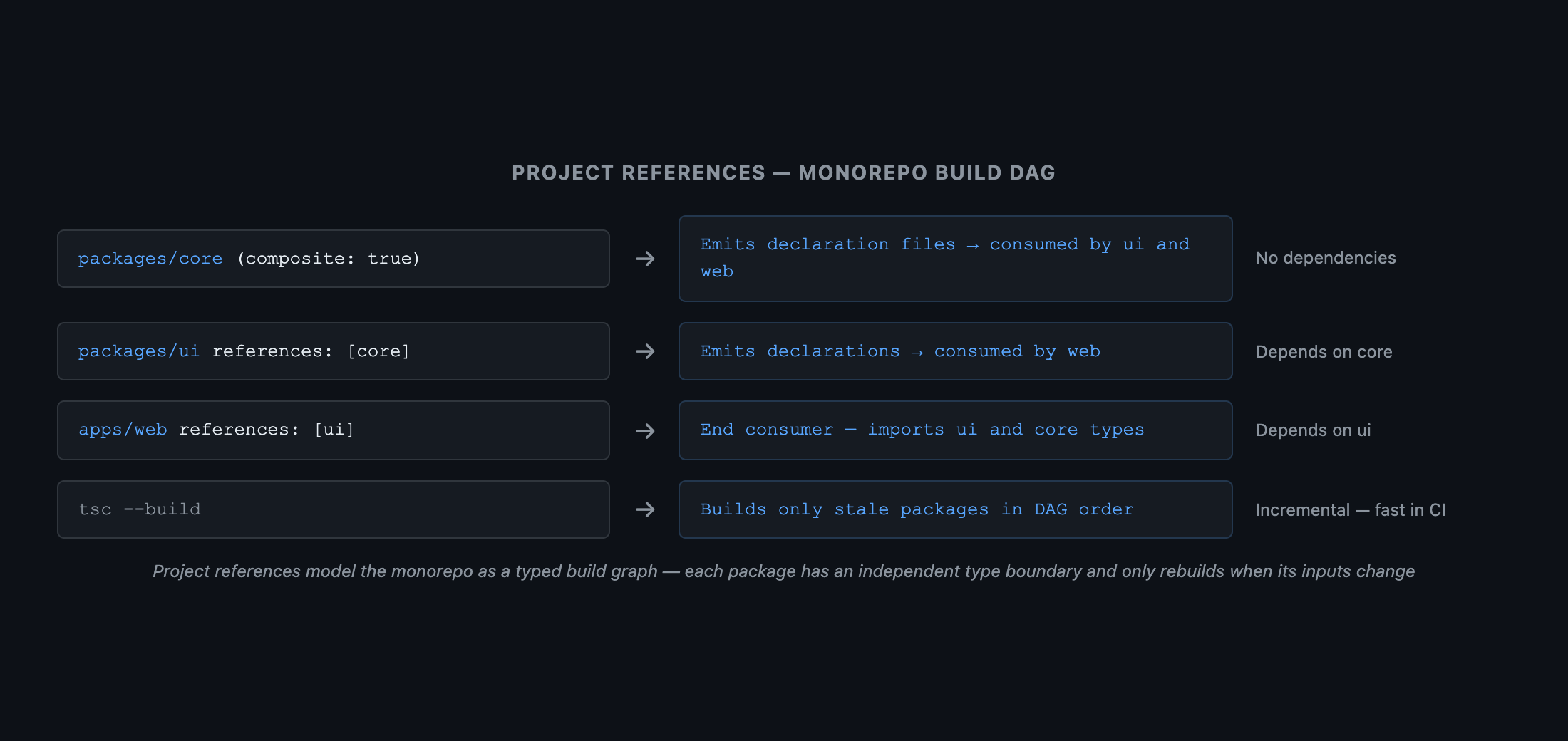
5. Project References — Monorepo Build Architecture
For monorepos with multiple TypeScript packages, project references enable incremental builds and proper type boundaries:
6. A Note on Decorators
experimentalDecorators (the stage-2 metadata-emitting decorator system) and the stage-3 decorator standard (TypeScript 5.0+) are separate systems that are not compatible with each other. Deep coverage of the decorator ecosystem — Angular's dependency injection, NestJS modules, MobX @observable — is intentionally out of scope for this series. If your project requires decorators, consult the official NestJS or Angular documentation for the experimentalDecorators + emitDecoratorMetadata configuration.
Summary
| Flag | When to Enable | What It Prevents |
|---|---|---|
strict |
Always | Null crashes, implicit any, unsafe this |
exactOptionalPropertyTypes |
Always | Conflating "absent" with "explicitly undefined" |
noUncheckedIndexedAccess |
Always | Treating arr[n] as non-nullable |
noImplicitOverride |
Class-heavy codebases | Silent method override without override keyword |
isolatedModules |
With Vite / SWC / esbuild | Non-isolatable constructs (const enum, untagged re-exports) |
verbatimModuleSyntax |
TS 5.0+ projects | Ambiguous type-vs-value imports |
satisfies (operator) |
Config objects, lookup maps | Type widening on object literals |
composite + references |
Monorepos | Full rebuilds on unchanged packages |
What's Next
In Part 8, we cover Declaration Merging and Module Augmentation — the mechanism that lets you extend third-party library types safely, add properties to Express's Request, type
process.env, and declare non-JS file imports, all without forking anything.
This article was developed with AI-assisted deep search, specification cross-referencing, and technical research synthesis.