The Request-Response Bottleneck: Short Polling, Long Polling & The Latency-Overhead Tradeoff
Polling is not an obsolete anti-pattern but a quantifiable engineering trade-off. This article derives the polling overhead equation from first principles — TCP handshake costs, header-to-payload ratios, and browser 6-connection pool exhaustion — then builds event-driven long polling in Node.js/Express that resolves via in-memory EventEmitter bridges rather than database spin-locks, and maps both patterns to their CAP theorem alignment.
Real-Time Web Architecture: From Polling & SSE to WebSockets & Distributed Backplanes
The Request-Response Bottleneck: Short Polling, Long Polling & The Latency-Overhead Tradeoff
Real-time is not a library you import, but an architectural contract across the network stack: choose the lowest-complexity transport that matches your data symmetry, budget for long-lived socket file descriptors, and decouple stateful client connections from stateless event producers via a distributed backplane. This series builds that contract from first principles.
Every real-time system begins with the same naive pattern: ask the server if anything changed. The client polls. The server responds. Repeat every second. This is polling — and most teams condemn it without ever quantifying why, leaving them to reach for WebSockets in contexts where a CDN-cached conditional HTTP request would be orders of magnitude cheaper, more reliable, and easier to operate.
This article derives the polling overhead equation from wire-level first principles, implements event-driven long polling that resolves via in-memory bridges rather than database spin-locks, and maps both transport choices to their CAP theorem alignment. By the end, you will have a precise, quantitative framework for deciding when polling is the correct architectural choice — and exactly where it breaks.
1. The HTTP Request-Response Baseline
1.1 The TCP 3-Way Handshake and TLS 1.3 Overhead
Before a single byte of application data is transmitted, every new HTTP connection pays a mandatory infrastructure tax. Understanding this tax is the foundation of every real-time transport tradeoff.
A cold HTTP/1.1 request with a new TCP connection:
Three round trips on a cold connection. At 50ms RTT (typical US cross-region latency), that is 150ms of pure infrastructure overhead before the first application byte arrives. TLS 1.3 reduces this from the previous 4-RTT TLS 1.2 handshake down to 2 RTTs for the session establishment phase, and even supports 0-RTT resumption for previously seen clients — but only if the session ticket is valid and the application code is safe against replay attacks.
HTTP Keep-Alive changes the calculus. Once a TCP connection is established, HTTP/1.1 reuses it for subsequent requests via the Connection: keep-alive header. A warm polling loop only pays:
This is the steady-state cost that matters for polling calculations.
1.2 The Packet Overhead Equation
Before debating polling interval trade-offs, let's calculate the actual on-wire overhead for a typical polling request against a real endpoint.
A minimal short-poll HTTP request to /api/vehicles/positions:
Measured header size: ~520–780 bytes of HTTP request headers, depending on cookie length and token size.
Typical application payload: A { "hasUpdates": false } response is approximately 22 bytes of JSON. A list of 50 vehicle positions might be 4KB.
The overhead ratio for a "nothing changed" poll response:
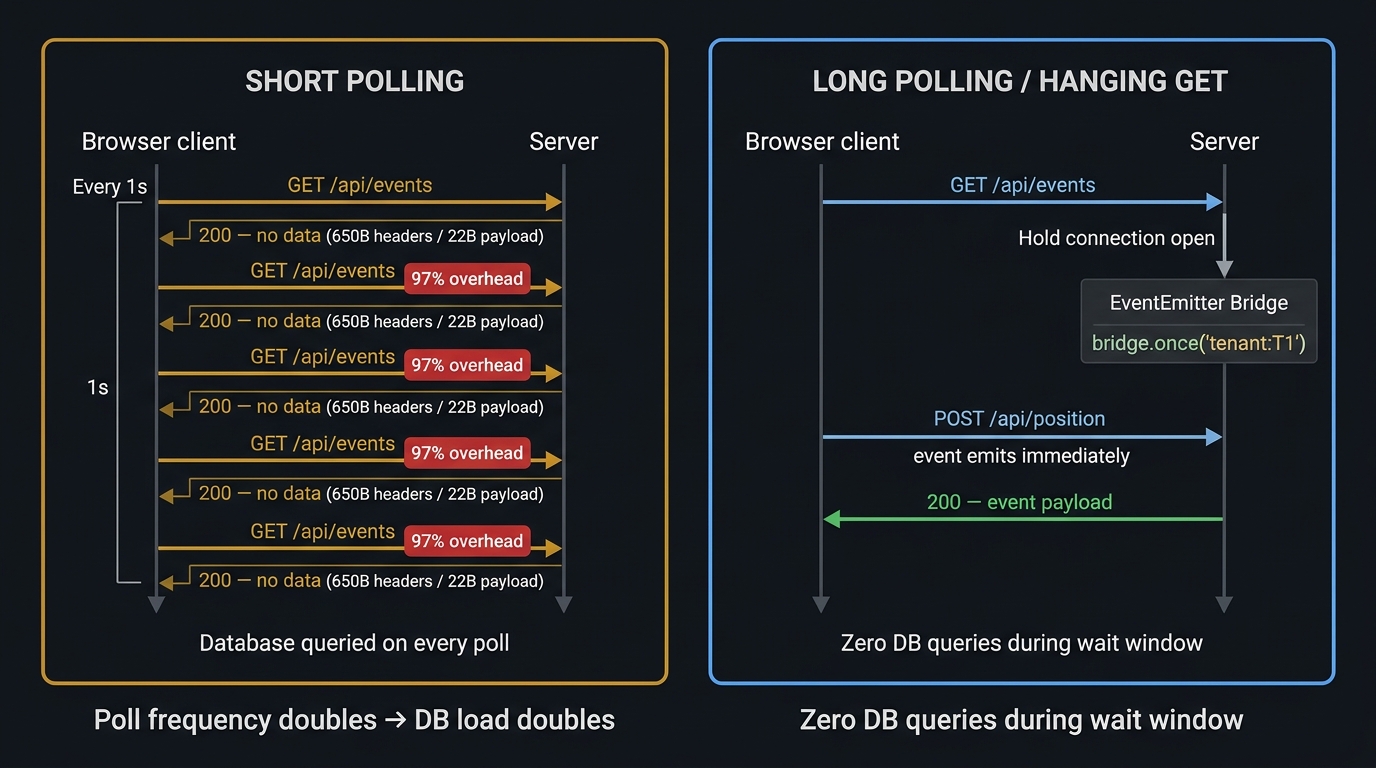
For every 100 bytes transmitted in a high-frequency polling loop returning empty responses, only 3 bytes are application data. The remaining 97% is protocol scaffolding.
This overhead ratio is the core reason why polling is called "wasteful." The problem is not polling itself — it is polling at a frequency that generates far more header overhead than application data. A conditional ETag-based poll that returns 304 Not Modified in 22 bytes is dramatically cheaper than a full JSON response, and is highly CDN-cacheable.
2. Short Polling: Mechanics, Latency Bounds & Edge Caching
2.1 The Expected Latency Equation
Short polling works by sending requests at a fixed interval I. If an event occurs at a uniformly random time within that interval, the expected delivery latency is:
$$E[\text{latency}] = \frac{I}{2}$$
Where:
- I: The polling interval in seconds/milliseconds.
- E[latency]: The average time between an event occurring on the server and the client observing it.
At a 1-second polling interval, clients observe events with an average 500ms delay. At 5 seconds, it is 2.5 seconds. The worst-case delivery latency is always the full interval I.
The server load compound effect. If you have C concurrent clients polling at interval I, the server receives C / I requests per second. Doubling the polling frequency (halving I) doubles the request rate. Doubling the number of clients doubles it again. Combined:
$$\text{RPS} = \frac{C}{I}$$
| Clients | Interval | Requests/s | Notes |
|---|---|---|---|
| 1,000 | 5s | 200 | Manageable |
| 1,000 | 1s | 1,000 | Moderate load |
| 10,000 | 1s | 10,000 | Requires horizontal scaling |
| 10,000 | 250ms | 40,000 | Significant database pressure |
Every short poll request that hits the database compounds quadratically as you increase both client count and frequency. CDN-edge caching with conditional ETag headers is not an optimization for polling — it is an architectural necessity at scale.
2.2 Conditional Requests & CDN Edge Caching
For cacheable, low-velocity data (public vehicle positions updated every 5 seconds, sports scores, stock summary snapshots), HTTP conditional requests transform short polling from a bandwidth problem into a highly efficient edge-served pattern.
The server implementation:
The client polling loop with conditional validation:
With a CDN in front (Cloudflare, AWS CloudFront), the 304 Not Modified response is served entirely from the edge — the origin Express server is never invoked until the ETag changes. This transforms polling from a per-client database hit into a single origin revalidation every 5 seconds, regardless of how many thousands of clients are polling.
Short polling with conditional ETag headers is architecturally superior to WebSockets for publicly cacheable, low-velocity data. A live leaderboard or weather dashboard that updates every 10 seconds does not need a persistent TCP socket — it needs a well-configured CDN with a strong Cache-Control policy.
2.3 When Short Polling is the Correct Choice
| Use Case | Why Polling Wins |
|---|---|
| Public cacheable feeds (scores, leaderboards, news) | CDN serves 304 Not Modified; origin load is near-zero |
| Battery-sensitive mobile apps | Persistent sockets drain radio power; polling allows deep sleep between intervals |
| Serverless environments (AWS Lambda, Vercel Functions) | Long-lived TCP connections are impossible; stateless HTTP invocations are the execution model |
| Low-frequency telemetry (hourly analytics, aggregated metrics) | Polling interval matches the data update cadence; persistent sockets waste resources |
| Browser extension content scripts | No persistent background connection model; polling to a REST API is the correct pattern |
3. Long Polling: Event-Driven Hanging GETs
3.1 The Core Mechanism
Long polling — also called the "Comet" pattern or "hanging GET" — eliminates the delivery latency of short polling by keeping the HTTP request open on the server until either an event fires or a timeout is reached.
The request lifecycle:
- Client sends
GET /api/events/subscribe. - Server receives the request but does not respond immediately. It holds the
resobject and registers a listener. - When an event occurs (vehicle position update, order status change), the server writes the response and closes the request.
- Client receives the response, processes the event, and immediately re-opens a new hanging request.
- If no event fires within the timeout window (typically 25–30 seconds), the server sends an empty
{ "events": [] }heartbeat response.
3.2 The Anti-Pattern: Database Spin-Lock Inside a Hanging Request
The most common long polling implementation mistake is replacing the short polling interval with a polling loop inside the hanging request:
This is a disaster:
- It does not eliminate database queries — it just moves them server-side. 1,000 concurrent clients still generate 2 database queries per second per client (2,000 total QPS) during the spin loop.
- Node.js is single-threaded and event-loop driven. The
await sleep(500)releases the event loop between iterations, but the accumulation of 1,000 simultaneous database queries will saturate the database connection pool and stall the event loop. - It provides no delivery latency improvement over short polling — events are still only observed at the next 500ms spin iteration.
3.3 The Correct Pattern: In-Memory EventEmitter Bridge
The correct architecture decouples the hanging request from any polling mechanism entirely. An in-memory EventEmitter (or Redis Pub/Sub channel in a multi-node setup) serves as the bridge:
What makes this correct:
- The database is queried only once per write — when the event is created. Zero queries during the hanging wait period.
- Each waiting client is a single
EventEmitterlistener — memory cost is approximately 120 bytes per listener, not a database connection. - Event delivery latency is sub-millisecond — the
EventEmitter.emit()call is synchronous within the Node.js event loop. - The
req.on('close')handler prevents ghost listeners when clients disconnect abruptly.
3.4 Client-Side Reconnection Loop
The client must immediately re-open the hanging request after each response:
Unlike short polling where the client controls the interval, long polling intervals are controlled server-side by the timeout window. The client simply reconnects immediately after each response — the server's timeout window is the implicit "interval."
4. The Browser 6-Connection Pool Deadlock
4.1 HTTP/1.1 Connection Limits
HTTP/1.1 browsers enforce a hard limit of 6 simultaneous TCP connections per origin (per scheme + host + port combination). This limit exists to prevent any single website from monopolizing network resources.
When a long-polling or SSE connection holds one of those 6 slots, it occupies it for the entire 25-second timeout window. Open multiple tabs to the same application:
Every subsequent REST API call from any tab is blocked until a poll response frees a slot. The application becomes unresponsive.
This is not a theoretical edge case. Any user who opens your application in multiple tabs simultaneously will experience complete browser-level request stalling under HTTP/1.1 long polling. This is the primary reason SSE and WebSockets (which use a single persistent connection rather than repeatedly re-connecting) are superior for multi-tab applications.
HTTP/2 resolves this entirely. HTTP/2 multiplexes all requests over a single TCP connection using independent stream IDs. A single HTTP/2 connection to api.fleettracker.io can carry 100+ simultaneous SSE streams, long-poll requests, and REST calls concurrently without any inter-stream blocking.
| Transport | HTTP/1.1 Multi-Tab Impact | HTTP/2 Multi-Tab Impact |
|---|---|---|
| Short Polling (1s interval) | 6 tabs = 6 polls/s; REST calls compete for slots | Multiplexed; no contention |
| Long Polling (25s window) | 6 tabs exhausts connection pool entirely | Single connection; all streams independent |
| SSE | Identical to long polling — one persistent connection per tab | Single connection multiplexed |
| WebSockets | Each WebSocket is a separate TCP connection (post-upgrade) | Unaffected — WebSockets bypass HTTP/2 streams |
5. Proxy & Gateway Timeouts: The Silent Connection Killer
5.1 Nginx Default Timeouts
When long-polling requests pass through a reverse proxy, the proxy enforces its own read timeout — the maximum duration it will wait for a response from the upstream server before returning an error to the client.
Nginx default: proxy_read_timeout 60s;
If your long-poll timeout window is 60 seconds or longer, Nginx silently terminates the connection with a 504 Gateway Timeout before the server's heartbeat fires. The client receives a network error rather than an empty heartbeat, triggering unintended error-path reconnect logic.
The heartbeat is your safety valve. The server's periodic empty response (every 20–25 seconds) serves dual purposes:
- Proxy keep-alive: Resets the proxy's idle read timer before it fires.
- Client liveness signal: The client confirms the connection is still healthy and immediately re-opens the poll.
Set your server-side long poll timeout to always be at least 5–10 seconds shorter than the minimum proxy timeout in your infrastructure chain. Cloudflare's edge terminates idle connections at 100 seconds by default. AWS ALB's idle connection timeout defaults to 60 seconds. Your long poll window must be shorter than both.
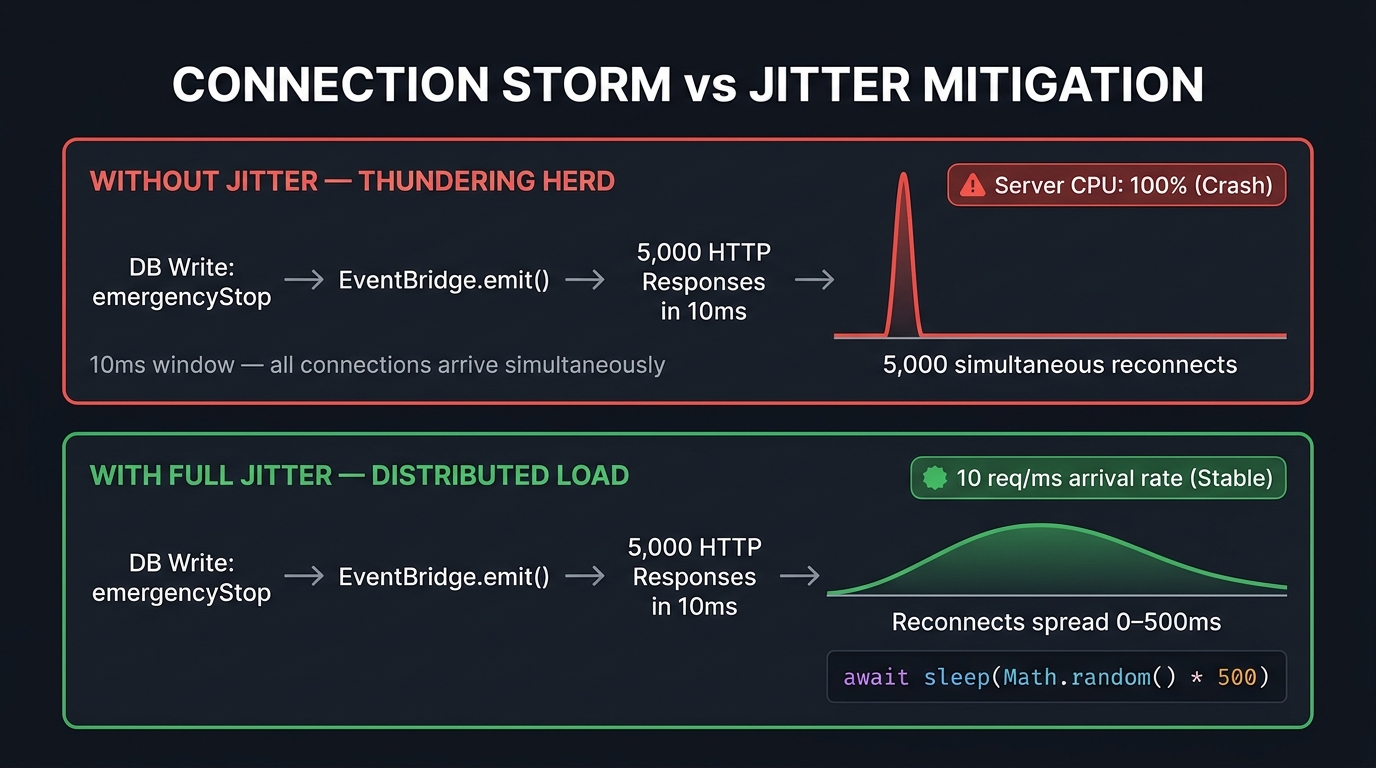
5.2 The Connection Storm (Thundering Herd)
The most dangerous failure mode in long polling is what happens when a broadcast event fires and thousands of waiting clients all receive responses simultaneously:
The mitigation is client-side jitter. After receiving a response, clients must not reconnect immediately with zero delay — they must apply a small randomized jitter window:
With 5,000 clients reconnecting uniformly distributed across 500ms, the reconnection arrival rate is 10,000 req/s rather than 5,000 req/s in a 10ms spike — a 50x reduction in instantaneous server pressure.
6. Resource Profiling: Polling at Scale
6.1 Memory & File Descriptor Cost
Every open HTTP connection in Node.js consumes an OS file descriptor. The OS imposes a hard limit on file descriptors per process (ulimit -n). Default Linux limits are 1,024 or 4,096 depending on the distribution. This must be raised before deploying any long-running connection server:
Memory cost comparison per connection type:
| Connection Type | Memory/Connection | 1,000 connections | 10,000 connections |
|---|---|---|---|
| Short poll (idle) | ~0 bytes (stateless) | ~0 MB | ~0 MB |
| Long poll (active) | ~8KB (socket + EventEmitter listener) | ~8 MB | ~80 MB |
| WebSocket (idle) | ~12KB (socket buffer + frame parser) | ~12 MB | ~120 MB |
| WebSocket (active w/ backpressure) | ~64KB+ (send/recv buffers full) | ~64 MB | ~640 MB |
6.2 When to Reach for Something Else
Long polling starts failing at scale under specific conditions:
| Symptom | Root Cause | Correct Response |
|---|---|---|
| Connection pool exhausted under multi-tab use | HTTP/1.1 6-connection limit | Migrate to SSE over HTTP/2 (Part 2) |
| Connection storms on broadcast events | Thundering herd on simultaneous resolution | Add jitter, or migrate to SSE with retry: tuning |
File descriptor exhaustion (EMFILE errors) |
ulimit -n too low |
Raise limit + consider WebSocket at this scale |
| Database overloaded by poll requests | Spin-lock anti-pattern | Fix the EventEmitter bridge (Section 3.3) |
| True bidirectional communication required | Long polling is request-response only | Migrate to WebSockets (Part 3) |
7. CAP Theorem Alignment
7.1 Short Polling: AP Semantics
Short polling is the purest Availability + Partition Tolerance (AP) transport pattern in the CAP theorem sense:
- Availability: Every poll request gets a deterministic response (even if stale). There is no blocking wait for a quorum or leader node. Any read replica can serve the response.
- Partition Tolerance: When a network partition isolates a database replica, short poll clients continue receiving responses — they receive the last known state rather than an error.
- Consistency: Sacrificed. The delivery latency bound
E[latency] = I/2represents a bounded staleness window. Clients will always observe data that is at mostIseconds old.
This makes short polling the correct choice for AP-preferring distributed reads: public leaderboards, cached feeds, and read-heavy dashboards where temporary staleness is acceptable.
7.2 Long Polling: AP with Ephemeral State
Long polling introduces ephemeral server-side state (the hanging request and its associated EventEmitter listener). Under a network partition:
- If the client is partitioned from the server, the hanging request is dropped at the TCP level. The client detects this via a connection error and re-polls from its last known state.
- The server's in-memory listener is garbage-collected when
req.on('close')fires. - No data is permanently lost — the client simply misses events that occurred during the partition window and re-syncs on reconnect.
Long polling is AP with bounded gaps: it provides low-latency delivery under normal conditions but degrades gracefully to short-polling semantics during partitions, with the client picking up from its last known checkpoint.
Think of polling as a pull-based, stateless synchronization primitive. The CAP guarantees flow from the data store's consistency model, not the transport. Short polling over an AP data store (MongoDB with eventual consistency) gives you AP semantics. Short polling over a CP data store (MongoDB Replica Set with readConcern: "majority") gives you bounded CP semantics. The transport is neutral.
Summary
| Concept | Rule |
|---|---|
Short polling trades network bandwidth and database queries for stateless horizontal simplicity; conditional ETag headers at the CDN edge dramatically reduce origin load. |
Use If-None-Match + ETag on all public polling endpoints; 304 Not Modified responses can be served entirely from the CDN edge. |
| Long polling must resolve via in-memory EventEmitter bridges — not database spin-locks — or it simply relocates short polling overhead to the backend. | Publish events to an in-memory EventEmitter on write; each hanging client is a single listener, not a database query. |
| Under HTTP/1.1, long-polling multiple tabs exhausts the browser's 6-connection pool, stalling all concurrent REST requests to the same origin. | HTTP/2 stream multiplexing eliminates the connection-pool deadlock; SSE over HTTP/2 is the correct upgrade path (Part 2). |
| Intermediate proxies enforce strict read timeouts; long polling architectures require periodic empty heartbeat responses before the proxy severs the connection. | Set server poll timeout to 25s; set proxy_read_timeout 35s in Nginx; send empty heartbeat at 20s to reset all proxy idle timers. |
| Broadcast events in long polling trigger connection storms where all waiting clients reconnect simultaneously, demanding client-side exponential backoff with full jitter. | Apply 0–500ms random jitter before reconnecting; the server's retry: header equivalent (for long polling: a reconnectIn field in the response) can instruct the client window. |
What's Next
Long polling solves the delivery latency problem of short polling, but holds one HTTP/1.1 connection per client and cannot serve bidirectional data push efficiently at scale. In Part 2, we examine Server-Sent Events (SSE) — a W3C standard that provides a persistent, unidirectional server-to-client HTTP stream with native browser auto-reconnection, Last-Event-ID state reconciliation, and HTTP/2 multiplexing across dozens of independent event channels over a single TCP connection.
Part 2 → Server-Sent Events: High-Throughput Unidirectional Streaming over HTTP —
realtime-server-sent-events-sse-streaming(coming in Part 2 of this series)
This article was developed with AI-assisted deep search, specification cross-referencing, and technical research synthesis.