Production Hardening: CSWSH Security, Connection Storms, Socket Backpressure & WebTransport Horizons
Operating real-time systems at production scale demands strict defensive engineering. This article neutralizes Cross-Site WebSocket Hijacking (CSWSH) — the attack vector that bypasses CORS entirely — with Origin header whitelisting and cryptographic ticket tokens; survives rolling deployment connection storms using exponential backoff with full jitter; prevents silent V8 heap exhaustion via lossy conflation and lossless flow-control backpressure policies; and evaluates WebTransport over HTTP/3 QUIC against the corporate UDP firewall reality.
Real-Time Web Architecture: From Polling & SSE to WebSockets & Distributed Backplanes
Production Hardening: CSWSH Security, Connection Storms, Socket Backpressure & WebTransport Horizons
Real-time is not a library you import, but an architectural contract across the network stack: choose the lowest-complexity transport that matches your data symmetry, budget for long-lived socket file descriptors, and decouple stateful client connections from stateless event producers via a distributed backplane. Parts 1–5 built that complete distributed real-time system. This final article hardens it for adversarial production conditions.
Real-time infrastructure attracts a specific category of production failure that purely request-response systems never encounter: a security vulnerability that CORS does not protect against, a deployment process that can crash new instances with its own reconnection traffic, a memory leak that accumulates silently until the V8 heap exhausts, and a graceful shutdown that is not graceful at all. Each failure mode appears only at scale — invisible in a 10-client demo, catastrophic with 50,000 concurrent connections.
This article implements four defensive engineering practices: CSWSH attack neutralization, exponential backoff with full jitter for connection storm survival, socket backpressure policies (lossy conflation vs lossless flow control), and production observability. It closes with the WebTransport horizon — HTTP/3 QUIC's replacement for WebSockets and why corporate UDP firewall reality demands a fallback strategy.
1. Cross-Site WebSocket Hijacking (CSWSH)
1.1 Why CORS Does Not Protect WebSockets
Cross-Origin Resource Sharing (CORS) is an HTTP mechanism. It works by adding request headers (Origin) and response headers (Access-Control-Allow-Origin) to HTTP requests. For standard fetch() calls, the browser refuses to read cross-origin responses unless the server explicitly allows it.
WebSockets are not standard HTTP requests. When a browser executes new WebSocket('wss://api.target.com/ws') from a malicious page at https://evil.com:
- The browser sends an HTTP/1.1 Upgrade request with
Origin: https://evil.com. - The browser automatically includes all cookies for
api.target.com— including session cookies, JWTs stored in cookies, and any authentication state. - The WebSocket upgrade completes — no CORS preflight, no blocking, no warning.
- The attacker now has an authenticated WebSocket connection to
api.target.com, opened from their malicious page.
This is Cross-Site WebSocket Hijacking (CSWSH) — a variant of CSRF that targets WebSocket endpoints. The attack does not require XSS. It works from any page the victim visits.
1.2 Defense Layer 1: Origin Header Whitelist
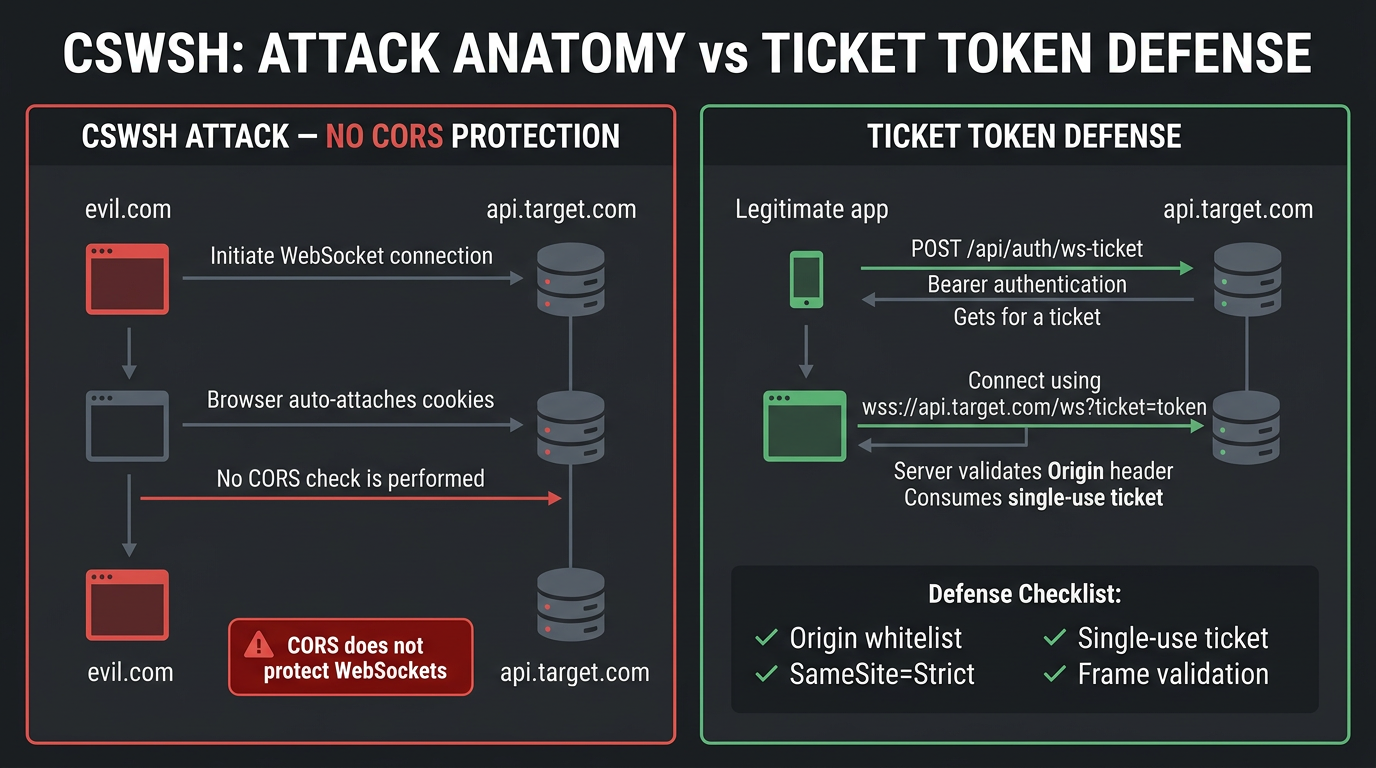
Never validate the Origin header with a substring match or wildcard (origin.endsWith('.fleettracker.io')). Subdomain takeover attacks can register evil.fleettracker.io and bypass substring checks. Always use an explicit allow-list with exact string equality.
1.3 Defense Layer 2: SameSite Cookie Policy
Even with Origin validation, session cookies should use SameSite=Strict or SameSite=Lax to prevent the browser from sending them in cross-origin requests at all:
SameSite=Strict means the browser will not send the cookie on any cross-site request — including WebSocket upgrades from cross-origin pages. Combined with Origin validation, this provides defense in depth.
1.4 Defense Layer 3: Rate-Limiting Handshakes
A WebSocket server without handshake rate limiting is vulnerable to connection flood denial-of-service attacks:
1.5 Defense Layer 4: Payload Validation with Zod
2. Connection Storms & Thundering Herd
2.1 The Rolling Deployment Scenario
A Kubernetes rolling deployment terminates one pod at a time and starts replacements. If your cluster has 3 nodes with 50,000 total connections:
The solution requires two components: server-side graceful drain and client-side jitter.
2.2 Graceful Server Drain
2.3 Client-Side Exponential Backoff with Full Jitter
The standard reconnection strategy distributes load over a safe window:
$$t_{\text{wait}} = \text{random}(0,\ \min(M,\ B \times 2^{\text{attempt}}))$$
Where:
- B (base): 1,000ms — minimum reconnect delay
- M (maximum): 30,000ms — maximum reconnect delay ceiling
- attempt: current reconnect attempt count (resets to 0 on successful connection)
- random(0, cap): uniform random value in range — the "full jitter"
Jitter distribution at 10,000 simultaneous reconnections (attempt 3, cap = 8s):
| Strategy | Peak reconnect rate | Window | Server impact |
|---|---|---|---|
| No backoff (instant) | 10,000 req in 10ms | 10ms | 1,000,000 req/s — crash |
| Exponential (no jitter) | 10,000 req in ~1ms spike | 1ms | Still 10,000,000 req/s |
| Exponential + full jitter | ~1.25 req/ms average | 8,000ms | ~1,250 req/s — safe |
3. Socket Backpressure: Preventing V8 Heap Exhaustion
3.1 The Slow Client Problem
A server pushing 5MB/s of vehicle telemetry to a mobile client on a 500KB/s 3G connection creates a toxic situation:
- Node.js calls
socket.send(data)at 5MB/s. - The OS TCP send buffer fills up (typically 208KB default).
- The OS signals backpressure —
socket.send()is still accepted by the WebSocket library, but the data queues in V8 heap memory (socket.bufferedAmount). - The backlog grows at 4.5MB/s indefinitely.
- After minutes, the Node.js heap exhausts, the OOM killer fires, and the entire server process crashes — taking down all 49,999 other clients.
3.2 Lossy Conflation for Telemetry Streams
For data streams where only the latest value matters (GPS positions, live metrics, cursor coordinates), intermediate updates can be safely dropped:
3.3 Lossless Flow Control for Financial & Chat Streams
For message streams where every event matters (chat messages, financial transactions, order status), lossy conflation is unacceptable. Instead, pause upstream production and close abusive connections:
The key distinction: Telemetry streams (GPS, sensor readings) use lossy conflation — drop intermediate updates, always deliver the latest. Financial/chat streams use lossless flow control — pause or close the connection rather than lose data. Choose based on whether the client can reconstruct missed state from the next delivery.
4. Production Observability
4.1 Essential Real-Time Metrics
Alert thresholds (Grafana / AlertManager):
| Metric | Warning | Critical | Action |
|---|---|---|---|
ws_active_connections_total |
>40,000 | >55,000 | Scale out — add pod |
ws_broadcast_latency_ms p99 |
>100ms | >500ms | Check Redis backplane lag |
ws_socket_buffer_bytes p95 |
>64KB | >256KB | Check for slow clients |
ws_connections_total{outcome=rejected_auth} rate |
>10/min | >100/min | Potential credential stuffing |
5. The WebTransport Horizon
5.1 What WebTransport Solves
WebTransport is a W3C/IETF standard that provides bidirectional, multiplexed client-server communication over HTTP/3 (QUIC, built on UDP). It directly addresses two fundamental WebSocket limitations:
TCP Head-of-Line Blocking: WebSocket runs over TCP. If a single TCP packet is lost, all subsequent packets — even from unrelated data streams — are blocked until the lost packet is retransmitted. In a vehicle telemetry system sending 100 concurrent vehicle streams over one WebSocket connection, a single packet drop pauses all 100 streams.
WebTransport with QUIC: Each data stream is an independent QUIC stream. A packet loss on vehicle B12's stream does not block vehicle C04's stream. QUIC's independent stream multiplexing eliminates TCP head-of-line blocking.
Additional features:
- Unreliable datagrams: UDP-like semantics for telemetry where losing a GPS packet is acceptable. Zero retransmission overhead.
- Multiplexed reliable streams: Multiple independent ordered byte streams over one QUIC connection.
- Connection migration: Client IP changes (Wi-Fi → cellular) do not terminate the QUIC connection — it migrates transparently.
5.2 The Corporate UDP Firewall Reality
WebTransport runs on UDP port 443 (QUIC). Enterprise corporate networks routinely block all UDP traffic except DNS (port 53) on their perimeter firewalls. This is not an edge case — it affects a significant portion of enterprise users:
| Network Type | UDP 443 Open? | WebTransport Available? |
|---|---|---|
| Home broadband | Usually yes | ✅ |
| Mobile (4G/5G) | Yes | ✅ |
| Corporate enterprise | Frequently blocked | ❌ |
| University campus | Often blocked | ❌ |
| Hotel / café Wi-Fi | Variable | ⚠️ |
WebTransport provides automatic TCP fallback via HTTP/3's connection migration to HTTP/2 over TLS (WebSockets), but this must be explicitly handled in your application layer:
5.3 The Definitive Real-Time Protocol Decision Matrix
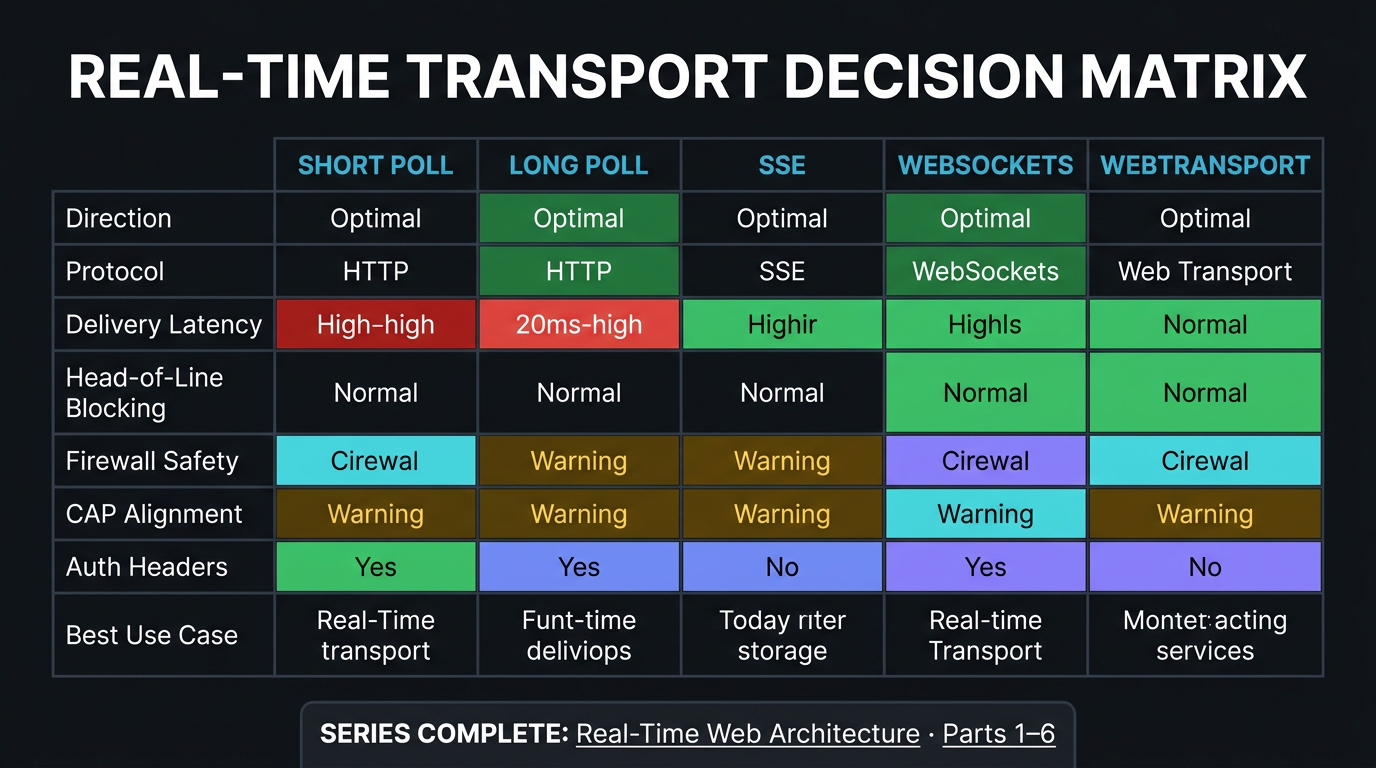
| Property | Short Polling | Long Polling | SSE | WebSockets | WebTransport |
|---|---|---|---|---|---|
| Transport | HTTP req/resp | HTTP req/resp | HTTP streaming | TCP (via HTTP) | QUIC (UDP) |
| Direction | Unidirectional (pull) | Unidirectional (push) | Unidirectional (push) | Bidirectional | Bidirectional |
| Latency | I/2 interval | Sub-ms event | Sub-ms event | Sub-ms | Sub-ms |
| Head-of-line blocking | N/A | N/A | N/A | ✅ Yes (TCP) | ❌ No (QUIC streams) |
| Firewall-friendly | ✅ Any HTTP | ✅ Any HTTP | ✅ Any HTTP | ⚠️ Port 443 | ⚠️ UDP 443 (often blocked) |
| CAP alignment | AP | AP | AP (Monotonic Read) | CP per-stream | CP per-stream |
| Browser support | All | All | All | All | Chromium 97+, FF 114+ |
| Auth headers | ✅ Yes | ✅ Yes | ❌ No (ticket needed) | ❌ No (ticket needed) | ✅ Yes |
| CDN cacheable | ✅ Yes | ❌ No | ❌ No | ❌ No | ❌ No |
| Binary efficiency | Base64 overhead | Base64 overhead | Base64 overhead | ✅ Native binary | ✅ Native binary |
| Best for | Public cached feeds | Internal dashboards | Notifications, LLM | Chat, gaming, commands | High-frequency telemetry |
Summary
| Concept | Rule |
|---|---|
WebSockets bypass CORS entirely; the browser automatically attaches ambient cookies to cross-origin WebSocket upgrades, making Origin header validation and ticket tokens mandatory defenses against CSWSH. |
Validate req.headers.origin against an explicit allow-list; use SameSite=Strict cookies; rate-limit handshakes via Redis token bucket; validate all frames with Zod. |
| Rolling server deployments that terminate 50,000+ connections simultaneously trigger thundering herd reconnection spikes; exponential backoff with full jitter distributes reconnection load across a safe window. | Drain sockets in batches over a 30-second window with close code 1001 Going Away; client implements random(0, min(30000, 1000 × 2^attempt)) jitter. |
Outbound socket buffer bloat causes silent V8 heap exhaustion; apply lossy conflation for telemetry streams and lossless upstream-pause for financial or chat streams when bufferedAmount exceeds thresholds. |
Monitor socket._socket.bufferSize; drop intermediate GPS updates on high watermark (conflation); close slow financial clients with 1008 Policy Violation on critical watermark. |
Graceful server shutdown must stagger WebSocket disconnections over a drain window with close code 1001 Going Away, not abrupt TCP termination, to prevent client-side connection storms. |
Set DRAIN_WINDOW_MS = 30_000; close BATCH_SIZE = 100 sockets per delayPerBatch interval; always stop accepting new connections before beginning drain. |
| WebTransport over HTTP/3 eliminates TCP head-of-line blocking, but UDP port 443 is blocked on many corporate networks; production architectures must maintain automatic fallback to TCP WebSockets. | Probe WebTransport with a 2-second timeout; fall back to wss:// on failure; treat WebTransport as a progressive enhancement, not a hard requirement. |
What's Next
This concludes the Real-Time Web Architecture series. You have built a complete, production-hardened real-time web system from first principles:
- Part 1: Short and long polling — latency equations, EventEmitter bridges, connection storms
- Part 2: Server-Sent Events — wire protocol, Nginx configuration,
Last-Event-IDreconciliation, HTTP/2 multiplexing - Part 3: RFC 6455 WebSockets — binary frame anatomy, XOR masking, OS socket math, raw
wsvs Socket.IO - Part 4: Stateful connections — React StrictMode singleton, cryptographic ticket auth, MongoDB Change Streams, Single Ingestion Worker
- Part 5: Horizontal scaling — Nginx WebSocket proxy, sticky session demystification, Redis Pub/Sub (AP) vs Streams (CP)
- Part 6: Production hardening — CSWSH defense, connection storm mitigation, backpressure policies, WebTransport horizon
For the full distributed event streaming layer (Kafka, RabbitMQ, consumer groups at enterprise scale), see the companion Distributed Messaging Systems series.
This article was developed with AI-assisted deep search, specification cross-referencing, and technical research synthesis.