WebSockets Under the Hood: RFC 6455 Framing, the Upgrade Handshake & Raw ws vs socket.io
WebSockets establish true full-duplex TCP communication by hijacking an HTTP request through the 101 Switching Protocols handshake. This article dissects RFC 6455 binary frame headers, explains why client-to-server frames must be XOR-masked, calculates OS file descriptor and socket buffer memory requirements for 50,000 concurrent connections, and draws a precise architectural boundary between raw ws and the Engine.IO abstraction layer inside socket.io.
Real-Time Web Architecture: From Polling & SSE to WebSockets & Distributed Backplanes
WebSockets Under the Hood: RFC 6455 Framing, the Upgrade Handshake & Raw ws vs socket.io
Real-time is not a library you import, but an architectural contract across the network stack: choose the lowest-complexity transport that matches your data symmetry, budget for long-lived socket file descriptors, and decouple stateful client connections from stateless event producers via a distributed backplane. Parts 1 and 2 established that polling and SSE serve unidirectional or infrequent data push over ordinary HTTP. The moment your architecture requires genuine bidirectionality — the client sends commands, the server sends state, and both channels operate concurrently at sub-50ms latency — HTTP's request-response model cannot deliver it. WebSockets can.
But "just use Socket.IO" is not an architectural decision — it is an abdication of one. Socket.IO bundles Engine.IO, a custom transport abstraction, packet framing, namespace multiplexing, and an automatic polling fallback. Each of these choices carries memory overhead, network cost, and scaling constraints that are invisible until you hit production scale. This article builds the complete mental model from the TCP wire up: the 101 handshake, the binary frame layout, the 4-byte masking key requirement, OS socket resource math, and a precise benchmark-driven comparison between raw ws and Socket.IO.
1. The HTTP 101 Upgrade Handshake
1.1 Why WebSockets Start as HTTP
WebSockets hijack an existing HTTP/1.1 request to establish a persistent TCP connection. This design decision was intentional: it allows WebSocket traffic to traverse existing HTTP infrastructure (firewalls, proxies, load balancers) that expect HTTP on port 80/443 without requiring new port allocations.
The handshake uses standard HTTP headers to negotiate the protocol switch:
Client initiates:
Server responds:
After the 101 response, the TCP connection is permanently taken over by the WebSocket protocol. HTTP is done. No more HTTP verbs, no more headers, no more request-response cycles — raw binary frames flow in both directions over the same socket.
1.2 The Sec-WebSocket-Accept Validation
The Sec-WebSocket-Accept header is a cryptographic challenge-response that proves the server actually understands the WebSocket protocol (preventing non-WebSocket HTTP servers from accidentally accepting upgrade requests):
The magic GUID (258EAFA5-E914-47DA-95CA-C5AB0DC85B11) is a fixed string specified in RFC 6455. It is hardcoded — never changes. Its purpose is to prevent a non-WebSocket-aware HTTP server from accidentally accepting a WebSocket upgrade by echoing back whatever the client sent.
2. Dissecting the RFC 6455 Wire Frame
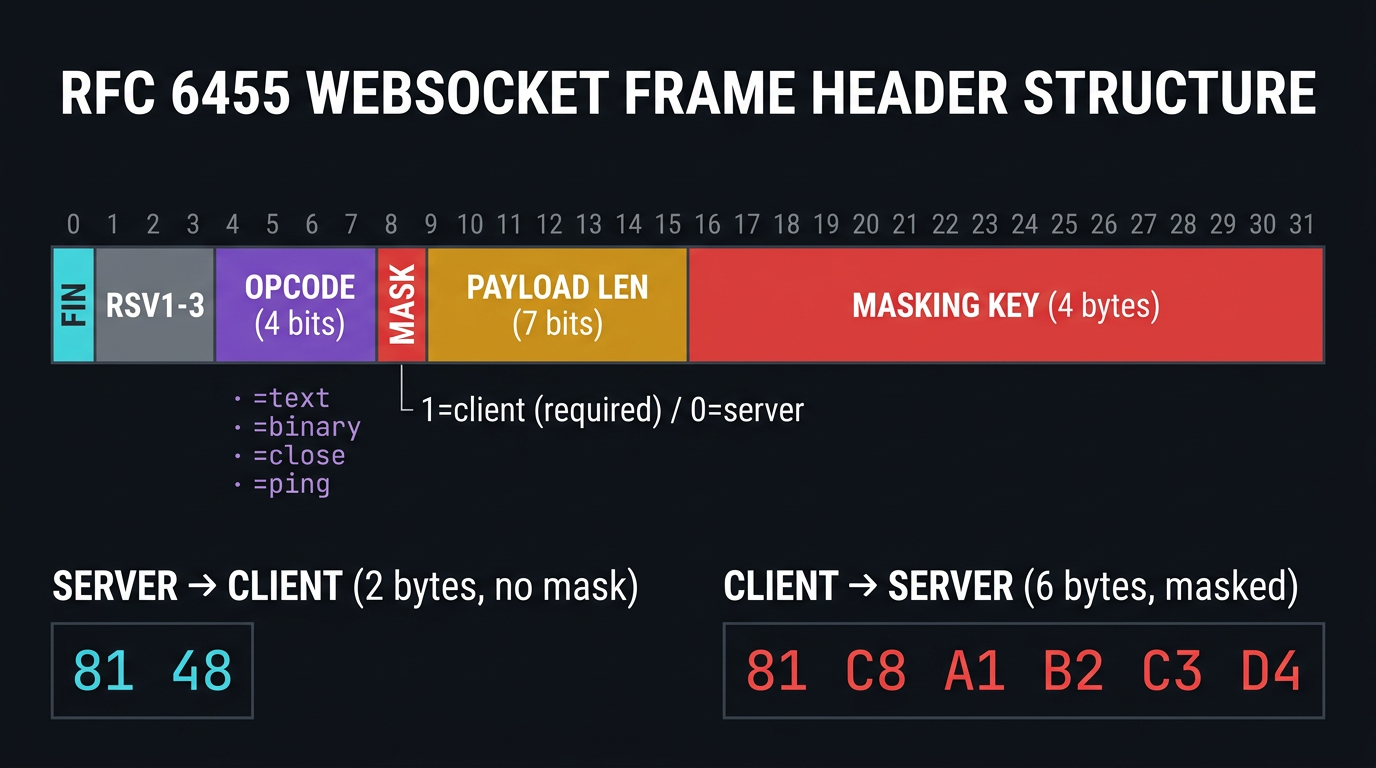
2.1 The Binary Frame Header Layout
Once the handshake completes, all communication uses a compact binary frame format. Understanding the frame structure is essential for debugging network issues, calculating overhead, and evaluating serialization choices.
| Bit Field | Size | Meaning |
|---|---|---|
| FIN | 1 bit | 1 = final fragment of message. 0 = more fragments follow (frame fragmentation). |
| RSV1-3 | 3 bits | Reserved; must be 0 unless a negotiated extension uses them (e.g., permessage-deflate uses RSV1 for compressed frames). |
| Opcode | 4 bits | Frame type: 0x0 continuation, 0x1 UTF-8 text, 0x2 binary, 0x8 close, 0x9 ping, 0xA pong |
| MASK | 1 bit | 1 if payload is masked. Client-to-server frames MUST always be masked. Server-to-client frames MUST NEVER be masked. |
| Payload Length | 7 bits | 0–125: actual length. 126: next 2 bytes are the 16-bit true length. 127: next 8 bytes are the 64-bit true length. |
| Masking Key | 32 bits | Present only if MASK=1. Four bytes used to XOR the payload. |
| Payload Data | variable | Application data, XOR-masked if MASK=1. |
Minimum frame overhead:
- Small payload (≤125 bytes): 2 bytes of header (no masking key for server frames)
- Client frame with masking key: 6 bytes of header (2 header + 4 masking key bytes)
- Compare to HTTP/1.1: 520–800 bytes of headers
2.2 Why Client-to-Server Frames MUST Be Masked
The 4-byte XOR masking requirement for client-to-server frames is not encryption — a fixed key in the same frame provides zero security. It is a poison pill against cache-poisoning attacks on transparent HTTP proxies.
The attack scenario without masking:
A malicious attacker crafts a WebSocket payload that looks like a valid HTTP response:
An intermediate transparent proxy that does not understand WebSockets but intercepts the traffic might interpret this binary stream as a legitimate HTTP exchange and cache the fake response, poisoning its cache for other users on the same network.
XOR masking with a random 4-byte key makes it statistically impossible to craft a payload that looks like a valid HTTP request/response after masking — because the mask key changes randomly for every frame.
Server-to-client frames are never masked — servers do not send frames to proxies (they send directly to the authenticated client over TLS), so the cache-poisoning threat does not apply. The masking requirement is strictly one-directional.
2.3 OpCodes and Control Frames
| OpCode | Name | Max Payload | Fragmentation | Purpose |
|---|---|---|---|---|
0x0 |
Continuation | Unlimited | Part of sequence | Fragment of a larger message (FIN=0 until last) |
0x1 |
Text | Unlimited | ✅ Allowed | UTF-8 encoded text payload (e.g., JSON strings) |
0x2 |
Binary | Unlimited | ✅ Allowed | Arbitrary binary data (MessagePack, Protocol Buffers, raw bytes) |
0x8 |
Close | ≤125 bytes | ❌ Never | Initiate graceful connection shutdown; includes status code + reason |
0x9 |
Ping | ≤125 bytes | ❌ Never | Heartbeat probe — recipient must send Pong |
0xA |
Pong | ≤125 bytes | ❌ Never | Heartbeat response to Ping |
Control frames (Close, Ping, Pong) must have FIN=1 and must never exceed 125 bytes of payload. They can be interleaved between data frame fragments.
3. OS & Node.js Resource Reality
3.1 File Descriptors
Every open TCP socket — including WebSocket connections — consumes one OS file descriptor. The OS kernel maintains a table of open file descriptors per process, with a hard ceiling enforced by ulimit.
At the default ulimit -n 1024, your Node.js WebSocket server can accept at most ~1,000 concurrent connections before the OS returns EMFILE: too many open files and rejects new socket accept() calls. Every new Node.js WebSocket server must raise this limit before deployment.
3.2 Socket Buffer Memory
Beyond file descriptors, each TCP socket allocates kernel memory for send and receive buffers. These are separate from Node.js heap memory — they live in kernel space:
Memory calculation for a WebSocket server:
| Connections | Idle socket memory | Node.js overhead | Total estimate |
|---|---|---|---|
| 1,000 | ~4MB (4KB × 1,000) | ~12MB (12KB/conn) | ~16MB |
| 10,000 | ~40MB | ~120MB | ~160MB |
| 50,000 | ~200MB | ~600MB | ~800MB |
| 100,000 | ~400MB | ~1.2GB | ~1.6GB |
At 50,000 concurrent connections, a single Node.js WebSocket server needs approximately 800MB of combined kernel + heap memory under idle conditions. Active connections with full send buffers can easily require 3–4× more.
3.3 Application-Level Ping/Pong: Why TCP Keep-Alive Is Insufficient
TCP has its own keep-alive mechanism — but it is tuned for infrastructure failure detection, not application health monitoring:
TCP keep-alive takes up to 2 hours + 675 seconds (9 × 75s) to detect a dead socket at default settings. A half-open socket — where one end is dead but the other doesn't know — can persist for hours, consuming a file descriptor and memory buffer the entire time.
Application-level WebSocket Ping/Pong is the only reliable liveness mechanism:
socket.ping() sends an RFC 6455 OpCode 0x9 Ping frame. The remote client (browser's native WebSocket implementation) automatically responds with a 0xA Pong frame — no client-side code required. This is a protocol-level heartbeat. Do not confuse it with application-level "ping" messages in your custom message protocol.
4. Raw ws vs socket.io — The Architectural Boundary
4.1 What Is Engine.IO?
socket.io is not a WebSocket server. It is a messaging framework layered on Engine.IO, which is itself a transport abstraction layer. Engine.IO's behavior on connection:
The consequence: Socket.IO always initiates connections via HTTP long polling before attempting a WebSocket upgrade. This requires:
- Multiple HTTP requests to establish a single Socket.IO connection.
- The initial polling requests have a
sid(session ID) in the query string. - If you load-balance across multiple Node.js instances without sticky sessions, the upgrade
POSTand the pollingGETmay land on different instances — which have no knowledge of each other'ssid. The result:400 Session ID Unknownerrors.
4.2 Packet Overhead Comparison
Raw ws frame (UTF-8 JSON text, 48 bytes of payload):
Socket.IO packet wrapping the same payload:
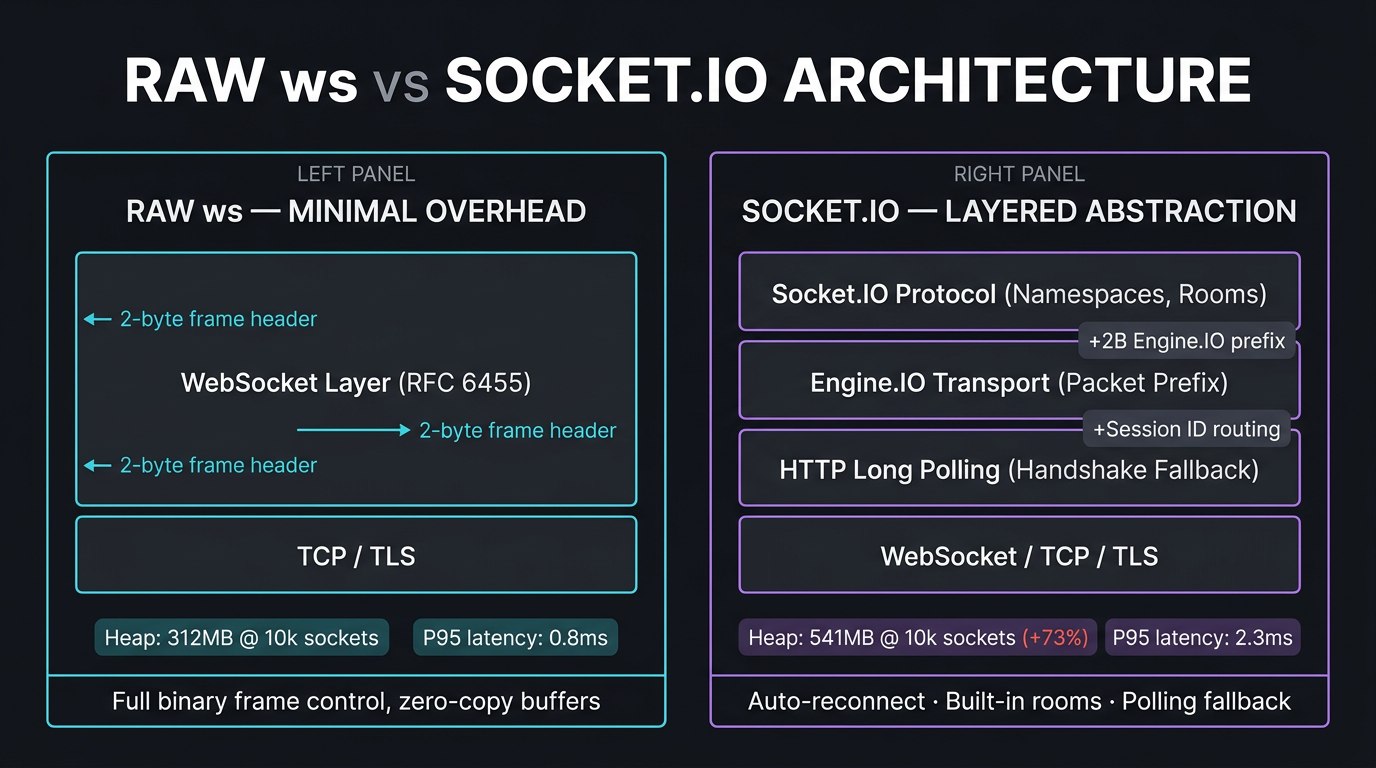
The overhead is small in absolute terms. At 10,000 messages per second, Socket.IO sends ~80KB/s more data than raw ws for the same events. The more significant overhead is CPU — Socket.IO must parse the Engine.IO packet type, strip the namespace prefix, deserialize the event name from the array envelope, and route to the correct event handler.
4.3 Server Memory Benchmark: 10,000 Concurrent Sockets
The memory difference (~230MB for 10,000 sockets) scales linearly. At 50,000 sockets, Socket.IO uses approximately 1.15GB more heap than raw ws. If your server has 4GB of RAM and you are running at scale, this difference determines whether you fit on one instance or need two.
4.4 When Socket.IO Is the Correct Choice
| Requirement | Raw ws |
Socket.IO |
|---|---|---|
| Minimum memory & CPU overhead | ✅ | ❌ |
| Binary MessagePack / Protobuf payloads | ✅ | ✅ (with binary support) |
| Automatic polling fallback for proxy-blocked WebSockets | ❌ | ✅ |
| Built-in room / namespace broadcast | Implement yourself | ✅ |
| Automatic client reconnection with state recovery | Implement yourself | ✅ |
Multi-node cluster with @socket.io/redis-adapter |
Complex | ✅ |
| Custom packet protocol control | Full control | Framework-constrained |
Use raw ws when you own the client (React Native app, server-to-server), control the network (no legacy corporate proxies), and need maximum performance. Use Socket.IO when targeting heterogeneous browsers in enterprise/corporate networks where WebSocket ports may be blocked, or when you want built-in room abstractions and don't want to implement reconnection logic.
4.5 A Minimal Production ws Server
5. Serialization: JSON vs Binary Formats
For high-throughput telemetry (vehicle positions, sensor readings), JSON serialization is often the bottleneck — not network bandwidth:
| Format | Encode speed | Decode speed | Wire size | Schema required |
|---|---|---|---|---|
| JSON | Baseline | Baseline | Baseline | No |
| MessagePack | 4.6× faster | 3.8× faster | −40% | No |
| Protocol Buffers | 6× faster | 5× faster | −60% | Yes (.proto file) |
| CBOR | 3× faster | 3× faster | −35% | No |
6. CAP Alignment: Network Partitions & Half-Open Sockets
6.1 Silent TCP Partitions
In the CAP theorem, a network partition is a communication failure that prevents some nodes from reaching others. For WebSocket servers, the most dangerous partition is the half-open socket: the client's OS has experienced a network interruption, but the server has not yet detected it (TCP keep-alive has not fired yet, which can take 2 hours at default settings).
During this partition:
- The server holds the file descriptor, kernel buffers, and all application-level state (ConnectionManager entries, room memberships).
- Messages sent by the server are queued in the kernel send buffer, waiting for TCP acknowledgment that never arrives.
- From the server's perspective, the client appears fully connected.
This is the availability side of the CAP trade-off for WebSockets: the server remains available (accepting new connections, processing messages from other clients), but the consistency of the "connected" state is violated — the server believes the client is present when it is not.
Application-level Ping/Pong (Section 3.3) is the only reliable mechanism to detect half-open sockets quickly. It converts a potential 2-hour detection window into a 40-second window (30s ping interval + 10s pong timeout).
WebSocket connections are CP-leaning at the transport layer: once connected, the server maintains strict causal ordering of frames delivered to each client (TCP guarantees in-order delivery). But under network partitions, the system must choose: either pause message delivery to the partitioned client (consistency) or drop the connection and force reconnection (availability). The Ping/Pong mechanism implements the availability choice — it fails fast and forces reconnection rather than silently accumulating undelivered messages in a bloated kernel send buffer.
Summary
| Concept | Rule |
|---|---|
| The WebSocket handshake starts as an HTTP/1.1 GET request and transitions to raw TCP framing via the 101 Switching Protocols response and SHA-1 Sec-WebSocket-Accept challenge. | Validate Origin header during the upgrade request — this is the security boundary (covered in depth in Part 6). |
| All client-to-server WebSocket frames must be XOR-masked with a 4-byte key to prevent malicious transparent proxies from poisoning shared caches with crafted HTTP responses. | XOR masking is required by RFC 6455 §5.3; WebSocket libraries enforce it automatically — but understanding why is essential for diagnosing proxy-related frame corruption issues. |
Each connected socket consumes an OS file descriptor and kernel socket send/receive buffers; scaling beyond 10,000 connections requires explicit ulimit and kernel parameter tuning. |
Set LimitNOFILE=65536 in the systemd service file; tune net.core.rmem_default and net.ipv4.tcp_wmem in /etc/sysctl.conf. |
| Socket.IO is not a WebSocket server but a messaging framework layered on Engine.IO — it initiates connections via HTTP long polling before attempting an upgrade, requiring sticky sessions when load balanced. | Raw WebSockets do not need sticky sessions; only Socket.IO's multi-request HTTP polling handshake requires session affinity (explored in Part 5). |
Raw ws delivers minimal framing overhead and zero-copy binary buffers; Socket.IO is justified only when automatic polling fallbacks, built-in room broadcast, and client-side reconnection are required. |
Benchmark your specific workload before choosing; the ~230MB memory difference at 10,000 sockets is significant at scale but irrelevant for low-concurrency applications. |
What's Next
We now have a raw WebSocket server that handles the RFC 6455 handshake, manages Ping/Pong liveness detection, and maintains a ConnectionManager. But managing stateful connections inside an Express/Node.js application introduces integration challenges that most tutorials skip: React 18/19 StrictMode double-mount leaks, secure authentication on the WebSocket handshake (not in query strings), and the architectural coupling between database change detection and socket distribution. Part 4 solves these with a complete stateful connection management system including cryptographic ticket authentication, a singleton ConnectionManager, and a Single Ingestion Worker pattern over MongoDB Replica Set Change Streams.
Part 4 → Stateful Connection Management: Resilient Client Lifecycles & Database Change Streams —
realtime-stateful-connection-management-change-streams(coming in Part 4 of this series)
This article was developed with AI-assisted deep search, specification cross-referencing, and technical research synthesis.