The Boundary Decision: When Micro-Frontends Earn Their Complexity
Micro-frontends trade build-time certainty for runtime autonomy. This article gives you the framework to decide whether that trade is worth making — mapping DDD bounded contexts to deployment units and making the honest case for when a well-structured monorepo wins.
Micro-Frontend Architecture
The Boundary Decision: When Micro-Frontends Earn Their Complexity
A micro-frontend is not a smaller app — it is a domain boundary enforced at the deployment layer. If you can't explain the business capability it owns, you haven't drawn the boundary yet.
Somewhere in the last five years, a team at your company — or a company you've read about — adopted micro-frontends because their codebase felt large. Eighteen months later, they had eight independently deployed apps, three competing versions of React running in the same browser tab, a twelve-step local development setup nobody had written down, and the same two engineers who had touched everything before still touching everything — because the team structure never changed.
The architecture failed not because micro-frontends are a bad idea, but because the team adopted the technical pattern without solving the organizational problem the pattern exists to address. This article gives you the framework to make that decision correctly — and the honesty to recognize when a well-structured monorepo is the right call.
1. The Organizational Problem Comes First
1.1 Conway's Law Is Not a Suggestion
In 1967, Melvin Conway observed that organizations produce system designs that mirror their own communication structure. This is now called Conway's Law, and it is one of the most empirically validated observations in software engineering:
"Any organization that designs a system will produce a design whose structure is a copy of the organization's communication structure."
The implication is direct: if your company has a single frontend team, you will build a monolith — because all decisions flow through one communication channel. If your company has four product teams that must coordinate every release through a shared release train, you will experience all the coupling costs of a monolith regardless of whether you've technically split the codebase.
The Inverse Conway Maneuver is the deliberate response: if you want a particular system architecture, restructure your teams to match it first. Architecture follows communication structure. You cannot deploy your way out of a coordination problem.
Before evaluating any technical approach, answer this question: how many independent teams need to release to production independently, on different schedules, without coordinating with each other? That number is the only number that justifies micro-frontend complexity.
1.2 Reading the Monolith's Pain Signals
A monolith does not need to be decomposed simply because it is large. Scale is not the right trigger. The right trigger is coordination overhead — the moment the cost of synchronizing between teams exceeds the speed benefit of shared context.
These are the signals that a monolith has reached its organizational ceiling:
Deployment coupling — Team A's failing test in the Checkout flow delays Team B's Product Catalog hotfix. A rollback in the User Profile breaks the shared layout for every other team. No team can release without running the full test suite.
PR collision on shared surfaces — Three teams are simultaneously modifying NavBar.tsx, theme.css, or the shared routing config. Merge conflicts are a recurring tax on feature velocity.
Diffuse ownership — "Which team is responsible for this component?" has no clear answer. The correct answer to that question should always be exactly one team name. If two teams answer, or nobody answers, the boundary is already blurred — you just haven't formalized it.
Release train coupling — Features across multiple product areas ship together in a weekly or bi-weekly release. Independent release cadence is the goal; release trains are the symptom that it has not been achieved.
A monolith managed by two engineers who own the entire codebase is not in pain. A monolith managed by eight teams who must coordinate every feature branch is. The size of the codebase is a red herring. The size of the coordination surface is the actual problem.
2. Drawing the Boundary: Domain-Driven Design Applied to UI
2.1 The Bounded Context as a Deployment Unit
Domain-Driven Design (DDD) introduces the concept of a bounded context: a specific problem domain with its own ubiquitous language, its own data model, and its own rules that do not leak into adjacent domains. The word bounded is the key — the context has explicit edges.
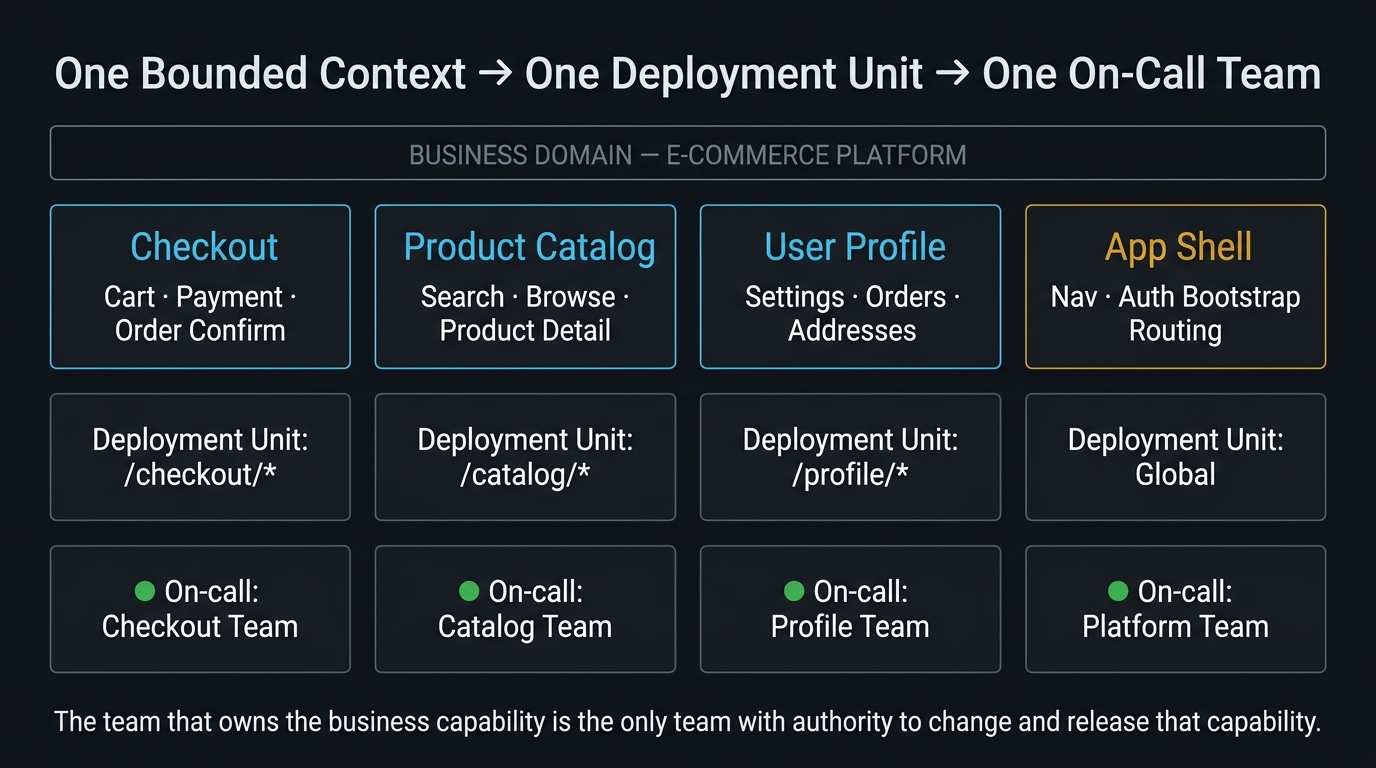
When applied to frontend architecture, a bounded context maps directly to a deployment unit. The mapping is not arbitrary — it is derived from the business capabilities your organization has already divided into product teams:
| Business Capability | Bounded Context | Owns |
|---|---|---|
| Purchasing flow | Checkout | Cart state, payment forms, order confirmation, receipt emails |
| Discovery & browsing | Product Catalog | Search, filters, product detail page, recommendations |
| Account management | User Profile | Settings, order history, addresses, preferences |
| Navigation & global chrome | App Shell | Top nav, footer, authentication bootstrapping, routing |
Each context owns its data, its user interactions, and its deployment pipeline. Nothing leaks across context boundaries except well-defined contracts.
2.2 The Layer Anti-Pattern
The most common mistake in MFE decomposition is splitting by technical layer rather than by business capability:
A layer-based split means the Checkout team's form changes require coordination with the forms-mfe team. You have decomposed the codebase without decomposing the coordination overhead. This is the worst of both worlds: runtime complexity with no autonomy benefit.
2.3 The Ownership Test
For every component, module, or page in your system, there is a simple test for whether your boundary is correct:
"Which team is on call at 2am when this breaks in production?"
If exactly one team answers — the boundary is correct. If two teams answer — the boundary is misdrawn. If nobody answers — you have an ownership vacuum, which is more dangerous than any architectural decision.
Domain ownership is deployment ownership. The team that owns the business capability must be the only team with the authority to change and release that capability.
A micro-frontend boundary is not a code organization pattern. It is an organizational contract formalized in software. The contract says: this team owns this capability, ships it independently, and is solely accountable for its correctness in production.
3. The Trade-off Matrix
Before committing to any architecture, produce this matrix for your specific context. Micro-frontends do not win every axis — and pretending otherwise is how teams end up with 18-month implementation regrets.
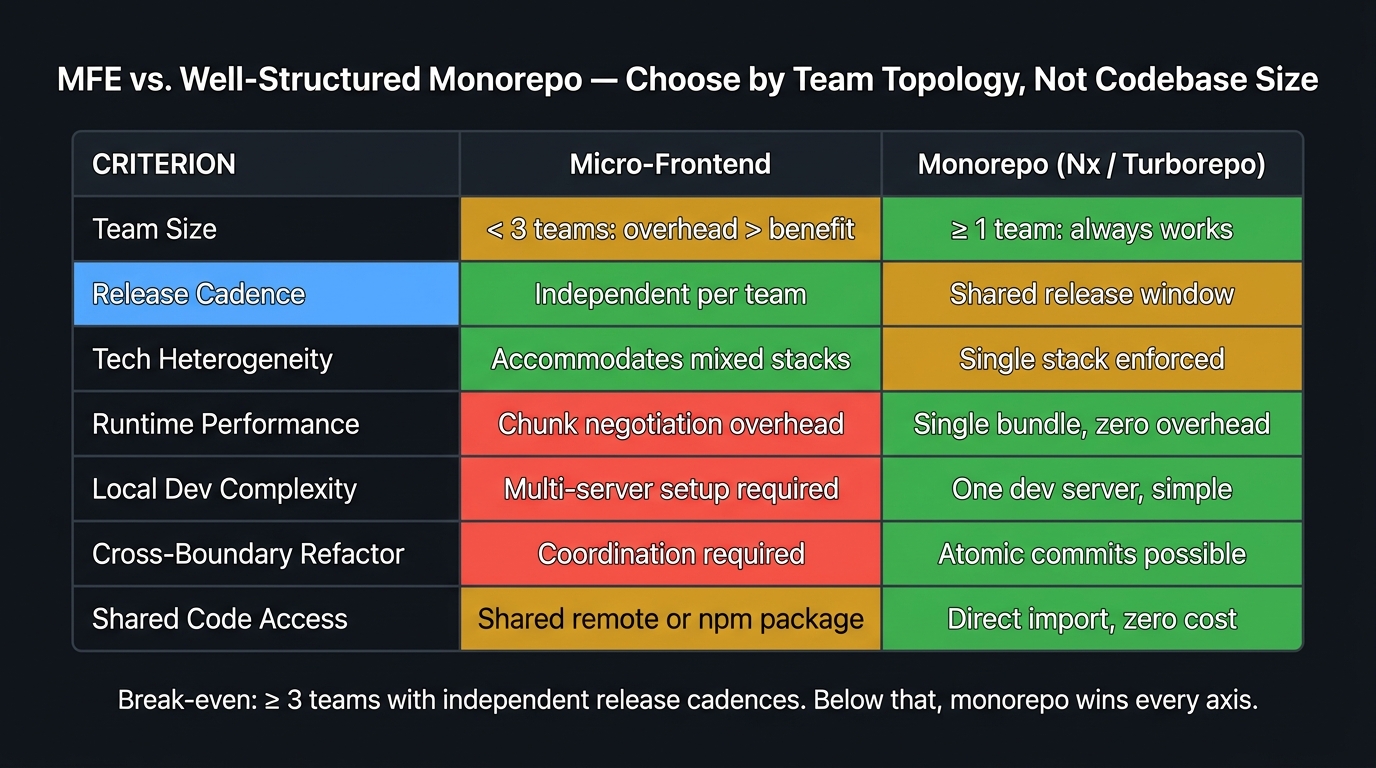
The critical insight in this matrix: micro-frontends are the right choice when team autonomy and independent release cadence are the primary constraints. They are the wrong choice when your primary constraints are runtime performance, local development simplicity, or developer experience for a small team.
Adopting micro-frontends to solve a performance problem is a category error. MFEs introduce runtime overhead — additional network requests, chunk coordination, shared dependency negotiation. If your monolith is slow, profile and optimize it. Do not decompose it.
4. The Case Against Micro-Frontends
This section exists because most micro-frontend guides skip it. A pattern that cannot be disqualified by any set of conditions is not engineering guidance — it is marketing.
Micro-frontends are objectively the wrong choice when:
Your team is smaller than three independently shipping groups. The coordination overhead of separate build systems, deployment pipelines, and cross-app contracts is designed to be amortized across multiple teams. Below that threshold, a single team with a well-organized monorepo ships faster, debugs faster, and onboards new engineers faster.
Your release cadence is synchronized. If all features ship in a weekly release window regardless of team, you gain zero deployment autonomy from MFEs. You pay all the complexity costs and receive none of the independence benefit.
Technology heterogeneity is the goal, not the constraint. Running React in the Checkout app and Vue in the Catalog app because different engineers prefer different frameworks is not an architectural advantage — it is a maintenance liability. MFEs accommodate heterogeneity when it exists for historical or acquisition reasons; they do not justify creating it.
You are pre-product-market-fit. Micro-frontends are an optimization for scale. Before your product has validated its core value proposition, the cost of maintaining distributed deployment infrastructure is pure waste. Build the monolith first. Decompose when the organizational pain is real and measurable, not anticipated.
Before proposing micro-frontends, answer this question to your team: "What specific deployment incident or coordination failure in the last 90 days would not have happened with MFEs?" If you cannot name one, you are solving a future problem at present cost.
4.1 The Monorepo Alternative
A monorepo with proper ownership tooling solves many of the problems that engineers incorrectly diagnose as requiring MFEs:
With @nx/enforce-module-boundaries, the Checkout team cannot import from the Catalog domain without an explicit dependency declaration. Ownership is enforced at lint time, not at deployment time. Affected builds mean CI only runs for what changed. You get team autonomy without runtime composition costs.
Nx affected and Turborepo filter achieve logical pipeline isolation inside a monorepo. If your only requirement is "Team A's change should not trigger Team B's CI pipeline," a monorepo with affected-build tooling solves this without any of the runtime complexity of Module Federation.
5. Composition Strategies: The Decision Before the Tooling
If you have completed the analysis above and determined that micro-frontends are genuinely the right call, the next decision — made before any tooling selection — is how you will compose independent deployment units into a coherent user experience.
There are three fundamental strategies. Each has a different cost profile.
Build-time composition (NPM packages) — Independent teams publish versioned packages; the host application installs them as dependencies and bundles them at build time. There is zero runtime overhead and no independent deployment: to update a remote package, the host must rebuild and redeploy. This is the correct starting point for teams that want code ownership without operational complexity.
Server-side composition (Edge Side Includes, SSR frameworks) — An edge server or CDN assembles HTML fragments from multiple origin servers before returning a response to the browser. Each fragment is independently deployed; composition happens at the network layer, not in the browser. Initial page load is fast (no client-side chunk negotiation), but personalized or interactive fragments require careful cache-busting strategy.
Runtime composition (Module Federation, Web Components, iframes) — The host application dynamically loads remote modules at runtime, from independently deployed origins. Teams deploy on their own schedule; the host discovers and loads the latest remote version on each page load. This is the highest-autonomy, highest-complexity strategy and the primary focus of Parts 3 and 4 of this series.
Do not select your tooling (Webpack, Rspack, Vite) before selecting your composition strategy. Module Federation is a runtime composition tool. Using it for a team that only needs build-time composition is equivalent to deploying Kubernetes to run a single-server Rails app.
Summary
| Concept | Rule |
|---|---|
| Unit of decomposition | Bounded context (business capability), not technical layer |
| Trigger for MFEs | Team topology + independent release cadence, not codebase size |
| Break-even point | ≥3 teams with independent release cadences; below that, monorepo wins |
| Monorepo vs. Polyrepo | An architectural decision, not a developer preference |
| Composition strategy | Must be chosen before any tooling decisions are made |
| When NOT to use MFEs | Team < 3, synchronized releases, pre-PMF, or performance is the primary constraint |
What's Next
In Part 2, we build the foundational mental model that makes everything in Parts 3–9 mechanical rather than magical: what a JavaScript chunk is, what dynamic
import()actually does on the network, and why two independently deployed apps sharing a library is a problem that requires runtime coordination to solve. Part 2 → JavaScript Modules, Chunks & Dynamic Import
References
This article was developed with AI-assisted deep search, specification cross-referencing, and technical research synthesis.