Authentication Architecture: JWT Self-Verification, OIDC Identity & RBAC at Scale
Authentication in microservices is not a single service problem — it is an identity propagation architecture problem. Stateless JWT self-verification removes the auth server as a synchronous bottleneck, OIDC standardizes the identity layer for SSO federation, and RBAC role claims enforced at the API Gateway perimeter prevent authorization logic from leaking into every downstream service.
API Architecture & System Resilience
Authentication Architecture: JWT Self-Verification, OIDC Identity & RBAC at Scale
Senior engineers don't just wire services together — they design the boundary: the contract, the trust model, the failure envelope, and the signal pipeline that proves it's working. Authentication in microservices is where the trust model is most commonly designed incorrectly. Teams extract auth logic into a dedicated service, then call that service on every request from every downstream service — replacing a stateless JWT verification (a cryptographic operation taking microseconds) with a synchronous network call (taking 20–200ms) that becomes a single point of failure for the entire system. The OIDC standard exists specifically to solve this: identity is established once, propagated as a signed, self-verifiable token, and enforced at the boundary rather than in every room behind it.
Series positioning: This is Part 5 of the API Architecture & System Resilience series. It builds on the API Gateway from Part 2 (the enforcement point) and the mTLS workload identity from Part 3 (the service-to-service layer). The browser-side OAuth2 pattern (PKCE, httpOnly cookies, token-mediating BFF) is covered in the Frontend Platform series — this article focuses on the microservice-side identity architecture.
1. JWT Anatomy & the aud Validation Gap
1.1 The Three-Part Structure
1.2 The Missing aud Validation
2. Stateless JWKS-Based Verification
2.1 The Auth Server Bottleneck
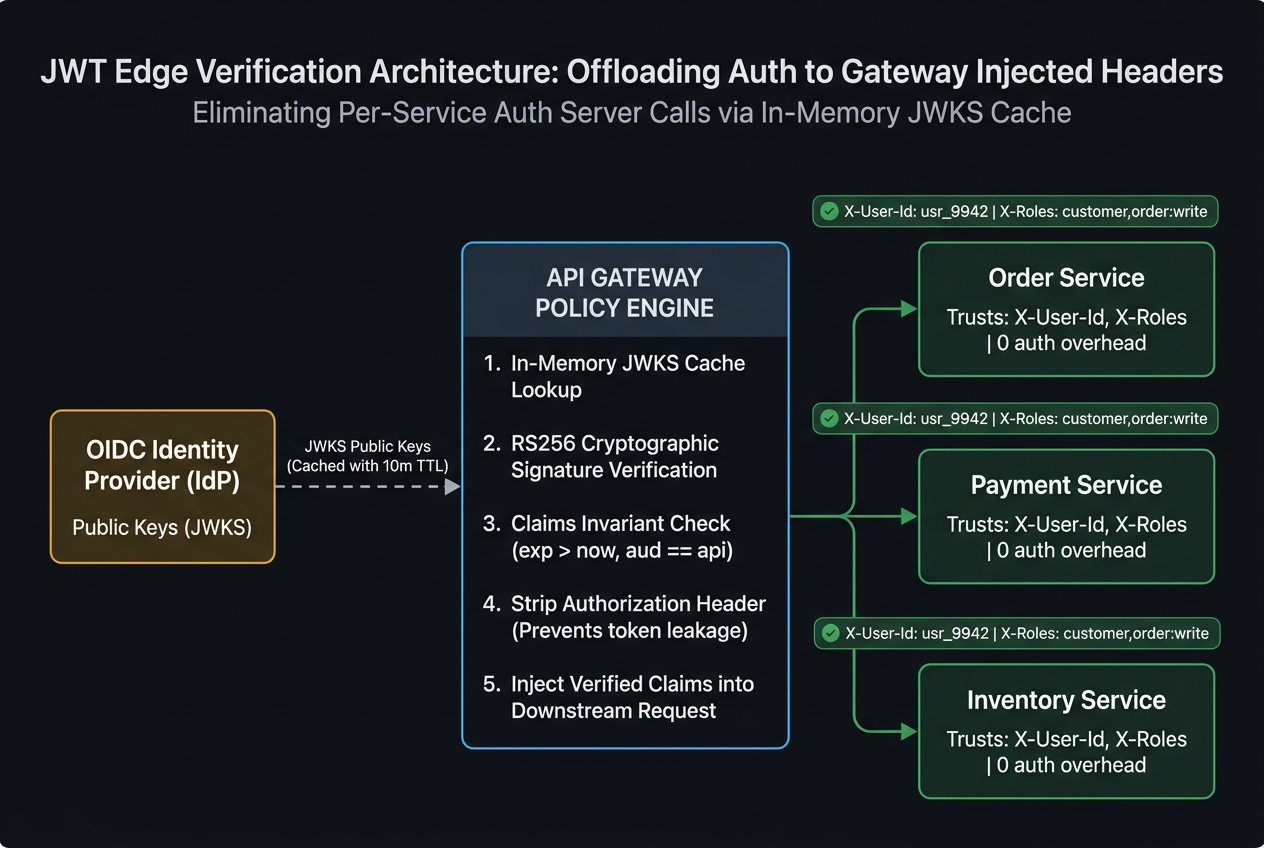
2.2 JWKS Public Key Caching
3. Token Rotation & Redis Blocklist Revocation
The blocklist only needs to survive until the token's natural expiry (exp claim). Use a Redis TTL that matches the remaining token validity: TTL = exp - Date.now()/1000. This keeps the blocklist bounded in size regardless of how many tokens are revoked.
4. OIDC: The Identity Layer
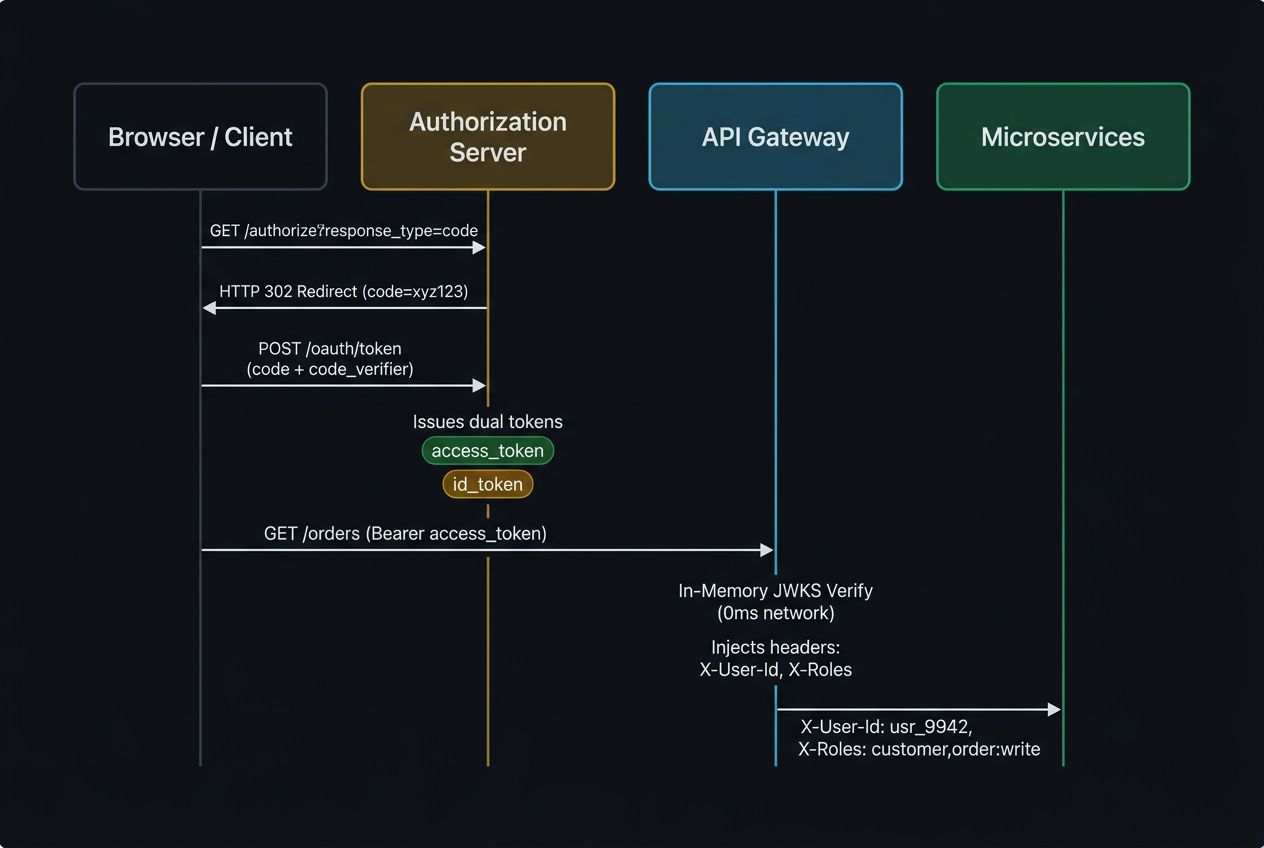
4.1 ID Token vs Access Token — The Critical Distinction
Sending the ID token to backend services is a security design flaw. The ID token's aud claim is the client application — any service that accepts it is violating the audience constraint. The ID token contains PII (email, name, picture) that backend services should not receive unless explicitly needed. Use the access token for service calls; use the ID token only in the client to display user information.
4.2 OIDC Discovery Document
5. SSO Federation via OIDC
The key to SSO is that the user's session lives at the Authorization Server, not in any individual application. When App B redirects to the AS with prompt=none, the AS detects the existing session and issues tokens without a login page.
6. RBAC via API Gateway Headers
7. ABAC with OPA for Fine-Grained Authorization
Summary
| Concern | Auth Architecture Rule |
|---|---|
| JWT verification | Cryptographic JWKS verification — never token introspection per request |
| aud claim | Mandatory validation on every service — prevents cross-service token replay |
| Algorithm | RS256 only — HS256 shared secrets cannot be distributed safely to multiple services |
| JWKS caching | 10-minute TTL with rate limit — prevents thundering herd on cache miss |
| Token revocation | Redis blocklist on jti claim with TTL = remaining token validity |
| ID token | For client only — never send to backend services; PII + wrong audience |
| RBAC | Role claims in JWT → gateway injects X-Roles header → services apply as data |
| ABAC | OPA Rego policies for fine-grained, attribute-based authorization without code changes |
What's Next
In Part 6, we build the signal pipeline that proves the system is working — Part 6: Distributed Observability covers OpenTelemetry instrumentation, W3C traceparent propagation across every service hop, tail-based sampling, and structured JSON logging correlated by trace and span IDs so that every incident can be resolved from a single Trace ID.
This article was developed with AI-assisted deep search, specification cross-referencing, and technical research synthesis.