Service Mesh & mTLS: Infrastructure-Layer Security, Discovery & Traffic Management
A service mesh moves authentication, encryption, and observability from application code into the infrastructure sidecar layer, making mTLS between every service pair the default rather than an opt-in that teams forget to implement. This article builds from Envoy sidecar mechanics and SPIFFE workload identity through Istio vs Linkerd tradeoffs to declarative traffic management and automatic golden signal telemetry.
API Architecture & System Resilience
Service Mesh & mTLS: Infrastructure-Layer Security, Discovery & Traffic Management
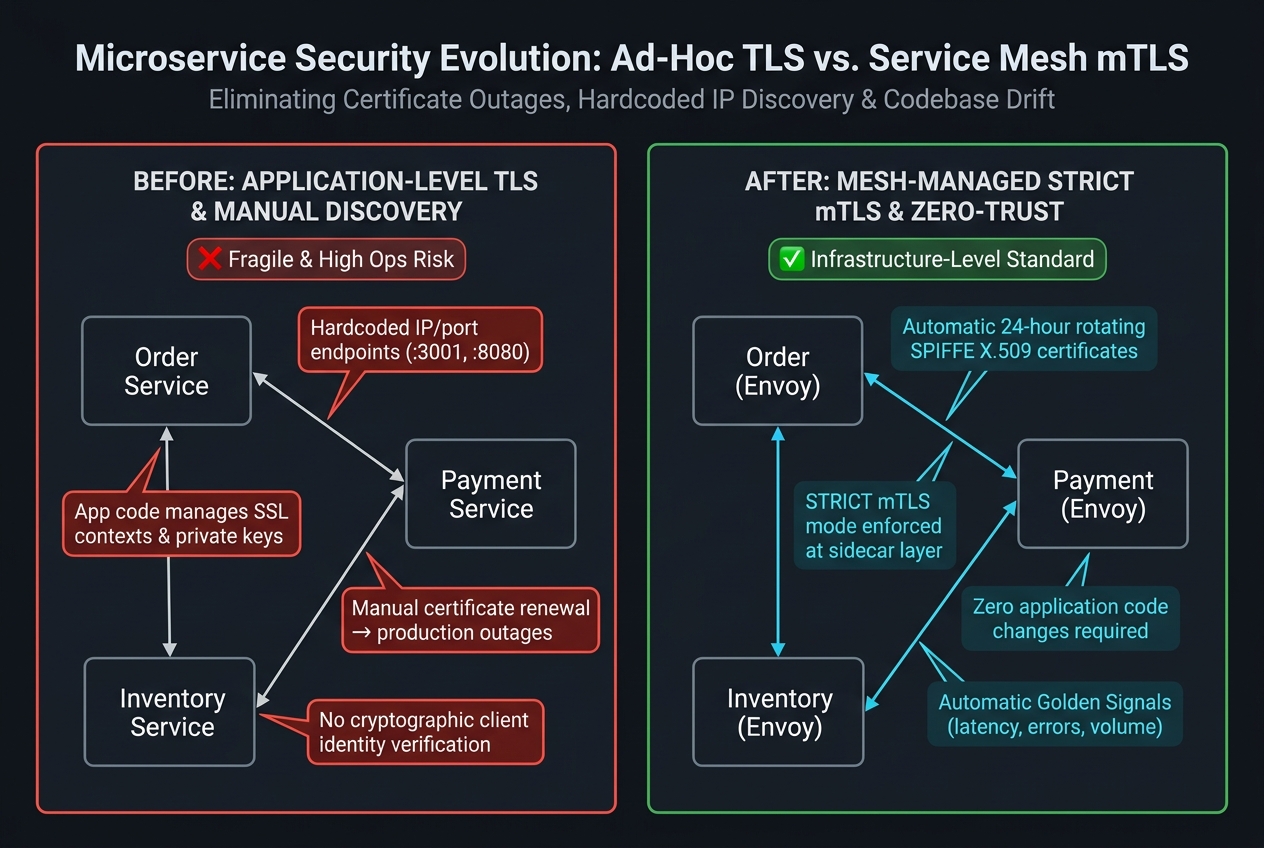
Senior engineers don't just wire services together — they design the boundary: the contract, the trust model, the failure envelope, and the signal pipeline that proves it's working. In most microservice deployments, the trust model between services is an afterthought: services communicate over plain TCP inside the cluster, assuming the network perimeter is secure. This assumption fails the moment a misconfigured pod, a compromised container, or a lateral movement attack gains network access. The service mesh eliminates this assumption by making encrypted, authenticated communication the infrastructure default — without a single line of application code changing.
Series positioning: This is Part 3 of the API Architecture & System Resilience series. It builds on the gateway pattern from Part 2 and provides the east-west (service-to-service) security and observability layer that complements the gateway's north-south (client-to-system) enforcement. Part 6: Distributed Observability depends on understanding how the sidecar generates telemetry.
1. The Application-Layer TLS Anti-Pattern
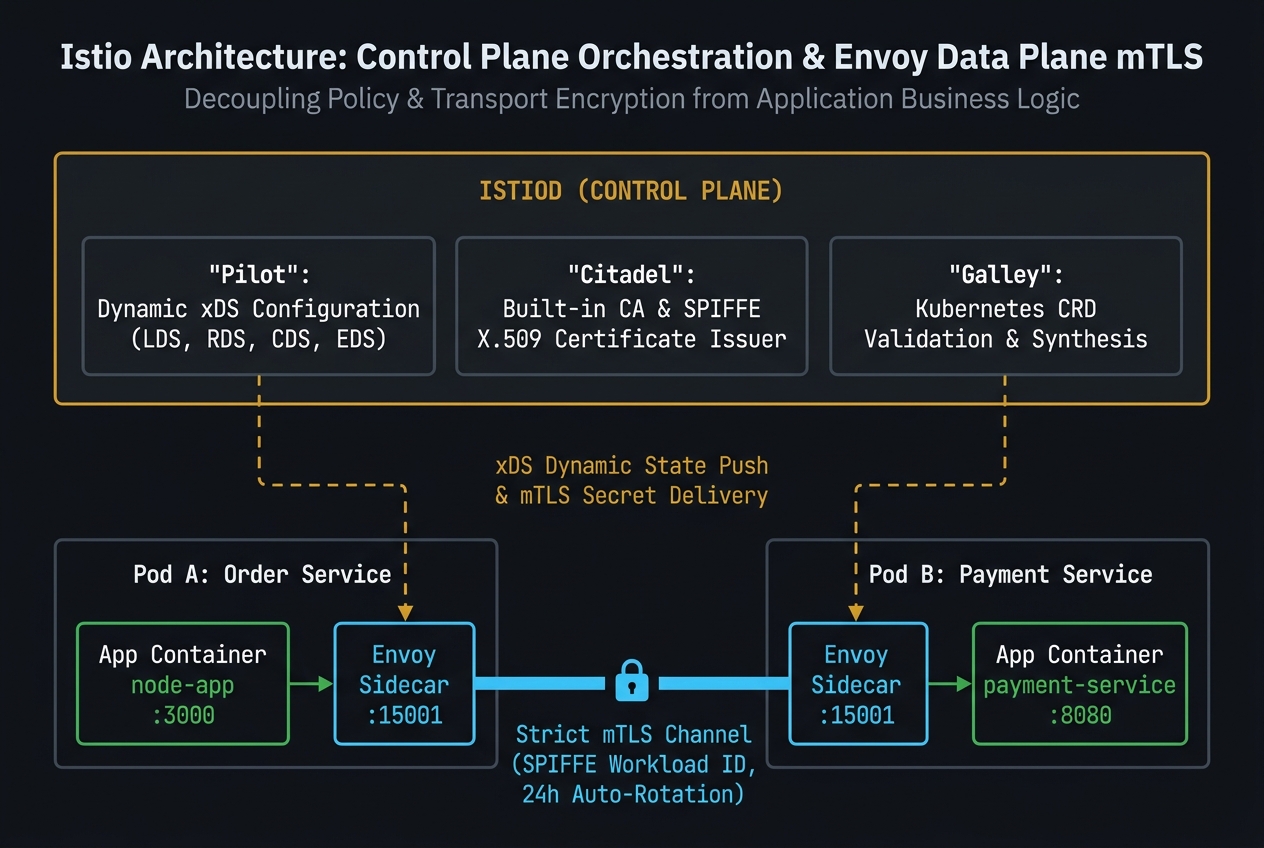
The service mesh eliminates this by injecting a sidecar proxy (Envoy) into every pod that handles all TLS termination and initiation automatically, using certificates issued by the mesh's own CA and rotated on a short TTL without service restarts.
2. The Envoy Sidecar Model
2.1 Traffic Interception — No Application Code Changes
Istio uses iptables rules injected by the init container to redirect all inbound and outbound TCP traffic through the Envoy sidecar transparently:
The application process never sees the TLS handshake. It writes to a local TCP socket; Envoy handles the encryption.
3. Service Discovery in Container Environments
3.1 Kubernetes DNS-Based Discovery
3.2 Consul Service Discovery (Multi-Cluster / Heterogeneous)
| Discovery Method | When to Use | Failure Behavior |
|---|---|---|
| Kubernetes CoreDNS | Same-cluster k8s services | DNS TTL refresh (typically 5s) |
| Consul | Multi-cluster, non-k8s services, service catalog | Health check removes instances within 10s |
| Eureka (Netflix) | Legacy Java microservice ecosystems | Heartbeat-based; 90s default eviction |
| Istio ServiceEntry | External services registered in the mesh | Immediate mesh policy enforcement |
4. mTLS & SPIFFE Workload Identity
4.1 Why Application-Layer Tokens Are Insufficient
4.2 SPIFFE Workload Identity with Istio
A SPIFFE URI (spiffe://cluster.local/ns/production/sa/order-service) is a globally unique, verifiable identity for a workload — issued by Istiod's certificate authority, embedded in the X.509 certificate of the Envoy sidecar, and rotated every 24 hours automatically. No shared secrets. No manual rotation. If the payment service receives a request from any identity other than order-service, Envoy rejects it at the network layer before the application process sees the connection.
SPIFFE workload identity is OAuth2 for machines at the infrastructure layer. Instead of a JWT signed by an auth server, a workload's identity is an X.509 certificate signed by the mesh CA. The key difference: the mesh CA rotates the certificate automatically; OAuth2 tokens require application-level refresh logic.
5. Traffic Management: Canary Deployments & Weighted Routing
This configuration requires zero changes to either the order-service (the caller) or the payment-service (the callee). The mesh intercepts all payment-service traffic and routes it according to the VirtualService policy.
6. Istio vs Linkerd vs Consul Connect
| Criterion | Istio + Envoy | Linkerd | Consul Connect |
|---|---|---|---|
| Sidecar | Envoy (C++) — feature-rich | Linkerd2-proxy (Rust) — lightweight | Envoy |
| Control plane | Istiod | Linkerd control plane | Consul server |
| Latency overhead | ~5–10ms P99 per hop | ~1–3ms P99 per hop | ~5–8ms P99 per hop |
| mTLS | ✅ Automatic via SPIFFE | ✅ Automatic via trust anchors | ✅ Automatic via Vault/ACLs |
| Traffic management | Advanced (VirtualService, DestinationRule, WASM) | Basic (HTTPRoute, SMI) | Basic (intentions) |
| Observability | Golden signals + distributed tracing (built-in) | Golden signals (built-in) | Requires separate tooling |
| Multi-cluster | ✅ (Istio multi-primary) | ✅ (multicluster extension) | ✅ (Consul federation) |
| Best for | Feature-rich enterprise environments | Simplicity + performance | Existing Consul infrastructure |
7. Declarative Retry & Timeout Policies
retryOn: "5xx" retries on all 500-series errors including 500 Internal Server Error. This is dangerous for non-idempotent operations — if inventory-service processed a reservation and then returned 500 due to a response serialization error, a retry will create a duplicate reservation. Use connect-failure,refused-stream,503 to retry only on transport-level failures and overload signals, not application errors.
8. Automatic Telemetry from the Sidecar
The Envoy sidecar automatically emits:
- Metrics:
istio_requests_total,istio_request_duration_milliseconds,istio_tcp_connections_opened_total— the RED method automatically available per service pair - Traces: A span per hop with the
traceparentheader propagated downstream (see Part 6: Observability) - Access logs: Structured JSON with request metadata, upstream cluster, response flags, and byte counts
Summary
| Concern | Service Mesh Rule |
|---|---|
| mTLS | PeerAuthentication: STRICT — no plaintext intra-cluster traffic; automatic cert rotation |
| Workload Identity | SPIFFE X.509 cert per workload; AuthorizationPolicy per service for caller-level RBAC |
| Service Discovery | CoreDNS for same-cluster k8s; Consul for multi-cluster or heterogeneous environments |
| Traffic Management | VirtualService + DestinationRule for canary, A/B, weighted routing — zero application code |
| Retries | retryOn: "connect-failure,refused-stream,503" — never 5xx for non-idempotent operations |
| Telemetry | Sidecar auto-emits golden signals + traces to Prometheus + OTel without application changes |
| Mesh Choice | Linkerd for performance + simplicity; Istio for advanced traffic management + WASM extensions |
What's Next
In Part 4, we move to the real-time communication layer — Part 4: WebSockets, SSE & HTTP/3 examines how to build persistent, bidirectional connections that scale horizontally and how HTTP/3's QUIC transport eliminates the head-of-line blocking that makes TCP unsuitable for real-time multiplexed APIs.
This article was developed with AI-assisted deep search, specification cross-referencing, and technical research synthesis.