Retry Engineering: Exponential Backoff, Jitter & SLA-Derived Retry Budgets
Retry logic written naively creates thundering herds that amplify failures into sustained outages. Production retry engineering requires exponential backoff with randomized jitter to spread retry load, per-operation idempotency contracts to make retries safe, and budget-aware retry limits derived from the calling service's own SLA — not from intuition. This article covers the mathematics of jitter variants, the mechanics of async DLQ retry patterns, and the Retry-After compliance gap that turns most provider incidents into amplification events.
API Architecture & System Resilience
Retry Engineering: Exponential Backoff, Jitter & SLA-Derived Retry Budgets
Senior engineers don't just wire services together — they design the boundary: the contract, the trust model, the failure envelope, and the signal pipeline that proves it's working. Retry logic is where the failure envelope is most precisely defined: how many times will you try, how long will you wait between attempts, and what is the maximum wall-clock time you will spend retrying before you give up and tell the caller it failed? Most systems have no answers to these questions. They have a for (let i = 0; i < 3; i++) loop with a hardcoded 1-second sleep — and when a provider goes down, ten thousand services retry simultaneously, overwhelm the recovery path, and turn a 30-second incident into a 10-minute outage.
Series positioning: This is Part 7 of the API Architecture & System Resilience series. It builds on the rate limiting from the API Gateway (Part 2) and the RBAC idempotency contracts from the Auth Architecture (Part 5). The foundational idempotency key schema (SQL deduplication table) is covered in the Distributed Architecture series — this article focuses on retry engineering: the caller's side of the resilience contract.
1. The Thundering Herd Problem
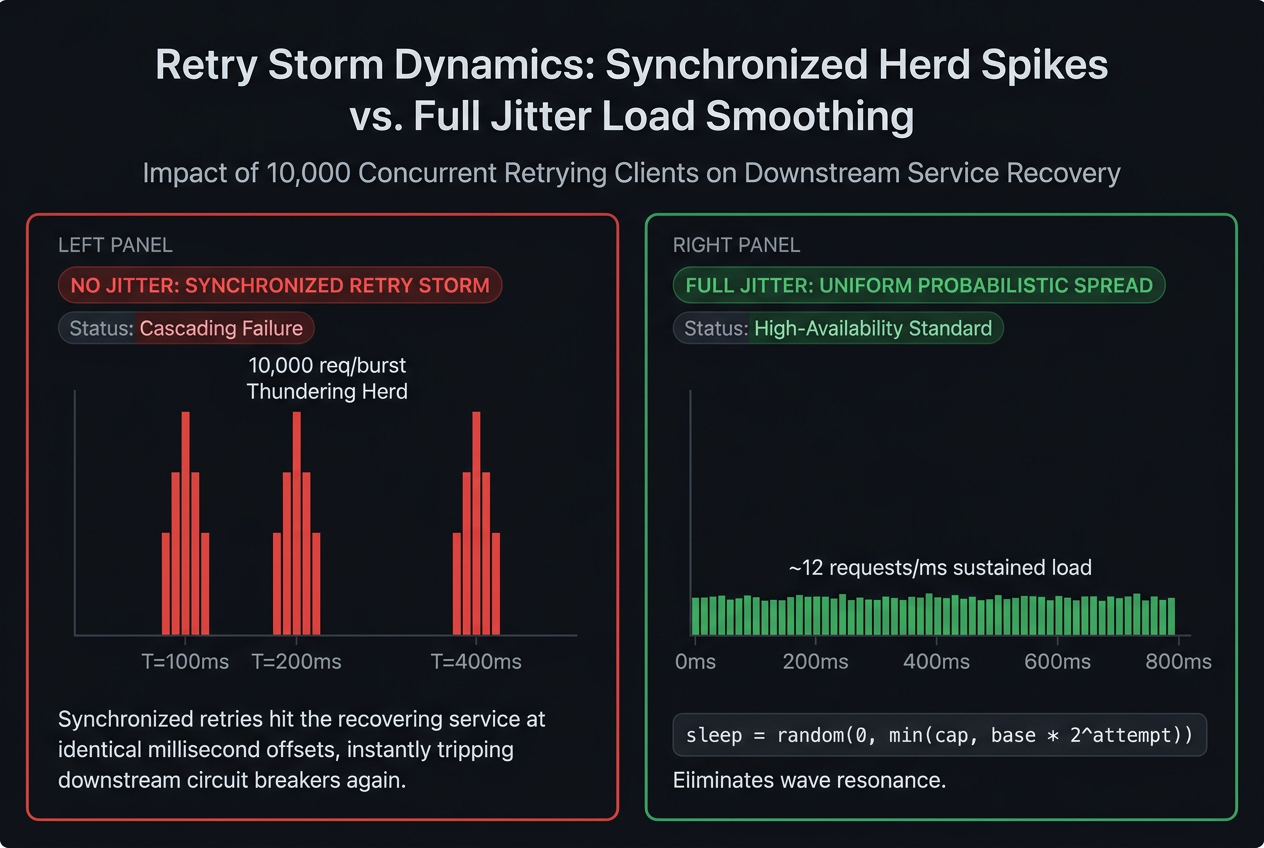
Without jitter, exponential backoff does not solve this — it just synchronizes the storm at progressively longer intervals.
2. Exponential Backoff Mathematics
2.1 The Base Algorithm
2.2 Jitter Variants
2.3 Jitter Comparison at Scale
| Strategy | 10k clients, attempt 3 | Retry load distribution |
|---|---|---|
| No jitter | All retry at exactly T+800ms | 10,000 req/ms spike |
| Equal jitter | Spread over 400–800ms window | ~25,000 req/s average |
| Full jitter | Spread over 0–800ms window | ~12,500 req/s average |
| Decorrelated | Spread over variable window | Most uniform — no predictable peak |
3. SLA-Derived Retry Budgets
3.1 The Most Common Mistake
3.2 Budget Derivation from SLA
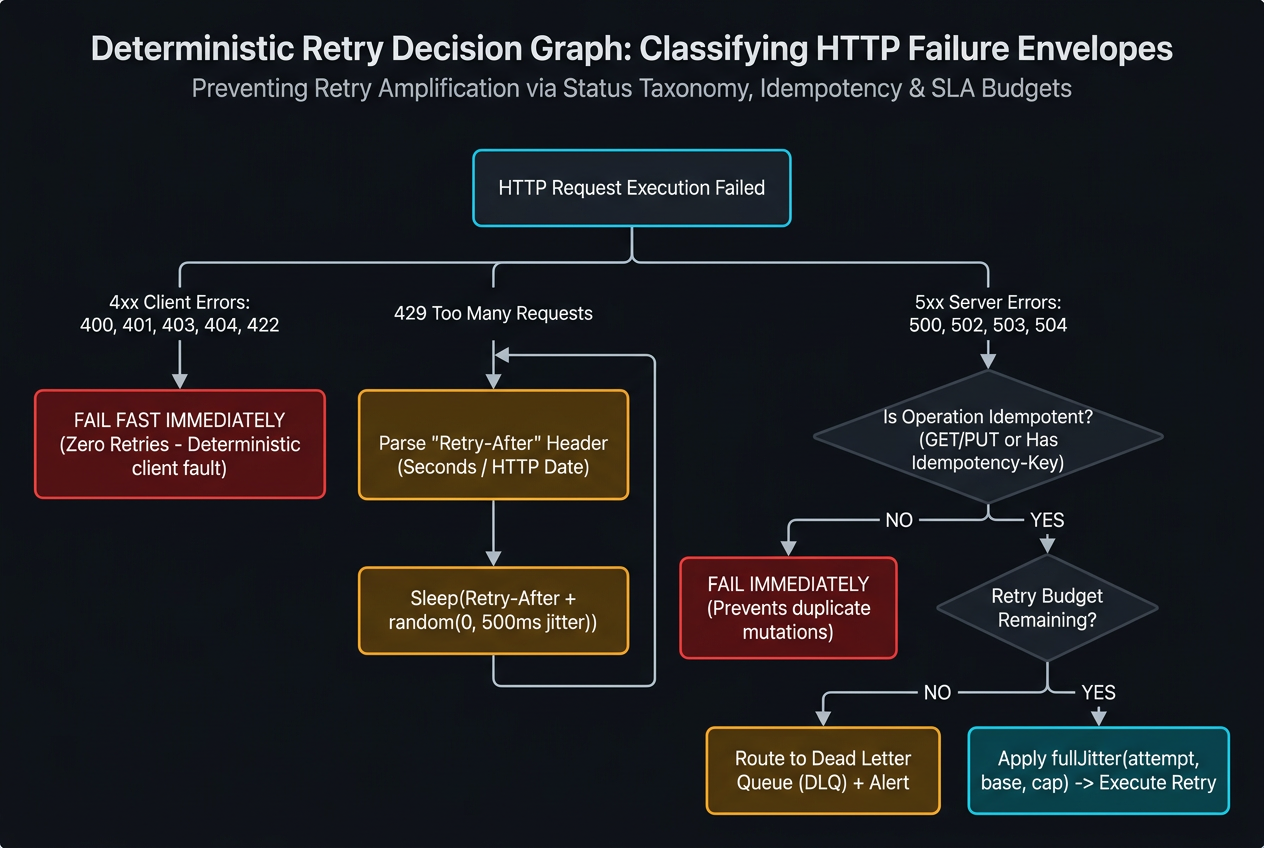
4. Non-Retryable Error Taxonomy
| Status Code | Retry? | Reason |
|---|---|---|
400 Bad Request |
❌ Never | Malformed request — retry sends same broken payload |
401 Unauthorized |
❌ Never | Token invalid — retry without re-auth sends same bad token |
403 Forbidden |
❌ Never | Insufficient permissions — retry with same identity always fails |
404 Not Found |
❌ Never | Resource does not exist — retry cannot create it |
409 Conflict |
❌ Never | State conflict — retry amplifies the conflict |
422 Unprocessable |
❌ Never | Semantic validation failed — payload must change |
429 Too Many Requests |
✅ Yes | Rate limited — retry after Retry-After seconds |
500 Internal Server Error |
⚠️ Sometimes | Transient; retry only for idempotent operations |
502 Bad Gateway |
✅ Yes | Gateway error — upstream unreachable |
503 Service Unavailable |
✅ Yes | Server overloaded — retry after Retry-After |
504 Gateway Timeout |
✅ Yes (carefully) | Upstream timed out — retry only if idempotent |
5. Idempotency: The Prerequisite for Safe Retries
6. Async DLQ Retry Patterns
6.1 Kafka Retry Topics
6.2 SQS Delay Queue Pattern
7. Retry-After Header Compliance
Summary
| Concern | Retry Engineering Rule |
|---|---|
| Jitter | Full jitter (random() × backoff) — not equal jitter, not no jitter |
| Budget | Derive maxAttempts from caller's SLA: floor(SLA / perAttemptTimeout) |
| Non-retryable codes | 400/401/403/404/409/422 — fail immediately; never retry |
| Idempotency key | Generate once before all attempts; same key on every retry |
| 429 handling | Read Retry-After header; respect it exactly plus small random jitter |
| 5xx retries | Only for idempotent operations; never POST without idempotency key |
| DLQ context | Include attemptCount, lastError, originalEnqueueTime on every DLQ message |
| Async retry | Kafka retry topics or SQS delay queues for event-driven retry — not synchronous sleep |
What's Next
This is the final article in the API Architecture & System Resilience series. You now have the complete picture: REST design discipline (P1), gateway enforcement (P2), service mesh security (P3), real-time communication (P4), identity propagation (P5), observability (P6), and resilient retry engineering (P7). The next natural step is the Advanced Database Engineering series — caching hierarchies, query optimization, and consistency models that back the services you have now designed.
This article was developed with AI-assisted deep search, specification cross-referencing, and technical research synthesis.