The Graph Mental Model: How GraphQL Thinks, Not How REST Thinks
GraphQL is not a faster REST — it is a typed traversal protocol for a data graph. Until you stop thinking in endpoints and start thinking in nodes, edges, and selection sets, every GraphQL decision you make is a REST decision in disguise.
GraphQL Frontend Engineering
The Graph Mental Model: How GraphQL Thinks, Not How REST Thinks
Most engineers adopt GraphQL the same wrong way. They install @apollo/client, replace fetch('/api/users') with useQuery(GET_USERS), notice that the schema already has an id and name field, and ship it. REST with extra steps.
That pattern fails — not because GraphQL is hard, but because the mental model never changed. The HTTP endpoint model (server decides the response shape, client takes what it gets) is so deeply wired into how we think about APIs that we unconsciously apply it to GraphQL too. The result: over-fetching on every query, cache misses that seem random, and a schema that looks like a database schema wearing a GraphQL costume.
A GraphQL client is not a data fetcher — it is a local replica of your server's data graph. Before that sentence becomes operational rather than abstract, you need a different mental model entirely. This article builds it from the ground up.
1. Why "REST But Flexible" Is the Wrong Frame
REST and GraphQL solve the same problem — moving data from a server to a client — but they place responsibility in different places. In REST, the server owns the response shape. When you call GET /users/1, the server decides what a User looks like: which fields are returned, which relationships are nested, and how deep the nesting goes. The client accepts whatever arrives.
GraphQL inverts this. The schema defines what can be fetched. The client decides what will be fetched. Every query is a typed declaration of exactly the data a component needs — no more, no less. The server executes that declaration faithfully.
REST: the server is a vending machine — it has fixed products (endpoints) and you take what's available.
The practical consequence: over-fetching and under-fetching are not implementation bugs in REST, they are architectural properties. The server can't know in advance what each client needs, so it either gives too much or forces multiple requests. GraphQL eliminates both by making the client's needs explicit at the query level.
1.1 The Cost/Benefit Decision — Before Everything Else
GraphQL earns its complexity. Before writing a single query, ask this question honestly:
| Question | If Yes | If No |
|---|---|---|
| Is the data model a genuine graph (entities with relationships)? | GraphQL earns its cache | TanStack Query + fetch is simpler |
| Do multiple teams independently consume the same API? | Schema contract discipline pays off | tRPC (shared types, no schema) |
| Do different clients need different field subsets? | GraphQL's per-query shape pays off | REST with projection (e.g. ?fields=id,name) |
| Will the schema evolve independently of clients? | @deprecated + additive changes |
REST versioning (/v2) |
@apollo/client is 47KB min+gzip. TanStack Query is 13KB. GraphQL earns those extra 34KB only when the normalized cache, fragment colocation, and optimistic UI are all in active use. If you're fetching a flat list and rendering it, reach for TanStack Query.
2. Graph Traversal vs. Endpoint Collection
The word "graph" in GraphQL is not marketing. It describes the actual data model the protocol traverses.
2.1 Nodes and Edges
A data graph has nodes (entities: User, Order, Product) and edges (relationships: User → orders, Order → items, Item → product). A GraphQL schema is a formal description of all nodes and all edges in a system.
2.2 Traversal vs. Endpoint Calls
REST fetches nodes through fixed URLs:
GraphQL traverses the graph in a single operation:
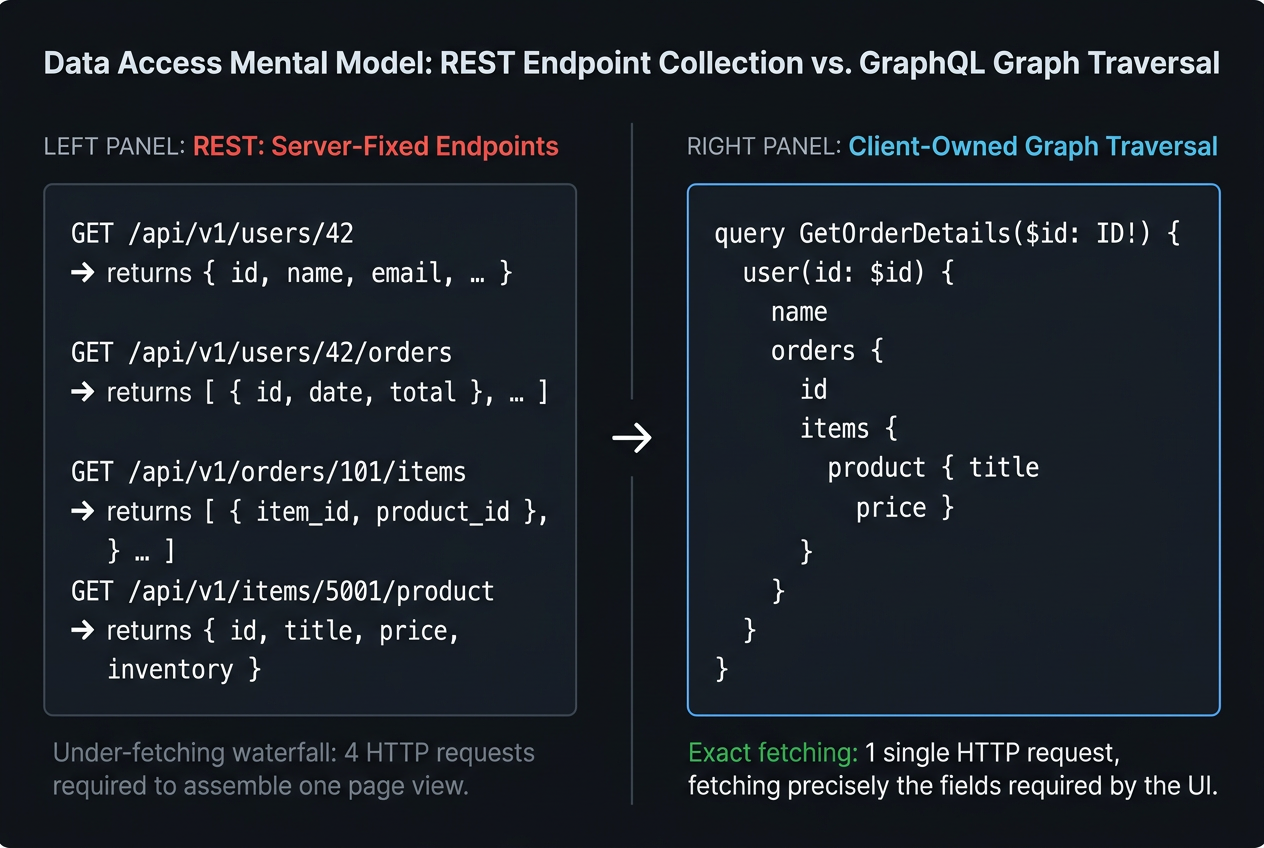
The traversal depth is a client decision. A mobile app needing only user.name sends one field. A dashboard needing the full order breakdown sends the full traversal. The server schema stays the same — only the query changes.
3. Reading SDL as a Frontend Consumer
The Schema Definition Language is the server's formal contract. As a frontend engineer you don't write SDL — but you read it constantly to know what's queryable and what your TypeScript types will look like.
3.1 Scalar Types — What They Mean for Your TypeScript
ID in GraphQL always becomes string in TypeScript, even when the underlying database uses integers. Never coerce a GraphQL ID to number — sorting and comparison will silently break.
3.2 Object Types — Traversal Targets
Every object type is a node you can traverse to. If the schema has User.orders: [Order!]!, you can traverse from any User to its Order nodes. If the schema doesn't have that edge, you can't traverse there regardless of what the database supports.
3.3 Interfaces and Unions — Polymorphic Returns
When a field returns an interface or union, you query the shared fields directly and use inline fragments for type-specific fields:
Unlike TypeScript's structural typing, GraphQL uses __resolveType at runtime to determine which concrete type each result is. Always include __typename in union/interface queries — Apollo Client uses it for normalized cache keying.
3.4 The Root Types as Operational Contracts
Query fields are the starting nodes for read traversals. Mutation fields perform writes and return the updated nodes for cache reconciliation. Subscription fields open persistent channels that push updates as the server state changes.
4. Production Query Discipline
Ad-hoc queries — strings you compose manually, field names you type from memory — are the first source of production GraphQL bugs. Production operations need three disciplines.
4.1 Variables — Parameterized Operations
String-interpolated queries cannot be hashed by Automatic Persisted Queries (APQ) because the query string changes with every variable value. Always use GraphQL variables.
4.2 Named Operations — The Traceability Contract
Every operation in production must have a PascalCase name:
The operation name is the trace correlation key that links a user-visible UI error to the exact server resolver that failed. Anonymous operations aggregate all metrics into one unlabeled bucket.
4.3 Fragments — The Component Data Contract
Fragments are named, reusable field selections. They are covered in depth in Part 4 — but introduce them now as the mechanism that separates ad-hoc queries from production operations:
A fragment is a typed data contract between a component and the graph. When UserCard renders, its data contract is the fragment — not a prop shape, not a runtime guess.
5. The Type-Safety Pipeline
The single most important productivity tool in a GraphQL frontend codebase is automatic type generation. Without it, every data.user.name access is an untyped runtime gamble.
5.1 SDL → Codegen → TypeScript
@graphql-codegen/cli v5 reads the server's schema (via introspection or SDL file) and generates TypeScript types for every operation document in your codebase:
After running graphql-codegen, every query gets a typed DocumentNode:
Run graphql-codegen --watch in development. Every time you save a query file, types regenerate. If a field you're querying is removed from the schema, the TypeScript compile fails — the schema change becomes a compile error, not a runtime surprise.
5.2 Apollo Sandbox for Schema Exploration
Apollo Sandbox (https://studio.apollographql.com/sandbox) is the browser-based schema explorer and query IDE that replaced Apollo Playground. It has:
- Full SDL browser with search
- Query autocomplete and validation against the live schema
- Operation history and sharing
- No installation required
Use it as the starting point for every new query — explore the schema, build the query, validate it, then paste the final operation into your codebase for codegen to type.
5.3 The GraphQL over HTTP Spec
The IETF-standardized application/graphql-response+json Content-Type changes one critical client behavior: HTTP 200 no longer means success. A GraphQL response with HTTP 200 + an errors array is a partial failure. The spec formalizes this by distinguishing data (partial result) from errors (what failed).
This is covered fully in Part 6 (Error Handling) — but note it here: if your error handler checks response.ok, it is wrong for GraphQL.
Summary
| Concept | Rule |
|---|---|
| Graph mental model | A GraphQL query is a typed traversal of a data graph, not a URL with parameters — this distinction changes every query design decision you make. |
| Schema as contract | The schema is the contract; client and server teams can evolve independently only if both treat breaking schema changes as breaking API changes. |
| Over/under-fetching | Over-fetching and under-fetching are symptoms of the server owning the response shape — GraphQL transfers that ownership to the client. |
| Type-safety pipeline | @graphql-codegen/cli v5 makes the SDL the single source of TypeScript truth; any operation type written by hand is a contract violation. |
| Cost/benefit | GraphQL earns its cost (schema registry, normalized cache complexity, query planning) only when the data model is a genuine graph and teams need independent schema evolution. |
What's Next
In Part 2, we go inside the InMemoryCache — the flat-key replica that stores every entity your queries return. Understanding the normalization model is what separates engineers who debug cache bugs in minutes from those who spend two days on them.
→ The Normalized Cache: Your Client's Replica of the Server Graph
This article was developed with AI-assisted deep search, specification cross-referencing, and technical research synthesis.