Siddhant Deval
Siddhant Deval
backend14 min read

Service-to-Service Communication: Synchronous vs Asynchronous, REST, gRPC & Event-Driven Patterns

Synchronous service-to-service calls create temporal coupling that propagates failures transitively across an entire call chain. Learn how to derive the correct communication style — REST, gRPC, or async events — from the latency, consistency, and failure-isolation requirements of each interaction.

Service-to-Service Communication: Synchronous vs Asynchronous, REST, gRPC & Event-Driven Patterns

At scale, the question is never whether your service will fail — it's whether a failure in one component silently poisons the rest. The choice of communication primitive between bounded contexts is the first place that principle becomes concrete. Most teams default to REST for everything, wire services into synchronous call chains three or four hops deep, and then discover that a single slow database query in a downstream service — one they don't even own — is adding 800ms to their checkout P99.

Architectural Note

Series positioning: This is Part 2 of the Distributed Architecture & System Design series. It builds on the domain boundaries established in Part 1: The Modular Monolith to Microservices Transition and examines how services communicate: comparing synchronous REST, high-performance binary gRPC, and asynchronous event streams before diving into Kafka internals in Part 3.


1. The Synchronous Coupling Hazard

TYPESCRIPT
// ❌ Synchronous call chain — three hops, three failure surfaces, one user wait
async function placeOrder(req: PlaceOrderRequest): Promise<Order> {
  const product     = await catalogClient.getProduct(req.productId)   // Hop 1: +40ms
  const reservation = await inventoryClient.reserve(req.productId, req.quantity) // Hop 2: +60ms
  const charge      = await paymentClient.charge(req.userId, product.priceCents) // Hop 3: +200ms
  return createOrder({ product, reservation, charge })
  // Total latency = SUM of all hops = 300ms minimum, before your own logic
  // If payment provider spikes to 10s → user waits 10s → connection held open
}
Performance / Safety Warning

In a synchronous call chain of depth N, tail latency is bounded by the SUM of each service's latency, not the maximum. If any one downstream service spikes, the user-facing P99 spikes proportionally.
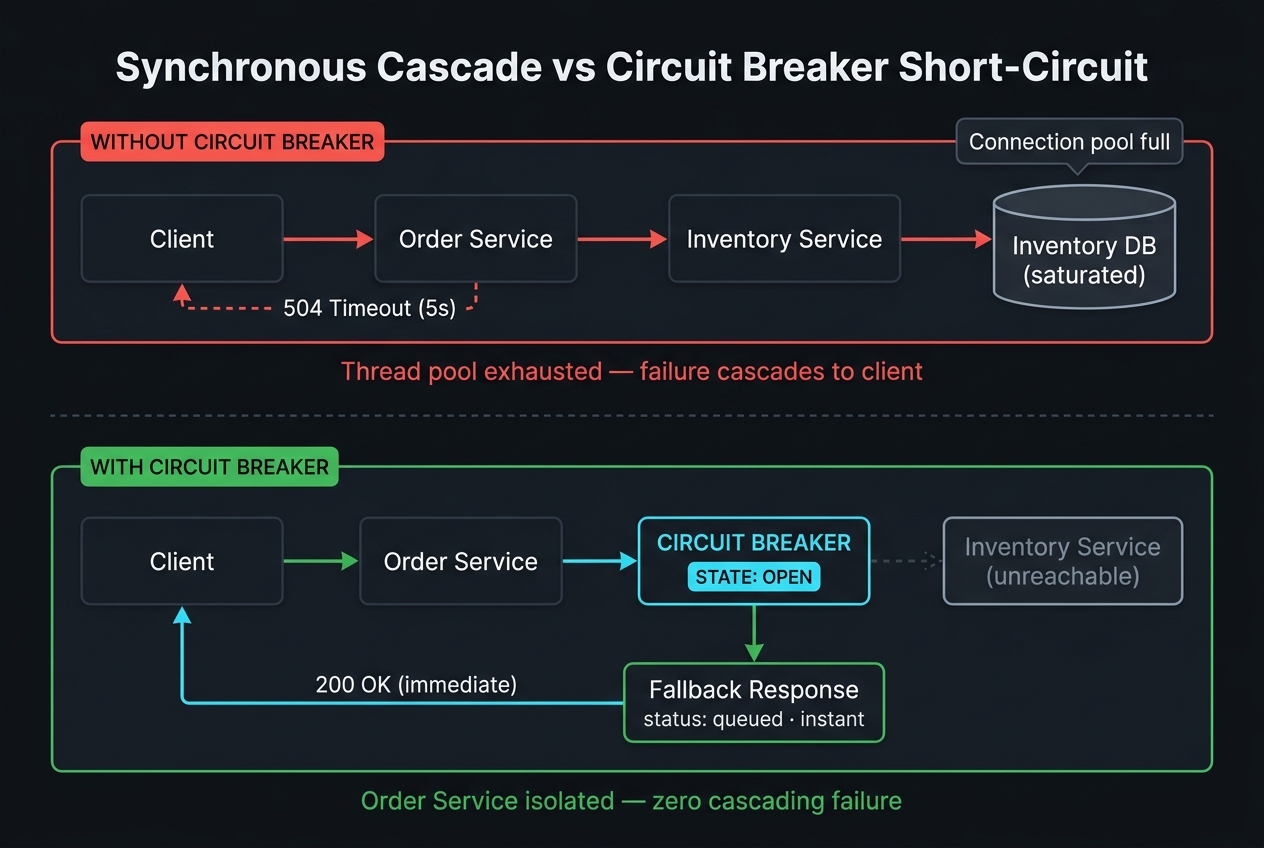
Cascading failure in synchronous call chain showing depth-4 timeout exhausting API gateway thread pool (left) versus circuit breaker fast-failing with cached fallback (right).
Cascading failure in synchronous call chain showing depth-4 timeout exhausting API gateway thread pool (left) versus circuit breaker fast-failing with cached…

1.1 Cascading Failure Sequence


2. Circuit Breakers

The circuit breaker pattern monitors downstream call failure rates and short-circuits calls to unhealthy dependencies before thread pool exhaustion occurs.

2.1 State Machine

TYPESCRIPT
// ✅ Circuit breaker with fallback — isolates failure without blocking threads
import CircuitBreaker from 'opossum'

const inventoryBreaker = new CircuitBreaker(
  (sku: string, qty: number) => inventoryClient.reserve(sku, qty),
  {
    timeout: 3000,
    errorThresholdPercentage: 50,
    resetTimeout: 30_000,
    volumeThreshold: 5,
  }
)

inventoryBreaker.fallback((sku, qty) => ({
  status: 'queued',
  message: 'Inventory service temporarily unavailable. Your order will be confirmed shortly.'
}))

const reservation = await inventoryBreaker.fire('SKU-001', 2)

2.2 Per-Hop Timeout Budgets

TYPESCRIPT
// ✅ Total SLA budget: 800ms — split explicitly across hops
const catalog   = await catalogClient.getProduct(productId,  { timeout: 150 })
const inventory = await inventoryClient.reserve(sku, qty,    { timeout: 200 })
const payment   = await paymentClient.charge(userId, amount, { timeout: 400 })
// Remaining 50ms: handler logic + network overhead

3. REST API Best Practices at Scale

3.1 Idempotency Keys

A network failure after the payment service processes a charge but before it returns a response leaves the order service uncertain — was the charge successful? Without idempotency, a retry doubles the charge.

TYPESCRIPT
// ✅ Idempotency key on all non-idempotent operations
const chargeResult = await paymentClient.charge({
  userId,
  amountCents: 4999,
  idempotencyKey: `order-${orderId}-charge`, // deterministic, stable across retries
})
// First call: processes charge, stores result keyed on idempotencyKey
// Subsequent retries: returns stored result — no double-charge
SQL
-- payment-service: idempotency deduplication table
CREATE TABLE idempotency_cache (
  idempotency_key TEXT PRIMARY KEY,
  response_body   JSONB NOT NULL,
  created_at      TIMESTAMPTZ DEFAULT now(),
  expires_at      TIMESTAMPTZ -- 24–48h TTL
);

3.2 Conditional Requests

TYPESCRIPT
// ✅ ETag-based conditional updates prevent lost writes under concurrent modification
// GET /inventory/SKU-001 → ETag: "W/\"abc123\""
const response = await inventoryClient.updateStock('SKU-001', { quantityOnHand: 35 }, {
  headers: { 'If-Match': '"W/\\"abc123\\""' }
})
// 412 Precondition Failed if another request modified the resource concurrently

4. gRPC & Protocol Buffers

4.1 The Service Contract

PROTOBUF
syntax = "proto3";
package inventory.v1;

service InventoryService {
  rpc GetStock (GetStockRequest)  returns (StockResponse);
  rpc Reserve  (ReserveRequest)   returns (ReservationResponse);
  rpc Watch    (WatchRequest)     returns (stream StockEvent);
}

message StockResponse {
  string sku              = 1; // field numbers are permanent — never reuse
  int32  quantity_on_hand = 2;
  int32  reserved_count   = 3;
  // New fields always added at end with new numbers — backward compatible
}
Crucial Requirement

Protobuf field numbers are permanent. Reusing a field number for a different type is a binary-breaking change that corrupts serialized data in deployed clients silently.

4.2 gRPC vs REST Tradeoff Matrix

Criterion REST + JSON gRPC + Protobuf
Payload size Verbose (~3–10× larger) Compact binary encoding
Serialization speed JSON parse is CPU-intensive Binary decode ~5–10× faster
Streaming support Polling or WebSocket Native server/client/bi-directional streaming
Schema enforcement Optional (OpenAPI, Zod) Mandatory — .proto is the contract
Browser compatibility Native Requires gRPC-Web proxy
Primary use case Public APIs, browser-facing Internal service mesh, high-throughput

5. Communication Pattern Decision Framework

5.1 Three Communication Intents

Intent Pattern Coupling Consistency
Request/Reply REST, gRPC Synchronous — caller blocks Strong
Fire-and-forget Message queue (one-way) Asynchronous Eventual
Event Notification Kafka, event bus Asynchronous Eventual

5.2 Choosing the Right Primitive

5.3 Events Describe Facts, Not Commands

TYPESCRIPT
// ❌ Synchronous coupling disguised as an event
await eventBus.publish('SendConfirmationEmail', { orderId, userId })
// This is a command — it demands that the notification service act

// ✅ Fact-based event — notification service decides independently how to react
await eventBus.publish('order.placed', {
  orderId: order.id,
  userId: order.userId,
  totalCents: order.totalCents,
  placedAt: order.createdAt.toISOString(),
})
// Notification failure does NOT affect order placement — domains are isolated
Mental Model Check

Events describe facts that happened ("OrderPlaced"), not commands that demand action ("SendConfirmationEmail"). A fact belongs to the producer. A command couples the producer to the consumer's implementation. When your event names sound like commands, you have not decoupled — you have just moved the coupling from a function call to a message.
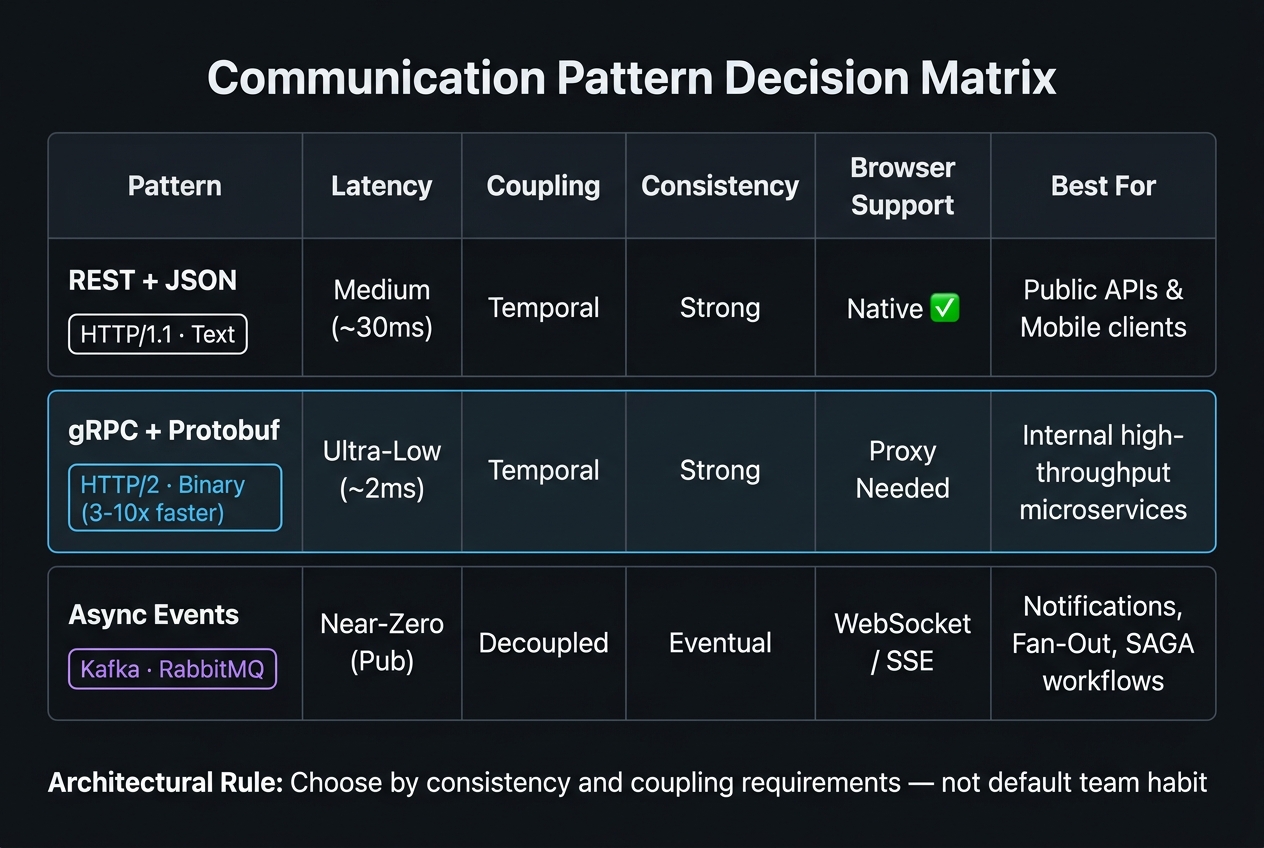
Comparison matrix evaluating REST, gRPC, and Asynchronous Events across protocol, serialization, coupling, latency, and primary use case.

6. Backpressure & Service Discovery

6.1 Consumer-Side Rate Limiting

TYPESCRIPT
// ✅ Explicit consumer rate limiting — prevents overwhelming downstream dependencies
await consumer.run({
  partitionsConsumedConcurrently: 3,
  eachMessage: async ({ message }) => {
    await rateLimiter.consume(1)  // token bucket: max 100 messages/s
    await emailClient.sendOrderConfirmation(event.userId, event.orderId)
  },
})

6.2 Health-Check Driven Routing

TYPESCRIPT
// ✅ Kubernetes readiness probe gates traffic — unhealthy pods removed automatically
app.get('/health/ready', async (_, res) => {
  const dbOk = await db.ping().catch(() => false)
  res.status(dbOk ? 200 : 503).json({ db: dbOk })
})
// kubelet calls /health/ready every 10s
// 503 → pod removed from Service endpoints → no traffic routed until recovery

Summary

Architectural Concern Production Rule
Synchronous Chain Latency Total latency = sum of all hops; a slow downstream adds directly to user-facing P99.
Circuit Breakers Trips on high failure rates; returns fallback immediately; prevents thread pool exhaustion.
Idempotency Keys Every non-idempotent call must carry a client-generated key; server deduplicates on retry.
gRPC vs REST gRPC for internal high-throughput binary paths; REST for public or browser-facing APIs.
Event-Driven Decoupling Emit facts, not commands; consumer failure is isolated; accept eventual consistency explicitly.

What's Next

Now that we have evaluated service communication patterns, Part 3: Apache Kafka Deep Dive explores the mechanics of Kafka's append-only commit log, partition topologies, consumer group rebalancing, and exactly-once delivery guarantees.

Research & Synthesis Note

This article was developed with AI-assisted deep search, specification cross-referencing, and technical research synthesis.

#Microservices#gRPC#REST#Event-Driven#Distributed Systems
Siddhant Deval

Written by Siddhant Deval

Senior Full-Stack Engineer building high-scale architectures, browser performance engineering systems, and SaaS platforms.