Siddhant Deval
Siddhant Deval
backend15 min read

RabbitMQ & AMQP Messaging Topologies: Exchanges, Queues, Routing & Delivery Guarantees

RabbitMQ's strength is flexible, broker-mediated routing logic — but this flexibility is only safe when delivery guarantees, queue durability, and dead-letter handling are configured explicitly rather than accepted as defaults. Master AMQP exchange types, quorum queues, publisher confirms, and the RabbitMQ vs Kafka decision matrix.

RabbitMQ & AMQP Messaging Topologies: Exchanges, Queues, Routing & Delivery Guarantees

Every boundary is a failure isolation decision — and the failure modes of a message broker are among the most invisible bugs in production. Teams adopt RabbitMQ for its flexible routing, set durable: false on queues because "it's just configuration", leave autoAck: true because "it's simpler", and then spend hours in a post-mortem the first time their broker restarts and discovers that 40,000 unacknowledged messages — all transient — have vanished permanently. Understanding AMQP is understanding what happens to a message at every hop and making every guarantee explicit.

Architectural Note

Series positioning: This is Part 4 of the Distributed Architecture & System Design series. Following Part 3: Apache Kafka Deep Dive, it examines AMQP broker-mediated routing, exchanges, quorum queues, and dead-letter pipelines, completing the transport foundation before we tackle CQRS in Part 5: Separating Write Models from Read Projections.


1. The AMQP Protocol Model

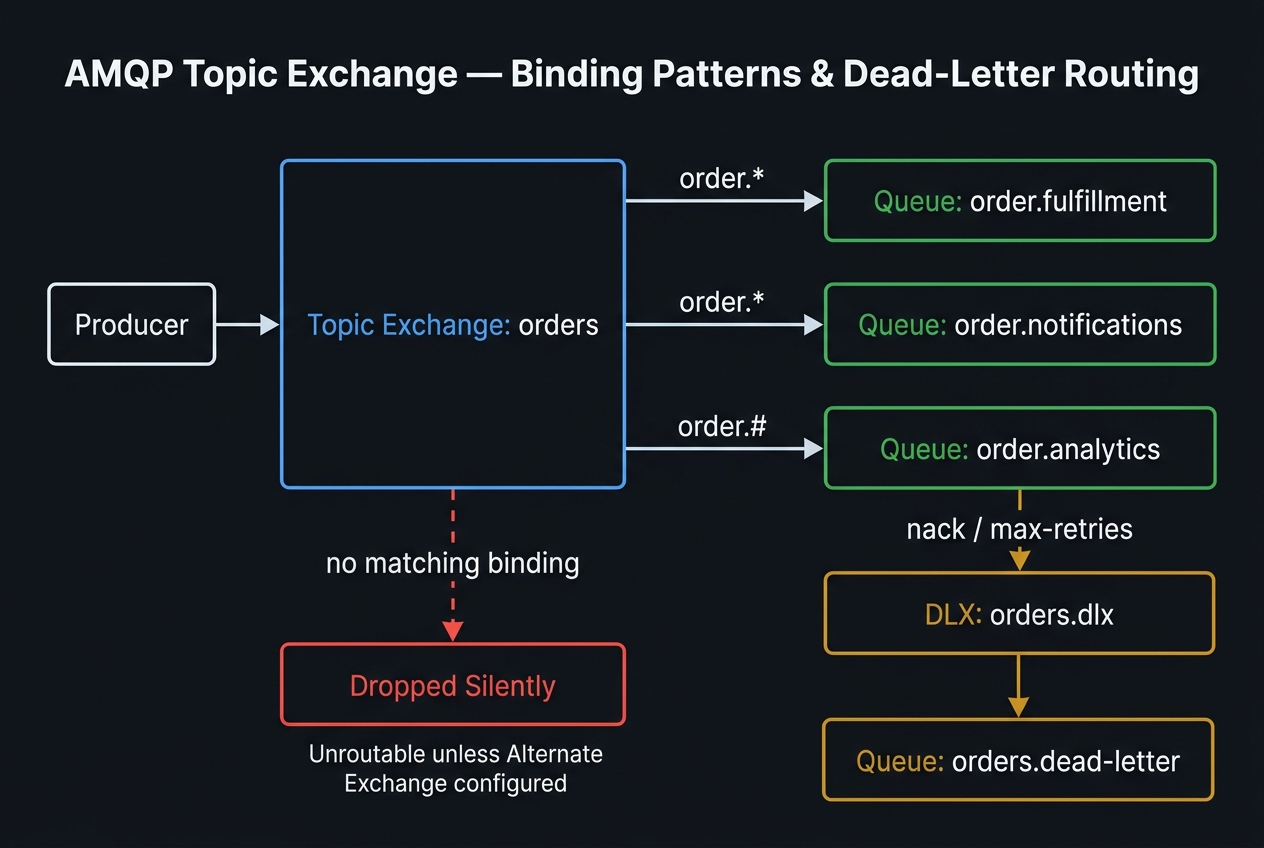
AMQP defines a routing layer between producers and consumers that does not exist in Kafka: the exchange. Exchanges do not store messages — they route based on type and binding keys.

Crucial Requirement

Publishing to an exchange with no matching binding silently drops the message unless an Alternate Exchange is configured. This is the most common silent data loss scenario in RabbitMQ deployments.

1.1 Channel Model

TYPESCRIPT
// ✅ One connection per process; one channel per consumer thread
const connection = await amqplib.connect('amqp://rabbitmq:5672')
const channel    = await connection.createChannel()

await channel.assertExchange('orders', 'topic', { durable: true })
await channel.assertQueue('order.fulfillment', {
  durable: true,
  arguments: {
    'x-dead-letter-exchange': 'orders.dlx',
    'x-message-ttl': 86_400_000,
    'x-queue-type': 'quorum',
  }
})
await channel.bindQueue('order.fulfillment', 'orders', 'order.placed')

2. Exchange Types & Routing Topologies

2.1 The Four Exchange Types

Type Routing Logic Use Case
Direct Exact match on routingKey Task queues, point-to-point
Fanout Broadcast — every bound queue receives every message Cache invalidation, pub/sub
Topic Wildcard matching (* = one word, # = zero or more) Category-based event routing
Headers Route on header key-value pairs, not routing key Complex attribute-based routing
RabbitMQ AMQP exchange routing topologies showing direct exact binding, fanout broadcast, and topic pattern matching with wildcard routing keys delivering messages to dedicated worker queues.
RabbitMQ AMQP exchange routing topologies showing direct exact binding, fanout broadcast, and topic pattern matching with wildcard routing keys delivering me…
TYPESCRIPT
// ✅ Topic exchange routing patterns
channel.publish('orders', 'order.placed.uk',    Buffer.from(...)) // UK placement
channel.publish('orders', 'order.placed.us',    Buffer.from(...)) // US placement
channel.publish('orders', 'order.cancelled.uk', Buffer.from(...)) // UK cancellation

// Bindings:
await channel.bindQueue('fulfillment-all',   'orders', 'order.#')        // all order events
await channel.bindQueue('fulfillment-placed','orders', 'order.placed.*') // placed only
await channel.bindQueue('fulfillment-uk',    'orders', '*.*.uk')          // UK only

2.2 Fanout for Cache Invalidation

TYPESCRIPT
// ✅ Fanout exchange — every bound service receives the message simultaneously
await channel.assertExchange('cache.invalidations', 'fanout', { durable: true })

// Each service creates its own exclusive queue and binds to the fanout
const { queue } = await channel.assertQueue('', { exclusive: true, autoDelete: true })
await channel.bindQueue(queue, 'cache.invalidations', '') // routing key ignored for fanout

channel.consume(queue, (msg) => {
  if (!msg) return
  const { entityType, entityId } = JSON.parse(msg.content.toString())
  localCache.invalidate(entityType, entityId)
  channel.ack(msg)
})

3. Queue Durability: The Durability Triad

For a message to survive a broker restart, all three must be configured:

TYPESCRIPT
// ❌ Common mistake — queue is durable but message is not
await channel.assertQueue('orders', { durable: true })
channel.sendToQueue('orders', Buffer.from(JSON.stringify(order)), { persistent: false })
// → message LOST on broker restart even though queue survives

// ✅ All three durable
await channel.assertExchange('orders', 'topic', { durable: true })   // (1) durable exchange
await channel.assertQueue('order.fulfillment', { durable: true })    // (2) durable queue
channel.publish('orders', 'order.placed',
  Buffer.from(JSON.stringify(order)),
  { persistent: true }  // (3) persistent message (deliveryMode: 2)
)

3.1 Quorum Queues vs Classic Mirrored Queues

Property Classic Mirrored (deprecated) Quorum Queues (recommended)
Replication Async mirroring — may lose data on failover Raft consensus — majority quorum required
Ordering Per-node Global
Poison message handling Requires DLX Built-in x-delivery-limit
Recommended since Legacy — avoid for new queues RabbitMQ 3.8+
TYPESCRIPT
// ✅ Quorum queue declaration
await channel.assertQueue('order.fulfillment', {
  durable: true,
  arguments: {
    'x-queue-type': 'quorum',
    'x-delivery-limit': 3,
    'x-dead-letter-exchange': 'orders.dlx',
  }
})

4. Message Acknowledgement & Prefetch

4.1 Manual Acknowledgement

TYPESCRIPT
// ❌ Auto-ACK — message deleted from queue on delivery, BEFORE your code processes it
channel.consume('order.fulfillment', async (msg) => {
  if (!msg) return
  await fulfillmentService.ship(JSON.parse(msg.content.toString()))
  // If ship() throws: message PERMANENTLY LOST — already ACK'd on delivery
}, { noAck: true })

// ✅ Manual ACK — message stays in queue until explicitly acknowledged
channel.consume('order.fulfillment', async (msg) => {
  if (!msg) return
  try {
    await fulfillmentService.ship(JSON.parse(msg.content.toString()))
    channel.ack(msg)
  } catch (err) {
    const requeue = isTransientError(err)
    channel.nack(msg, false, requeue)
    // requeue=true  → returns to queue head for redelivery
    // requeue=false → routes to DLX if configured, or discards
  }
}, { noAck: false })

4.2 Prefetch Count

TYPESCRIPT
// ✅ Limit unacknowledged messages per consumer — prevents one slow consumer hoarding all work
await channel.prefetch(10)
// Consumer holds at most 10 unacked messages; messages 11+ remain in queue for other consumers
Pro Tip & Optimization

Start with prefetch(1) for maximum fairness. Increase to 5–20 in production for throughput overlap — each consumer processes one message while the next is being delivered. Never leave unbounded: one slow consumer will drain the entire queue.


5. Dead-Letter Exchanges & Retry Topologies

5.1 DLX Configuration

TYPESCRIPT
// ✅ Step 1: Declare the DLX and its dead-letter queue
await channel.assertExchange('orders.dlx', 'topic', { durable: true })
await channel.assertQueue('orders.dead-letter', {
  durable: true,
  arguments: { 'x-queue-type': 'quorum' }
})
await channel.bindQueue('orders.dead-letter', 'orders.dlx', '#')

// ✅ Step 2: Main queue points at DLX for failures
await channel.assertQueue('order.fulfillment', {
  durable: true,
  arguments: {
    'x-queue-type': 'quorum',
    'x-dead-letter-exchange': 'orders.dlx',
    'x-dead-letter-routing-key': 'order.fulfillment.failed',
    'x-message-ttl': 300_000,   // expire unprocessed after 5min
    'x-delivery-limit': 3,      // DLX after 3 failed attempts
  }
})

5.2 Exponential Backoff Retry Topology
Dead-letter exchange and retry queue architecture showing failed consumer rejection without requeue, dead-letter routing to delay queue, and TTL-based retry loop before quarantine.
Dead-letter exchange and retry queue architecture showing failed consumer rejection without requeue, dead-letter routing to delay queue, and TTL-based retry…

6. Publisher Confirms

TYPESCRIPT
// ✅ Publisher confirms — broker guarantees message written to disk before ack
await channel.confirmSelect()

channel.publish('orders', 'order.placed',
  Buffer.from(JSON.stringify(order)),
  { persistent: true }
)
await channel.waitForConfirms()
// After this line: message guaranteed to survive broker restart and leader failover
Performance / Safety Warning

channel.publish() returning true means the channel write buffer accepted the message — it does NOT mean the broker received it. Only waitForConfirms() provides an end-to-end durability guarantee.


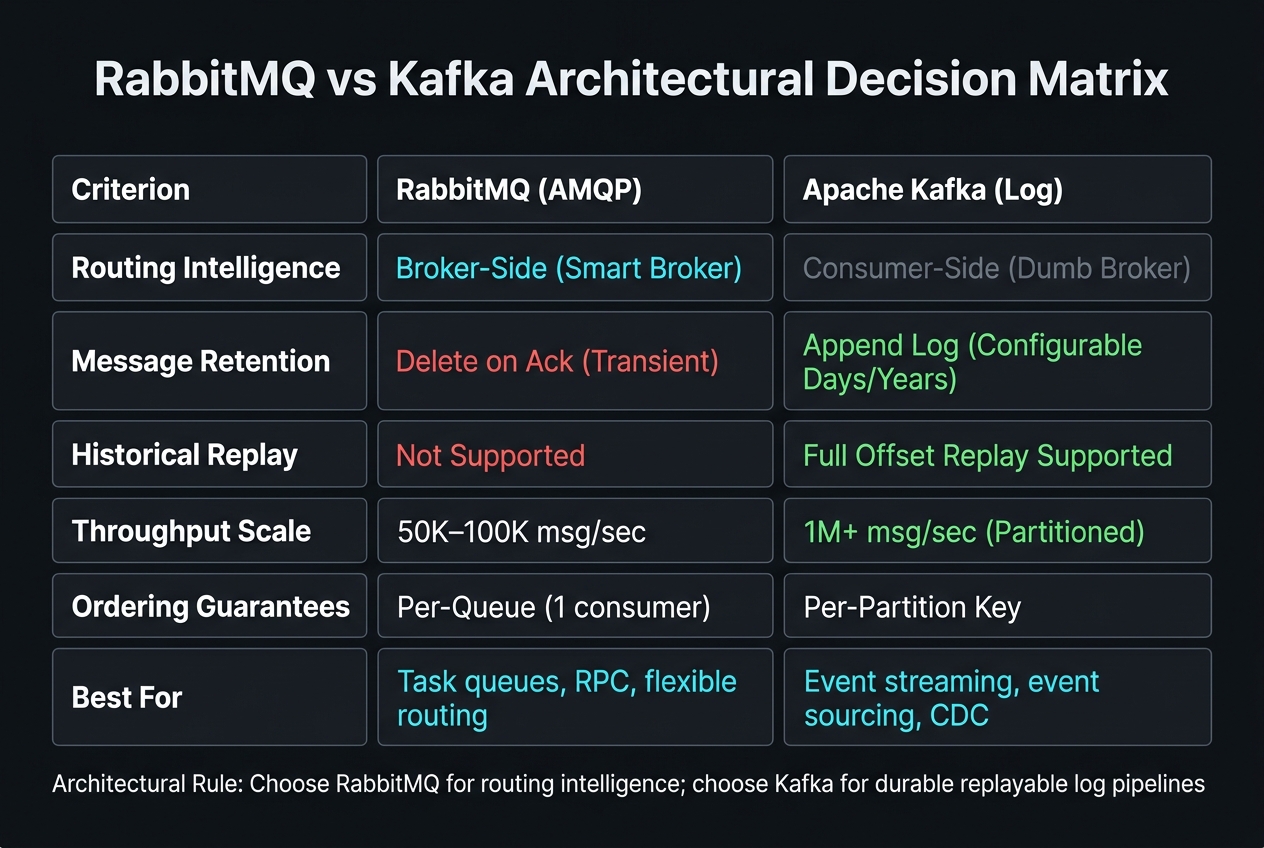
7. RabbitMQ vs Kafka Decision Matrix

Criterion RabbitMQ Kafka
Routing intelligence Broker-side (exchange/binding logic) Consumer-side (consumer filters in code)
Message retention Consumed messages deleted Configurable retention — messages persist after consumption
Replay Not supported Full replay from any offset, any consumer group
Throughput ~50K–100K msg/s per node ~1M+ msg/s per node
Ordering Per-queue (single consumer) Per-partition (within consumer group)
Best for Task queues, work distribution, flexible routing Event streaming, event sourcing, CDC pipelines
Mental Model Check

Choose RabbitMQ when the broker needs to make routing decisions — different consumers need different subsets of messages based on content or attributes. Choose Kafka when consumers need to process the same events independently, replay history, or build read models from an ordered event stream.


Summary

Architectural Concern Production Rule
Exchange Routing No matching binding = silent message drop — always configure an alternate exchange.
Quorum Queues Use quorum (not classic mirrors) for HA; Raft majority prevents loss on node failure.
Prefetch Count Bound per-consumer backlog (prefetch = 1); never leave unbounded to avoid worker starvation.
Dead-Letter Exchanges DLX captures nack'd, expired, and delivery-limit-exceeded messages; without DLX, failures are silently discarded.
RabbitMQ vs Kafka RabbitMQ = smart broker routing / task queues; Kafka = durable replayable log / event streaming.

What's Next

Now that our messaging transport layer is established, Part 5: CQRS Architecture explores the separation of authoritative write models from query-optimized read projections, examining aggregate invariants and the eventual consistency window.

Research & Synthesis Note

This article was developed with AI-assisted deep search, specification cross-referencing, and technical research synthesis.

#RabbitMQ#AMQP#Messaging#Event-Driven#Backend
Siddhant Deval

Written by Siddhant Deval

Senior Full-Stack Engineer building high-scale architectures, browser performance engineering systems, and SaaS platforms.