Materialized Views & Event-Driven Projections: Denormalized State, Rebuild Strategies & Consistency Models
Materialized views trade write-time normalization for read-time query performance, but their consistency model — synchronous inline vs asynchronous event-driven — must be chosen explicitly based on the staleness tolerance of each consumer. Learn multi-source projections, blue-green rebuild strategies, and projection lag observability.
Distributed Architecture & System Design
Materialized Views & Event-Driven Projections: Denormalized State, Rebuild Strategies & Consistency Models
Every boundary is a failure isolation decision — and one of the most consequential design decisions in a read-heavy distributed system is where you place the boundary between normalization and denormalization. A normalized database model is correct by construction: no redundancy, no anomalies. It is also catastrophically slow for any query that requires joining more than two or three tables under high read traffic. Materialized views resolve this by pre-computing and storing query results at write time — but the consistency model you choose for that pre-computation determines whether your read model silently serves stale data, or tightly couples read and write throughput in ways that defeat the entire purpose.
Series positioning: This is Part 7 of the Distributed Architecture & System Design series. Expanding on the CQRS and Event Sourcing patterns from Parts 5 and 6, this article examines materialized views, evaluating synchronous in-database projections against asynchronous event streams, zero-downtime blue-green rebuilds, and lag observability before we explore distributed workflows in Part 8: The SAGA Pattern.
1. The JOIN Performance Wall
2. Consistency Models for Materialized Views
The primary design decision for any materialized view is when the write to the view occurs relative to the originating write.
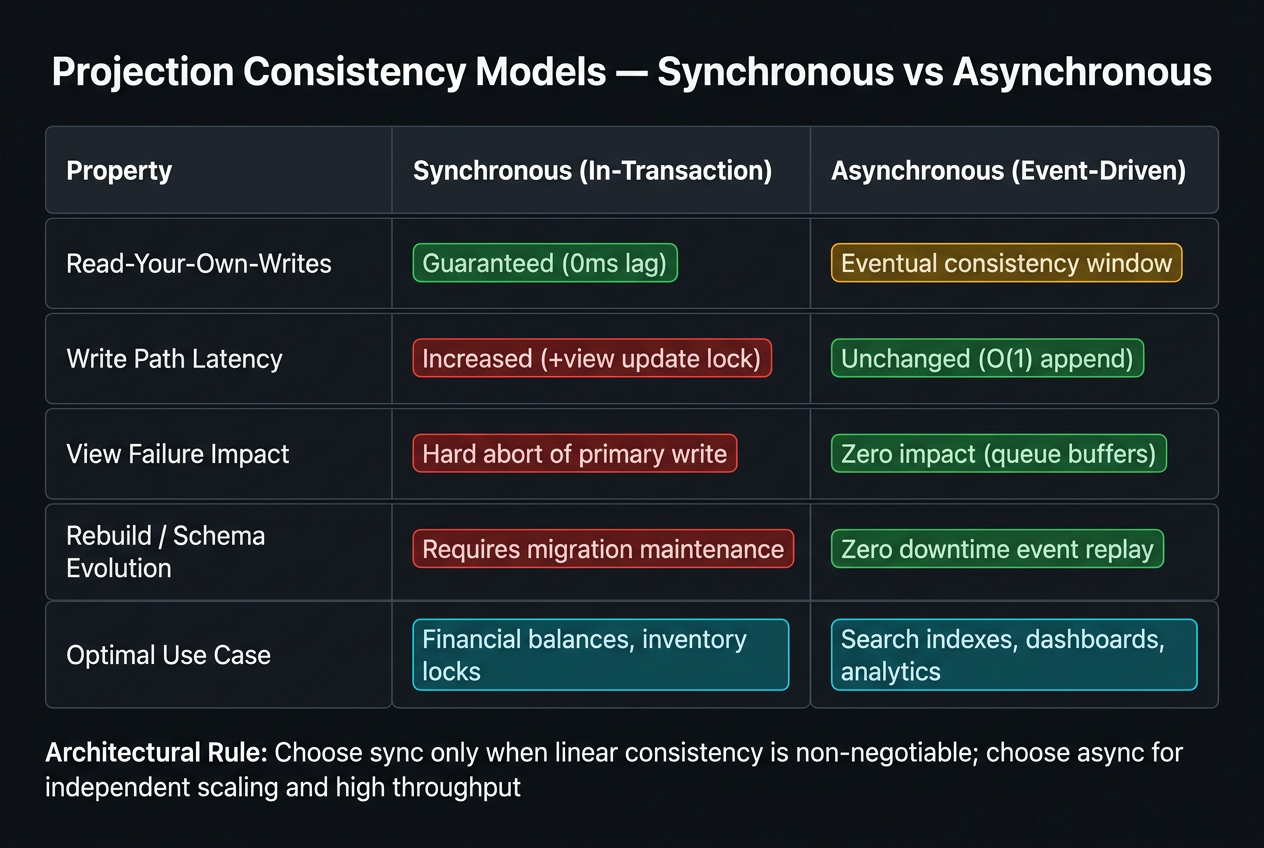
2.1 Synchronous Projection (In-Transaction)
2.2 Asynchronous Projection (Event-Driven)
3. Multi-Source Projections
A projection that joins events from multiple topics must handle out-of-order arrival gracefully.
Multi-source projections must be designed to tolerate partial state — some source events may not have arrived yet when the projection is queried. Every field in the projection must have a defined default value (0, null, empty array) that is valid in the absence of the source event.
4. Blue-Green Projection Rebuilds
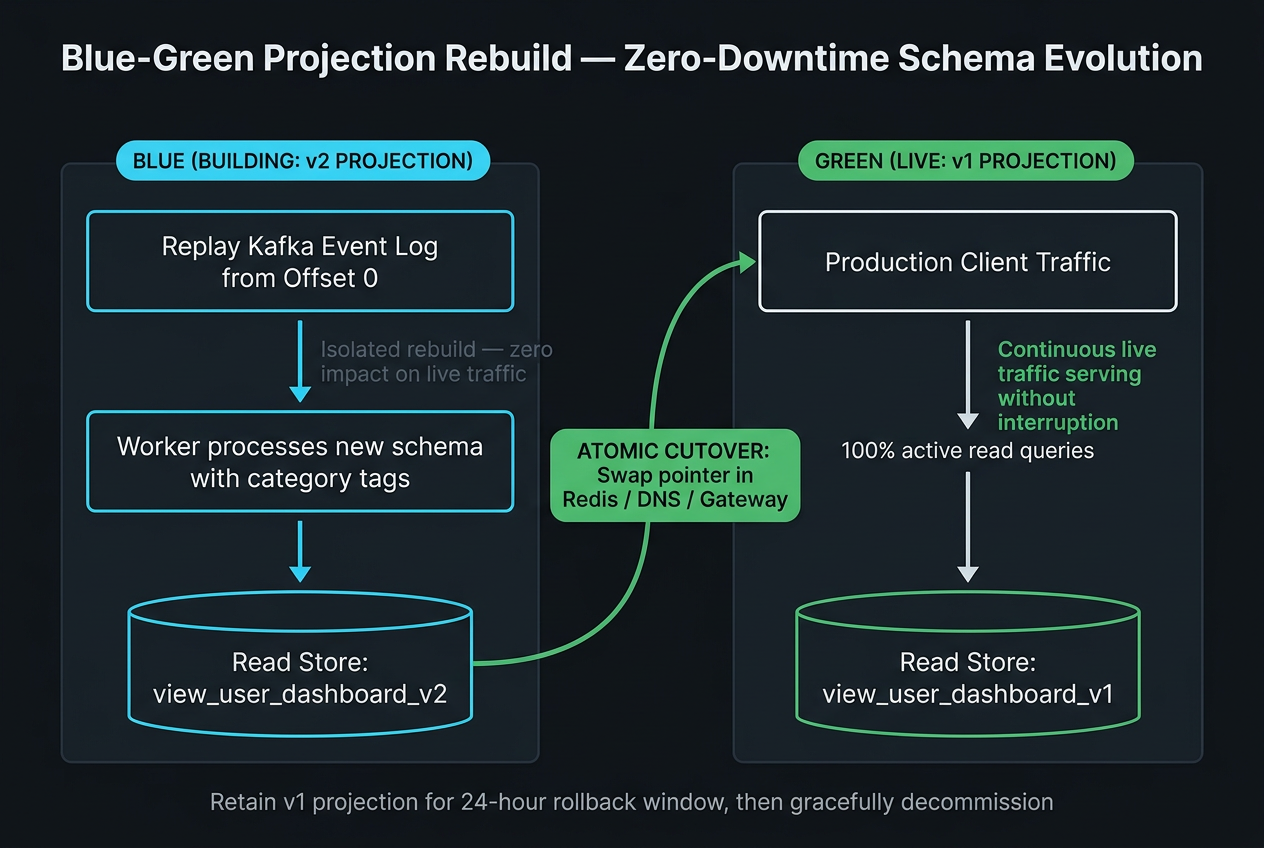
Adding a new field to an existing projection (e.g., adding categories_purchased to the user dashboard) requires replaying the full event log. A blue-green rebuild allows this without downtime:
5. Projection Lag Observability
| Lag Threshold | Action |
|---|---|
| < 1,000 messages | Normal — healthy projection pipeline |
| 1,000–10,000 | Warning — projection is falling behind; investigate consumer throughput |
| > 10,000 | Alert — staleness window is growing; add consumer instances or check for poison pills |
| Growing unboundedly | Critical — consumer is stuck; check DLQ and consumer process health |
Summary
| Architectural Concern | Production Rule |
|---|---|
| Materialized Views | Pre-computed at write time; eliminates JOIN overhead at read time; consistency model is the primary decision. |
| Synchronous Projections | Guarantees read-your-own-writes consistency; couples view store availability to the write transaction. |
| Asynchronous Projections | Decouples write throughput from read materialization; introduces explicit eventual consistency window. |
| Multi-Source State Joining | Must tolerate partial state; all fields must have defined defaults for absent source events. |
| Blue-Green Rebuilds | Build new projection version from event log while old version serves traffic; cut over atomically. |
What's Next
Now that we have analyzed projection models and materialized views, Part 8: The SAGA Pattern explores coordinating distributed multi-service workflows without distributed locks, contrasting choreography against orchestration with compensating rollbacks.
This article was developed with AI-assisted deep search, specification cross-referencing, and technical research synthesis.