The Modular Monolith to Microservices Transition: Bounded Contexts, Strangler Fig & Service Contracts
Decomposing a monolith by technical layer produces a distributed monolith — harder to operate than the original, with none of the isolation benefits. Learn how bounded context discovery, strangler fig extraction, and consumer-driven contract testing produce a safe, incremental migration path.
Distributed Architecture & System Design
The Modular Monolith to Microservices Transition: Bounded Contexts, Strangler Fig & Service Contracts
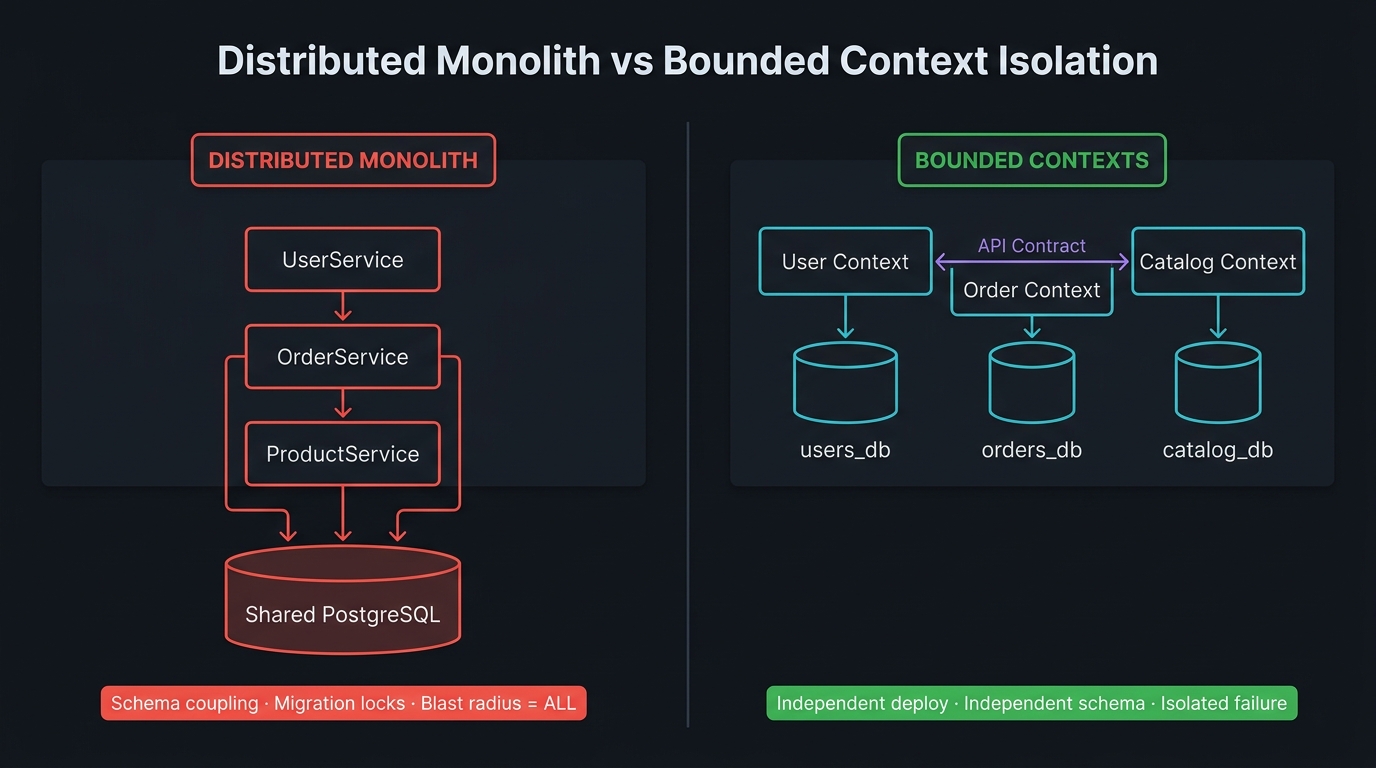
At scale, the question is never whether your service will fail — it's whether a failure in one component silently poisons the rest. Design every boundary, every message, and every transaction as if partial failure is the default, not the exception. This first principle exposes the most dangerous microservices anti-pattern in production today: teams that split a monolith by technical layer — a "UserService", an "OrderService", a "ProductService" — and then wire them all to the same PostgreSQL database. The result is a distributed monolith: every deployment risk is amplified across the network, every schema migration requires team-wide coordination, and a single slow query blocks all three "independent" services simultaneously.
Series positioning: This is Part 1 of the Distributed Architecture & System Design series. It establishes domain boundaries, Bounded Contexts, and the Strangler Fig migration pattern that provide the architectural foundation for service communication (Part 2), messaging brokers (Parts 3–4), CQRS and Event Sourcing (Parts 5–7), and distributed transactions and workflows (Parts 8–9).
1. The Distributed Monolith Anti-Pattern
The canonical failed decomposition looks like this:
This is not three microservices. This is a monolith where the module boundary is a network call. A schema rename in users.billing_address breaks order-service at runtime, not at compile time. A migration lock on the products table blocks order-service queries. The failure blast radius is identical to a monolith — but now you've added serialization overhead and distributed tracing complexity.
1.1 Why Technical Layering Is the Wrong Decomposition Axis
When engineers decompose by technical role ("auth service", "notification service", "data service"), they create services that cannot be deployed independently, cannot fail independently, and cannot evolve independently. These are not domain boundaries — they are implementation details elevated to deployment units.
2. Domain-Driven Design Fundamentals
Before a single service is extracted, you need a map of your domain.
2.1 Bounded Contexts
A bounded context is a semantic boundary within which a specific domain model applies — including its language, its invariants, and its data ownership. The word "product" means different things in different contexts:
| Context | What "Product" Means | Owned Data |
|---|---|---|
| Catalog | Marketing description, images, SEO | name, description, images[], category |
| Inventory | Stock levels, reservations, warehouse location | sku, quantity_on_hand, reserved_count |
| Pricing | Price rules, promotions, currency | base_price_cents, discount_rules[] |
| Shipping | Physical dimensions, weight class | weight_grams, dimensions_cm, is_fragile |
A microservice that encompasses all four concepts has no boundary. Four bounded contexts map to four independent services that communicate via explicit contracts, not shared database tables.
2.2 Context Maps
The Order context holds a product_id reference — a pointer, not a join. It does not own catalog data. If it needs a product name for an order confirmation email, it calls the Catalog API or reads from a pre-materialized projection. It never reaches into the Catalog database directly.
2.3 Subdomains vs Services
| Type | Definition | Decompose? |
|---|---|---|
| Core domain | Your primary competitive differentiator | Yes — maximize team autonomy |
| Supporting subdomain | Necessary but not differentiating (e.g., invoicing) | Maybe — modular monolith may suffice |
| Generic subdomain | Solved problems: auth, notifications, file storage | Use off-the-shelf; do not build |
3. Identifying Service Boundaries
3.1 The Four Coupling Heuristics
| Heuristic | Question | High coupling signal |
|---|---|---|
| Change frequency | How often does this context's logic change independently? | Different release cycles from adjacent contexts |
| Deployment independence | Can this be deployed without coordinating with other teams? | Currently requires a multi-team release window |
| Team ownership | Does a dedicated team own this end-to-end? | Currently shared ownership causing merge conflicts |
| Data ownership | Does this context own its data exclusively? | Currently shares a DB schema with other contexts |
3.2 The "Share Nothing" Principle
Denormalizing at write time (copying the product name into the order record) is intentional and correct. An order placed at a given price must preserve that price forever. The Catalog changing the product name six months later must not rewrite historical order records.
4. The Strangler Fig Pattern
4.1 The Big-Bang Rewrite Problem
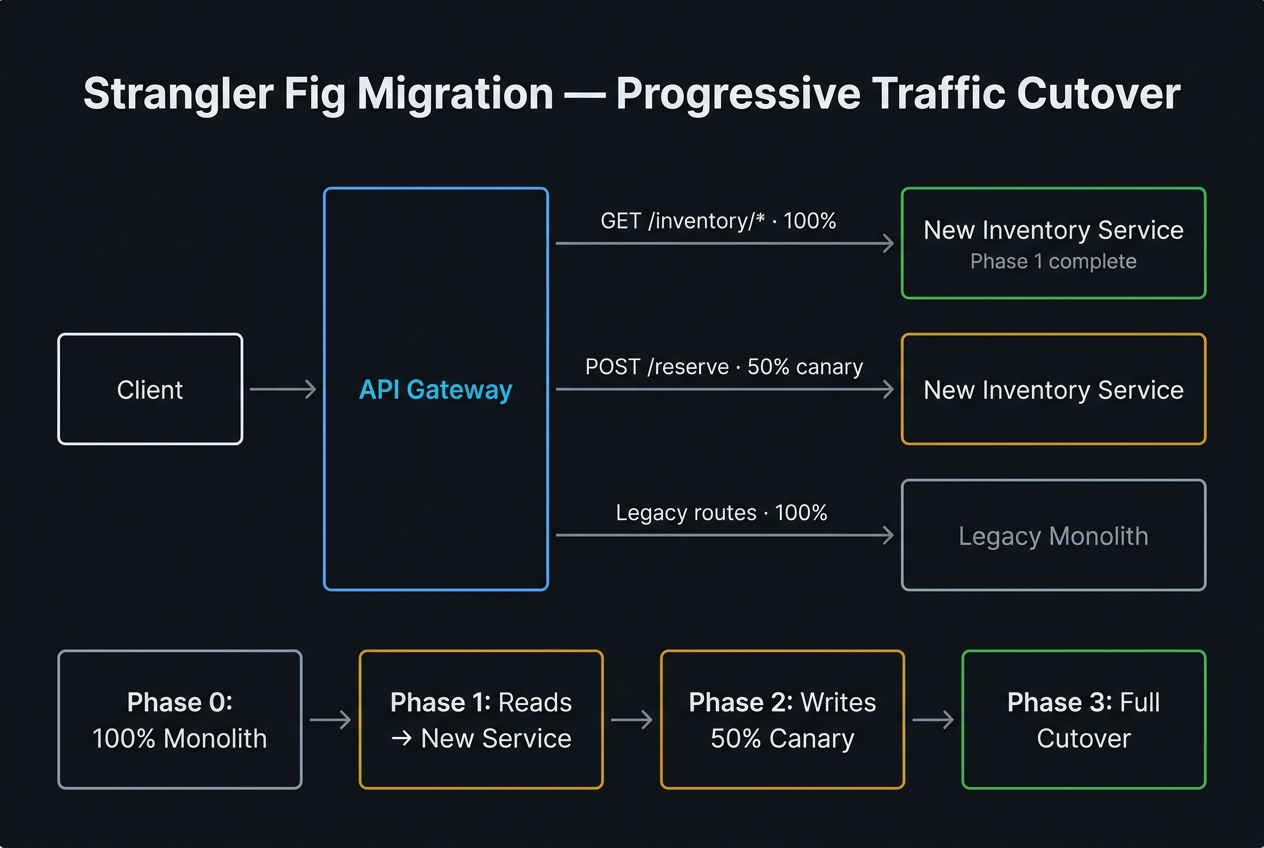
The strangler fig pattern replaces this with incremental, endpoint-by-endpoint migration.
4.2 Implementation: API Gateway Routing
| Migration Phase | Monolith % | New Service % |
|---|---|---|
| Phase 0 — all endpoints | 100% | 0% |
| Phase 1 — read-only endpoints | 0% | 100% |
| Phase 2 — write endpoints canary | 50% | 50% |
| Phase 3 — full cutover | 0% | 100% |
4.3 Anti-Corruption Layers
5. Service Contracts & Consumer-Driven Contract Testing
5.1 How Pact Works
The contract is owned by the consumer (Order Service), not the provider. The provider verifies it can satisfy every consumer contract before merging any API change. Breaking changes cannot be deployed silently.
5.2 API Versioning Rules
| Change Type | Action Required |
|---|---|
| Add new optional response field | No version bump — backward compatible |
| Add new required request parameter | Version bump mandatory |
| Rename existing field | Version bump mandatory |
| Remove existing field | Version bump + deprecation period |
6. Operational Readiness: The 8 Fallacies
| Fallacy | Real-World Consequence | Mitigation |
|---|---|---|
| The network is reliable | TCP connections drop; DNS resolves stale entries | Retry with exponential backoff + jitter |
| Latency is zero | 10ms cross-service call inside a 5-hop chain adds 50ms baseline | Set explicit timeout budgets per call |
| Bandwidth is infinite | High-volume fan-out saturates NICs | Cache aggressively; coalesce requests |
| The network is secure | Service-to-service traffic readable on internal network | mTLS; zero-trust networking |
| Topology doesn't change | Pod restarts, rolling deploys change IP addresses | Service discovery + health-check routing |
| There is one administrator | Multiple teams deploy independently; configs drift | Infrastructure as Code; GitOps |
| Transport cost is zero | Serialization CPU cost non-trivial at scale | Profile; consider Protobuf for hot paths |
| The network is homogeneous | Mixed cloud, on-prem, different MTUs | Test cross-network paths explicitly |
6.1 Minimum Observability Baseline
A well-structured modular monolith with clear module interfaces and no cross-module database queries is a valid final state — not a stepping stone. Extract to microservices when team autonomy, independent scaling, or independent deployment are current constraints, not hypothetical future ones.
Summary
| Architectural Concern | Production Rule |
|---|---|
| Distributed Monolith | Emerges when services share a database or synchronous call chains; combines monolith deployment risk with distributed system complexity. |
| Bounded Context | The correct decomposition unit — services must own their data model, schema, and ubiquitous language exclusively. |
| Strangler Fig Pattern | Migrates one endpoint at a time via API gateway routing; never requires a big-bang cutover. |
| Consumer-Driven Contracts | Pact makes API compatibility a CI gate — breaking changes cannot be deployed silently to production. |
| Operational Readiness | Every distributed system assumption is false; design for partial failure, latency budgets, and retry jitter explicitly. |
What's Next
Now that we have established bounded contexts and migration strategies, Part 2: Service-to-Service Communication explores how these services interact: analyzing synchronous REST vs binary gRPC vs asynchronous events, circuit breaker mechanics, and designing for failure isolation.
This article was developed with AI-assisted deep search, specification cross-referencing, and technical research synthesis.