ORM Internals: N+1, Lazy Loading & Eager Loading
An ORM is a state synchronization contract between your object graph and your database rows — not a query abstraction layer. This article explains why N+1 is an ORM default behavior (not a user error), when eager loading produces Cartesian explosion, and how the DataLoader pattern is the minimum correct implementation for any list-loading path.
Advanced Database & State Management
ORM Internals: N+1, Lazy Loading & Eager Loading
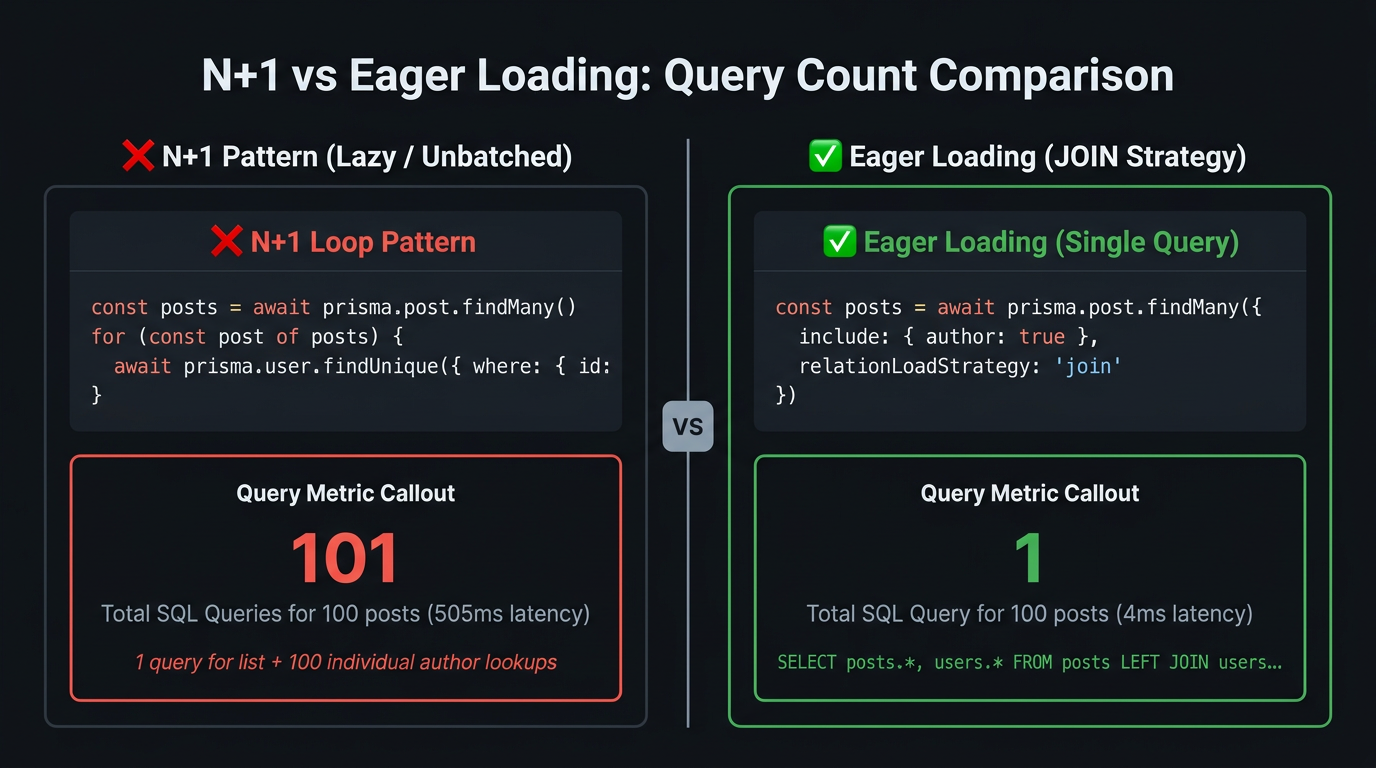
A database is not a dumb storage box — it is a contract between your write path, your read path, and your consistency guarantees. Every design decision you defer becomes a production incident you eventually own. At the application layer, the most deferred decision is this: knowing what SQL your ORM is actually generating. Engineers trust the ORM to "handle it" and discover in production, weeks after launch, that listing 100 blog posts fires 101 SQL queries — one for the list, one for each author. The N+1 problem is an ORM default behavior, not a user error. This article explains why it happens, how to catch it, and the minimum correct implementation for every list-loading path.
This is Part 5 of the Advanced Database & State Management series. The N+1 problem is fundamentally a query plan problem — understanding B-Tree index costs from Part 1 — Database Internals gives useful context for why N individual point lookups are always slower than one batched range query.
Cross-series reference: The DataLoader pattern taught here is the ORM-layer equivalent of the resolver-layer DataLoader in the GraphQL Backend & API Design (coming soon). The same batch-and-cache principle applies — the context differs (SQL vs GraphQL resolver), the contract is identical.
1. The N+1 Problem: Why It Is Invisible in Development
The N+1 problem occurs when an application loads a collection of N parent records, then executes one additional query per parent to load its related children — resulting in N+1 total queries instead of the correct answer of 1 (or 2 at most).
1.1 How It Manifests
1.2 Why It Is Invisible in Development
Development ORMs respond in sub-millisecond because the database is on localhost, the connection pool is warm, and the data fits in memory. The N+1 pattern only manifests at scale — and no standard unit test catches it, because unit tests do not measure query count.
Adding an index to the users.id column does not fix N+1. An index makes each of the 100 queries faster — but you still make 100 queries. The fix is to eliminate the queries, not to speed up each one.
2. ORM Query Generation: What the ORM Actually Emits
Understanding N+1 requires knowing exactly what SQL your ORM generates for each pattern. The ORM's query generation is deterministic — you can always find out.
2.1 The Three Patterns and Their SQL
2.2 Prisma 5.x relationLoadStrategy
Use relationLoadStrategy: 'join' for one-to-one and one-to-many relationships. Use relationLoadStrategy: 'query' (two queries) for many-to-many relationships — a JOIN on many-to-many produces a Cartesian product that Prisma must deduplicate, which can be slower than two batched queries for large result sets.
3. Lazy Loading: The Hidden SELECT
Lazy loading fires a SQL query when you access a property on an ORM entity. It is the mechanism behind N+1 — and it is invisible at the call site.
3.1 How Lazy Loading Works
3.2 The JSON Serializer Trap
JSON serialization is the most dangerous lazy loading trigger because it happens outside the controller's explicit code. The res.json() call looks innocent. The N queries are fired deep inside the serializer. Use a query logger with log_min_duration_statement = 0 in staging to catch this pattern before it reaches production.
4. Eager Loading: Correct Patterns and the Cartesian Trap
4.1 One-to-Many: Use include
4.2 Many-to-Many: Avoid the Cartesian Product
5. DataLoader: The Minimum Correct Implementation
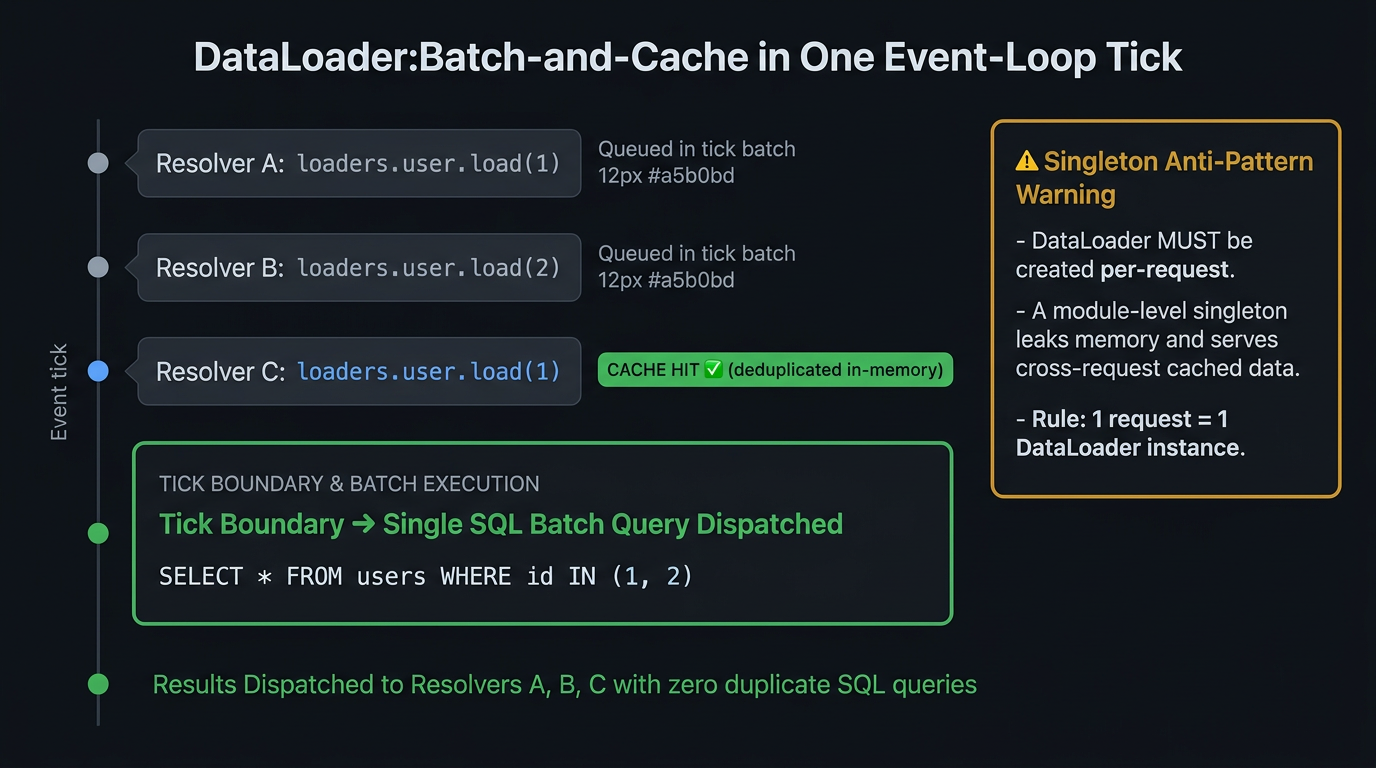
The DataLoader pattern was introduced by Facebook for GraphQL resolver batching but applies equally to any list-loading path in a server that handles many concurrent requests.
5.1 The Batch-and-Cache Contract
5.2 DataLoader Timing: The Event-Loop Tick
DataLoader caches within a single request lifecycle only — it is not a global cache. A new DataLoader instance must be created per request (or per GraphQL execution context). If you instantiate DataLoader as a module-level singleton, all requests share the same cache — requests see each other's data (correctness bug) and the cache grows unboundedly (memory leak).
5.3 Identity Map and Unit of Work: Change Tracking Internals
6. Query Logging: The Only Reliable N+1 Detector
The most effective N+1 detection setup: enable log_min_duration_statement = 0 in staging and run your full test suite against the staging database. Count identical query patterns in the log. Any pattern that repeats N times with only a different parameter value is an N+1.
Summary
| Concept | Rule |
|---|---|
| N+1 cause | ORM lazy loading is the default — every collection access fires N additional queries unless you explicitly opt into eager loading |
| N+1 visibility | Sub-millisecond in dev; hundreds of milliseconds in production — code review will not catch it |
| Fix N+1 | include / join for one-to-one and one-to-many; query strategy for many-to-many; DataLoader for resolver/service layer |
| Lazy loading in serializer | res.json() triggers lazy loading on all properties — the most dangerous N+1 pattern because it is invisible in controller code |
| Cartesian explosion | Many-to-many with JOIN returns N×M rows — use relationLoadStrategy: 'query' (two queries) instead |
| DataLoader timing | Coalesces all .load() calls within one event-loop tick into one batched query |
| DataLoader scope | Per-request instance only — module-level singleton causes cross-request cache pollution and memory leak |
| Identity Map | ORM tracks every loaded entity — EntityManager.clear() is mandatory in long-running workers to prevent unbounded memory growth |
| Query logging | log_min_duration_statement = 0 in staging is the only reliable N+1 detector — code review and unit tests are insufficient |
Prisma relationLoadStrategy |
'join' for one-to-one/one-to-many; 'query' for many-to-many — controls whether Prisma emits a JOIN or a second batched query |
What's Next
You have completed the core arc of the Advanced Database & State Management series. For the next layer — how these data patterns manifest in API design across service boundaries — see the GraphQL Backend & API Design (coming soon), which covers DataLoader in the resolver context, schema design as a domain contract, and query depth limiting as a production-operations requirement.
This article was developed with AI-assisted deep search, specification cross-referencing, and technical research synthesis.