Distributed Concurrency & Locking with Redis: SETNX, Redlock, Fencing Tokens & Leases
Distributed locks in Redis provide efficiency, not absolute safety, unless guarded against process pauses, network partitions, and clock drift. This article deconstructs atomic SETNX PX acquisition, Lua release scripts, watchdog heartbeat lease extensions, the Redlock quorum algorithm, Martin Kleppmann's critique, and Monotonic Fencing Tokens.
Caching & Distributed Concurrency
Distributed Concurrency & Locking with Redis: SETNX, Redlock, Fencing Tokens & Leases
A cache is not an optimization layer you sprinkle over slow queries — it is a volatile, distributed state machine with independent failure modes and eventual consistency tradeoffs. When you repurpose that volatile state machine for distributed concurrency, every guarantee holds only until the clock drifts, the runtime pauses, or the network partitions. In microservice architectures, coordinating execution across multiple independent server pods is a fundamental requirement: processing a payment exactly once, generating a monthly payroll report without duplicate runs, or leasing access to an external third-party API. Developers frequently reach for Redis, implement a quick SETNX lock 1, and assume they have mutual exclusion. In reality, naive distributed locks in Redis create silent deadlocks, stolen locks, and catastrophic data corruption. This article deconstructs single-instance lock mechanics, analyzes the Redlock quorum algorithm, explores Martin Kleppmann's famous critique, and derives the production standard: Monotonic Fencing Tokens.
This is Part 4 (the final capstone) of the Caching & Distributed Concurrency series. It follows Part 1 — Caching Topologies, Part 2 — Cache Invalidation Strategies, and Part 3 — High-Concurrency Cache Hazards.
1. The Anatomy of a Single-Instance Distributed Lock
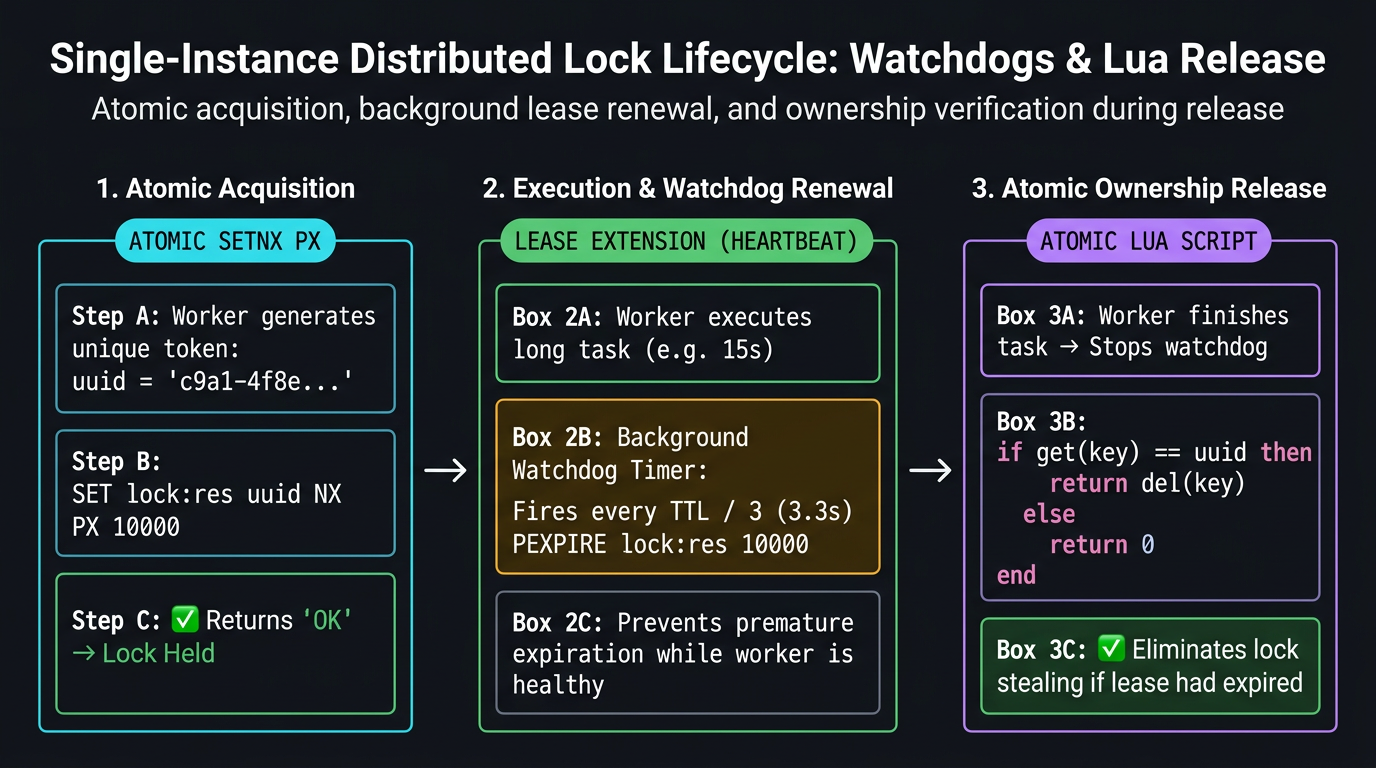
A distributed lock must satisfy three non-negotiable invariants:
- Safety (Mutual Exclusion): At most one worker can hold the lock at any given time.
- Liveness A (Deadlock Free): Even if a worker holding the lock crashes or gets partitioned, the lock must eventually become available again.
- Liveness B (Fault Tolerance): A client cannot release a lock that belongs to another client.
2. Multi-Instance Locking: The Redlock Algorithm
Single-instance locks fail if the Redis master crashes before replicating the lock key to its asynchronous replica. If the replica is promoted to master, a second worker acquires the same lock.
To overcome single-node failure, Salvatore Sanfilippo designed the Redlock Algorithm, which operates across $N$ completely independent Redis master nodes (typically $N=5$, running on separate physical machines or availability zones).
2.1 The Redlock Protocol Steps
- Timestamp: The client records the current time ($T_1$).
- Sequential Acquisition: The client attempts to acquire the lock on all $N$ instances sequentially, using the same key name and unique random value, with a small timeout on each instance (e.g., 5–50ms) to prevent hanging on a dead node.
- Quorum Verification: The client calculates the total elapsed time:
$$\text{elapsed_time} = T_2 - T_1$$
The lock is successfully acquired if and only if:
- The client acquired the lock on a majority of nodes ($M \ge \lfloor N/2 \rfloor + 1$, e.g., $\ge 3$ of 5).
- The total elapsed time is strictly less than the lock validity time: $$\text{validity_time} = \text{TTL} - \text{elapsed_time} - \text{clock_drift_allowance}$$
- Rollback on Failure: If the client fails to acquire a quorum or if the validity time is zero/negative, it immediately attempts to unlock all $N$ instances (even nodes it failed to lock).
3. The Distributed Systems Critique: Kleppmann vs. Sanfilippo
In 2016, distributed systems researcher Martin Kleppmann published a comprehensive critique of Redlock ("How to do distributed locking"), proving that in asynchronous distributed systems with unsynchronized clocks, no pure lock-based algorithm can guarantee safety on its own.
3.1 The Stop-the-World GC Pause & Hypervisor Stall Hazard
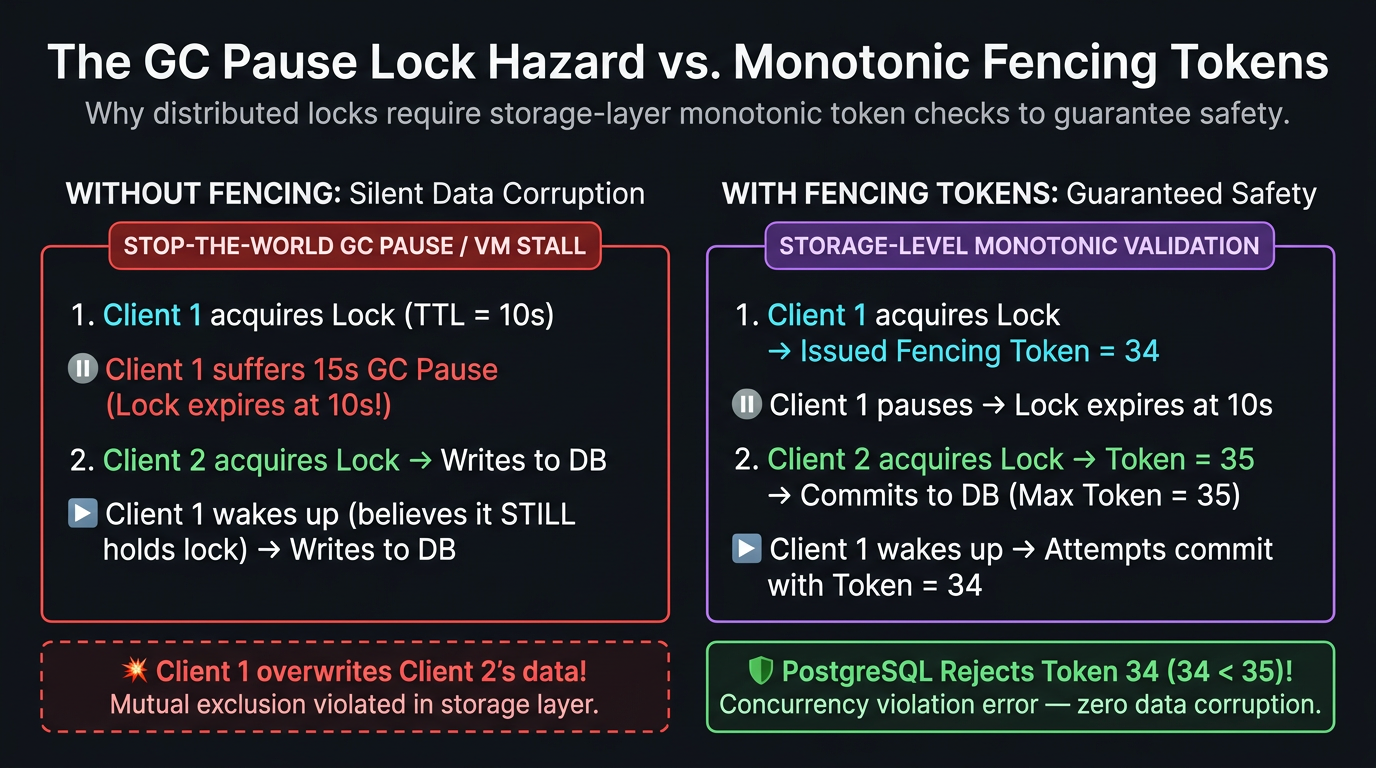
Consider what happens when Client 1 acquires a Redlock across a majority of nodes with a 10-second TTL:
Because Client 1 experiences a runtime pause that exceeds the lock TTL, the lock expires silently. Client 2 legitimately acquires the lock and commits a write. When Client 1 resumes, its execution pointer is inside the critical section; it issues its write to the storage layer, overwriting and corrupting Client 2's data.
3.2 Efficiency Locks vs. Correctness Locks
Kleppmann establishes a fundamental distinction:
- Locks for Efficiency: You want to avoid duplicate expensive computations (e.g., sending an email twice or resizing an image). Redlock or single-instance Redis is suitable here because an occasional duplicate execution is benign.
- Locks for Correctness: You must guarantee data integrity under all failure conditions (e.g., transferring financial funds or updating inventory). Redlock alone is insufficient.
3.3 Monotonic Fencing Tokens
To guarantee safety for correctness locks, the storage engine (PostgreSQL, MySQL, S3) must act as the ultimate concurrency validator using Monotonic Fencing Tokens:
- When a client acquires a distributed lock, the lock service returns a strictly monotonically increasing integer token ($1, 2, 3 \dots$).
- Every time a client writes to the storage layer, it passes its fencing token along with the payload.
- The storage layer checks: $$\text{incoming_token} > \text{highest_committed_token}$$
- If a client attempts to commit with an older token (e.g., Client 1 waking from a GC pause with
token=34after Client 2 committedtoken=35), the storage engine rejects the write with a concurrency violation.
4. Distributed Coordination Primitives in Redis
Beyond mutual exclusion locks, Redis powers critical distributed coordination primitives:
4.1 Distributed Rate Limiting: Sliding Window Counter via Atomic Lua
High-scale APIs require precise rate limiting across hundreds of container pods. While Fixed Window counters suffer from 2× burst spikes at window boundaries, a Sliding Window Counter with Dual Buckets provides 99% accuracy with $O(1)$ memory.
4.2 Idempotency Key Stores + Distributed Locking
For financial transactions, combining distributed locks with an Idempotency Store guarantees both mutual exclusion during execution and cached responses for duplicate retries:
Summary
| Concurrency Pattern | Production Invariant |
|---|---|
| Atomic Acquisition | Always use SET key token NX PX ttl in a single command; non-atomic SETNX + EXPIRE risks permanent deadlock on crash. |
| Atomic Ownership Release | Always release locks using an atomic Lua script that compares the caller's unique UUID token before deleting to prevent silent lock stealing. |
| Lease Watchdogs | Long-running tasks require background watchdog timers to renew leases while execution is healthy. |
| Redlock Quorum | Redlock provides fault-tolerant mutual exclusion across $N$ independent masters, but relies on synchronized physical clocks and bounded network delays. |
| Monotonic Fencing Tokens | Distributed locks alone cannot guarantee safety against stop-the-world GC pauses; storage layers must enforce strictly increasing fencing tokens to reject stale zombie writes. |
| Sliding Window Rate Limiting | Dual-bucket sliding window counters implemented in atomic Lua scripts provide $O(1)$ memory efficiency and eliminate boundary burst vulnerabilities. |
Series Conclusion: The Resilient Backend Curriculum
Across this 4-part series, we have bridged the gap between intermediate implementation and senior-level distributed systems design:
- Part 1: Caching Topologies established the multi-tier hierarchy spanning edge CDNs, in-process L1 memory with RESP3 tracking, and Redis Cluster sharding.
- Part 2: Cache Invalidation Strategies proved why Write-Invalidate beats Write-Update, solved Replica-Lag poisoning, and implemented CDC WAL tailing.
- Part 3: High-Concurrency Cache Hazards derived the XFetch probabilistic early expiration formula and built Cuckoo anti-penetration filters.
- Part 4: Distributed Concurrency & Locking deconstructed atomic lock lifecycles, watchdog heartbeats, Redlock trade-offs, and Monotonic Fencing Tokens.
Mastering these systems transforms caching from a fragile performance band-aid into a resilient, highly scalable distributed architecture.
This article was developed with AI-assisted deep search, specification cross-referencing, and technical research synthesis.