Testing GraphQL APIs: Resolvers, Integration & Schema Contracts
The correct test boundary for a GraphQL API is the execution layer — schema + resolvers + context — not the HTTP transport. Testing resolvers in isolation misses the execution chain, and testing via HTTP is too slow and coupled to transport.
GraphQL Backend & API Design
Testing GraphQL APIs: Resolvers, Integration & Schema Contracts
You own the schema and the resolvers — the schema is a public contract you can never silently break, and every resolver is a performance commitment you make on every query. Testing verifies both halves of that statement: that the resolver implementation is correct (unit and integration tests), and that the schema has not changed in a way that breaks existing client contracts (schema contract tests). The most dangerous test architecture for GraphQL is the one that tests each resolver in isolation: your resolver passes every unit test and still fails in integration because the parent resolver returned an unexpected shape, because the DataLoader was called with the wrong key type, or because a schema change silently changed the type of a field the resolver assumed was non-null.
This is Part 8 (final) of the GraphQL Backend & API Design series. It applies the schema design from Part 1, the DataLoader context from Part 2, and the breaking change detection from Part 7 to build a testing strategy that catches real failures.
1. The GraphQL Testing Pyramid
The key principle: unit tests alone are insufficient for GraphQL. The resolver chain failure mode — where individual resolvers pass in isolation but the execution chain fails — is only caught by integration testing at the graphql() execute level.
2. Unit Testing Resolvers with Mocked Context
Unit tests validate the logic inside a single resolver function with all dependencies mocked.
3. Integration Testing via graphql() Execute
Integration tests execute the full resolver chain through the GraphQL engine without HTTP overhead. This is the tier that catches resolver chain failures.
What graphql() execute adds versus unit testing: the GraphQL execution engine handles field resolution order, parent object passing, null propagation, and error collection. A resolver that returns the wrong type for a non-null field produces an error in graphql() execute that a unit test would never catch. This tier catches the "individual parts work, system is broken" failure class.
4. Schema Snapshot & Contract Testing
Schema contract tests validate that your schema has not changed in a breaking way relative to client operation documents.
5. Testing Subscriptions with Mocked AsyncIterators
6. graphql-yoga v5 Test Utilities
graphql-yoga v5 provides buildHTTPExecutor — a test utility that creates a fetch-based executor against the yoga instance without starting a real HTTP server:
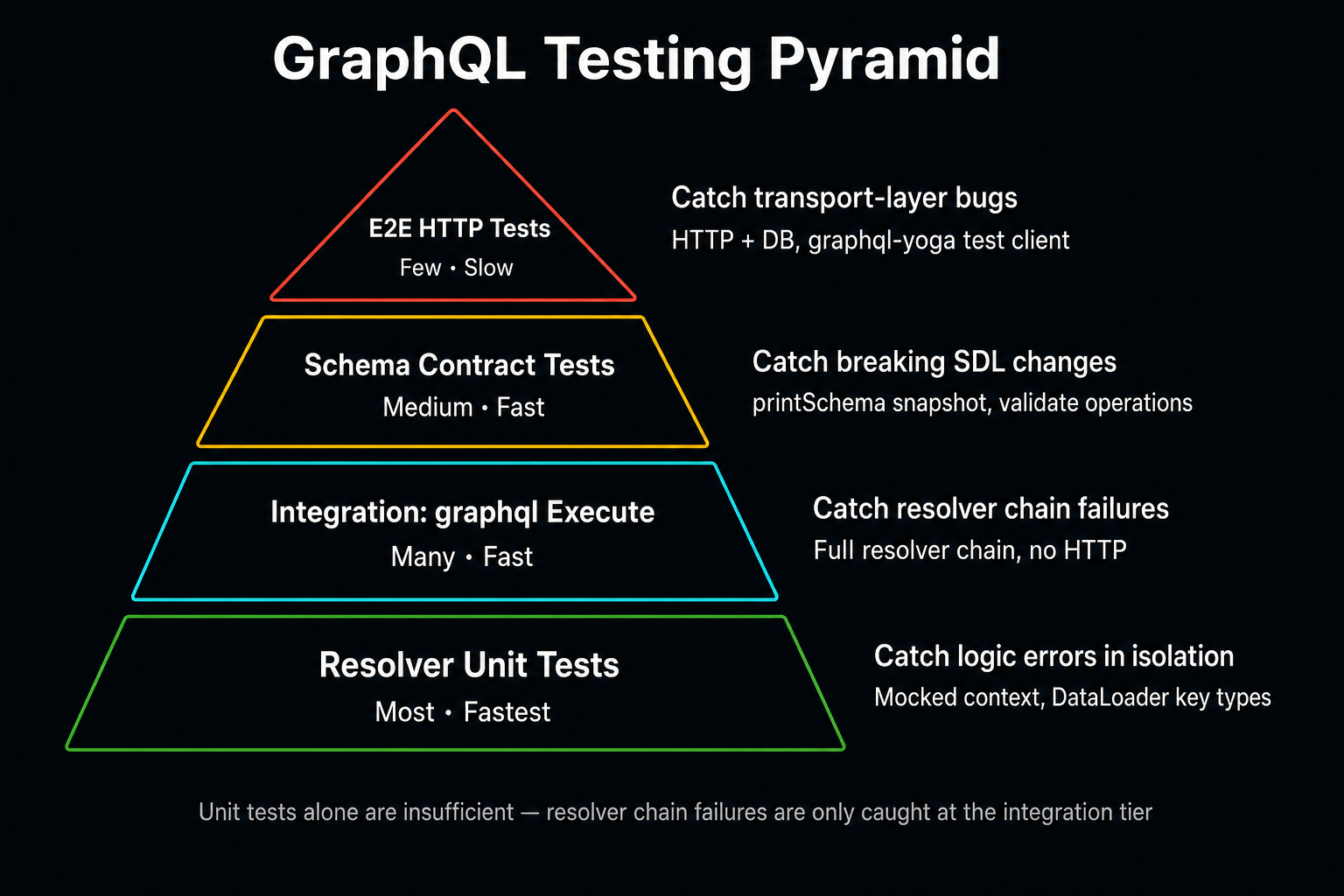
The four-tier testing pyramid: resolver unit tests catch logic errors in isolation, execution integration tests via graphql() catch resolver chain failures and null propagation, schema contract tests catch breaking SDL changes, and E2E HTTP tests catch transport-layer issues.
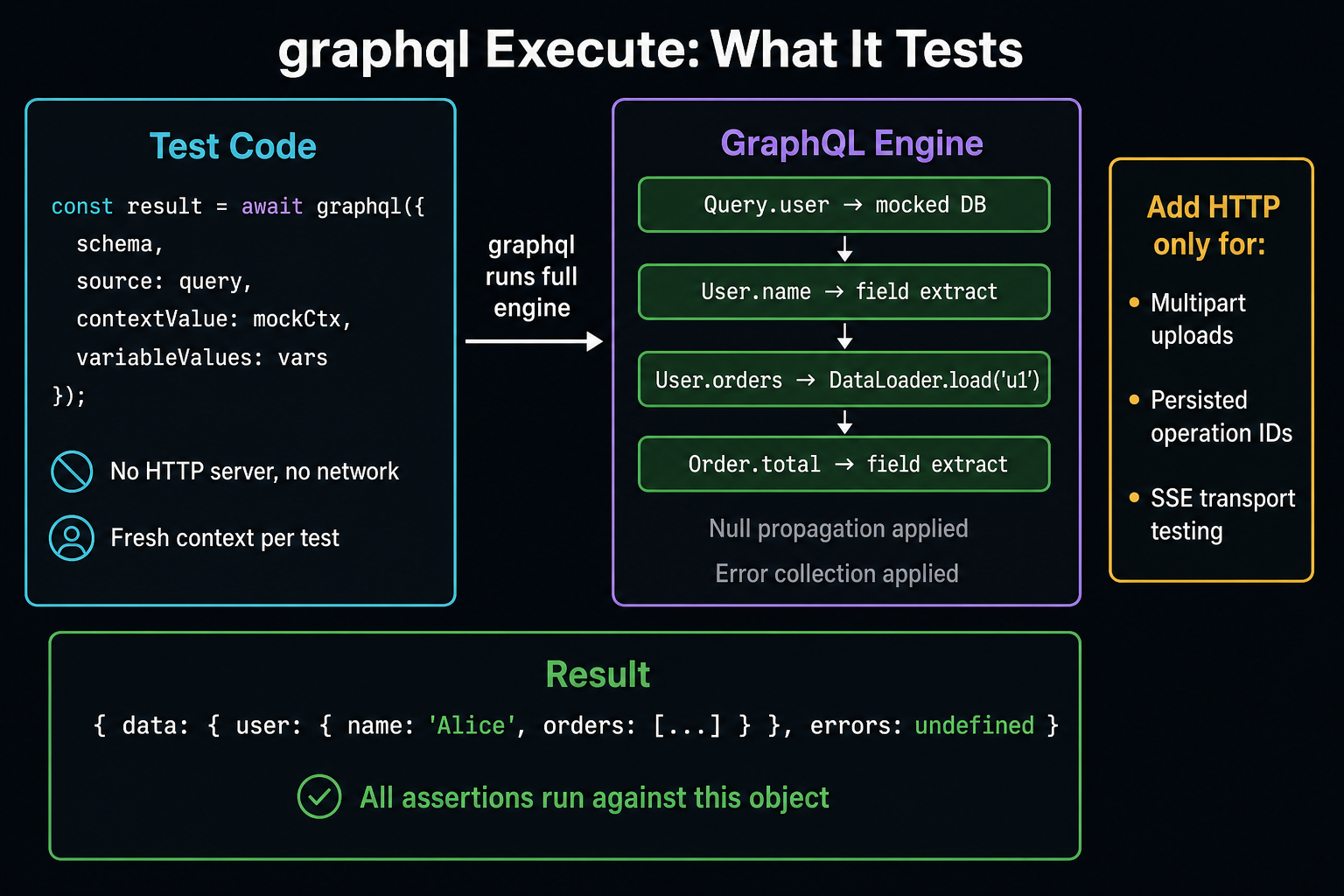
The graphql() execute function runs the complete resolver chain — field ordering, null propagation, error collection — without HTTP overhead. Add HTTP only when testing transport-specific behavior like multipart uploads, persisted operation IDs, or SSE.
Summary
| Concept | Rule |
|---|---|
| Resolver unit tests | Test one resolver in isolation with a mocked context. Verify the exact key type passed to DataLoader (string, not number) and the return shape contract with the parent resolver. |
Integration via graphql() |
Execute the full resolver chain through the GraphQL engine — no HTTP. This tier catches null propagation chains, DataLoader key mismatches, and resolver ordering failures that unit tests miss. |
| Schema snapshot tests | expect(printSchema(schema)).toMatchSnapshot() fails on any SDL change, forcing a conscious review of every schema modification before it can be merged. |
| Operation document validation | validate(schema, parse(operationDocument)) against all client .graphql files catches breaking SDL changes before CI — the same class of error as rover graph check. |
| Subscription testing | Test subscribe() returns an AsyncIterator and resolve() transforms the payload correctly using mocked AsyncIterator values — no live PubSub broker required. |
This concludes the GraphQL Backend & API Design series. The eight parts form a complete contract: the SDL is a domain contract (Part 1), every resolver is a performance commitment implemented correctly via DataLoader (Part 2), the subgraph boundary is a team boundary (Part 3), the subscription system scales horizontally (Part 4), every operation is measurable (Part 5), the schema has a defined attack surface defense (Part 6), every field has a lifecycle (Part 7), and every contract is verified by tests (Part 8).
This article was developed with AI-assisted deep search, specification cross-referencing, and technical research synthesis.