V8 Execution Context, Garbage Collection & Closures at Scale
Memory is not managed for you — every closure, detached DOM node, and global accumulation is a contract with the GC. Understanding V8's generational Orinoco GC, scope chain resolution, and hoisting mechanics is what separates engineers who diagnose memory leaks from engineers who restart the server.
JavaScript Engine Mastery
V8 Execution Context, Garbage Collection & Closures at Scale
The runtime is not a black box — every GC pause, every "state updated but UI didn't re-render" bug, and every server slowly leaking memory has a mechanical cause visible to engineers who read the engine. In Part 1 we traced how V8 compiles your code. Now we examine what happens after compilation: how the engine creates the runtime environment for each function call, how it decides which objects are garbage, and why closures — the most celebrated feature in JavaScript — are also the most effective way to accidentally fill the heap.
1. Execution Context and the Scope Chain
Every time a function is called, V8 creates an Execution Context — a record that tracks the current function's local variables, its this binding, and a pointer to its parent environment. These contexts stack vertically on the Call Stack and form a chain horizontally through the Scope Chain.
1.1 Lexical Environments and Scope Chains
A Lexical Environment is the runtime container for a function's variable bindings. It consists of:
- An Environment Record: a dictionary mapping identifier names to their current values
- A pointer to the outer environment — the lexical environment of the surrounding code
Scope chain resolution is a linked-list traversal from the innermost environment outward. This is why deeply nested functions with many outer variables have slightly slower identifier resolution — each unresolved name walks another link in the chain.
1.2 Creation Phase vs. Execution Phase
When V8 enters a new execution context, it performs two passes:
Creation Phase (before any code executes):
- Creates the Environment Record
- Allocates all
vardeclarations (initialized toundefined) - Allocates all function declarations (initialized to their full body)
- Allocates
letandconstdeclarations in the Temporal Dead Zone (TDZ) — present but not readable
Execution Phase (code runs line by line):
- Variable assignments and function calls execute in order
let/constbindings become readable only after their declaration line executes
1.3 Hoisting Beyond var
Hoisting is not special behavior for var — it is a consequence of the creation phase applied to all binding types:
The creation phase is V8 "reading ahead" to set up the environment record before execution begins. var gets undefined; function declarations get their full body; let/const/class get a TDZ marker that throws on access. After the creation phase, execution begins line-by-line and assignments fill in the actual values.
2. Garbage Collection: The V8 Orinoco GC
V8's garbage collector — code-named Orinoco — manages heap memory automatically. Understanding its mechanics explains why certain coding patterns cause "GC pressure" and how to write code that cooperates with the collector.
2.1 Mark-and-Sweep: The Core Algorithm
GC begins with liveness tracing: starting from a set of GC Roots (global objects, the current call stack, active closures), the collector marks every reachable object. After marking, it sweeps unmarked objects — they are garbage.
2.2 Generational Garbage Collection — Orinoco
V8's GC uses a generational hypothesis: most objects die young. Allocating and collecting many short-lived objects should be cheap; promoting long-lived objects to a more expensive collector is acceptable because it happens rarely.
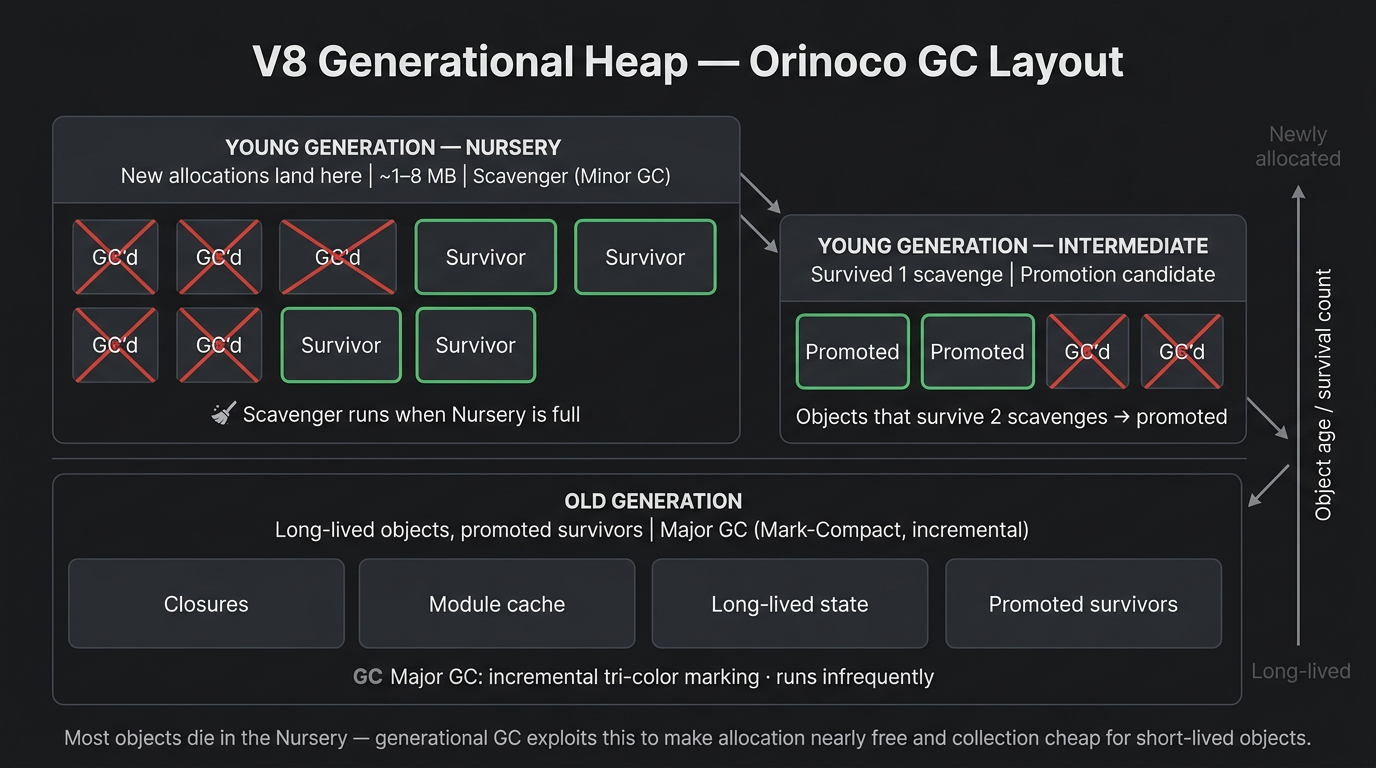
Young Generation (Scavenger / Minor GC):
- New objects are allocated into the Nursery (a small ~1–8 MB semi-space)
- When the Nursery fills, the Scavenger runs: it copies surviving objects (those with at least one reference) to the Intermediate semi-space; everything else is garbage
- Objects that survive two scavenges are promoted to the Old Generation
- Scavenging is fast — it only touches the small Young Generation, which is typically 90–95% garbage
Old Generation (Major GC / Mark-Compact):
- Long-lived objects, large objects, and promoted young objects live here
- Major GC runs the full incremental Mark-and-Sweep-Compact algorithm
- V8 runs major GC incrementally (breaking work into small slices) to avoid long stop-the-world pauses
- Compaction is optional — it moves surviving objects together to reduce fragmentation
The generational GC explains why short-lived objects in hot loops are not automatically a problem — the Scavenger cleans them cheaply. The danger is objects that escape the Young Generation: once promoted to the Old Generation, they cost much more to collect.
2.3 Identifying Memory Leaks
A memory leak is not always a bug — it is always a live reference that prevents GC from collecting an object you no longer need. The three most common causes:
1. Detached DOM Nodes:
2. Forgotten Event Listeners and Timers:
3. Accumulating Global References:
3. Closures at Scale
A closure is a function that retains access to its outer lexical environment after the outer function has returned. This is not a language quirk — it is an explicit guarantee: the inner function's outer environment reference keeps the environment record alive in the heap.
3.1 Data Privacy and Functional Currying
3.2 Memory Retention Consequences
The closure retains its entire outer lexical environment, not just the variables it actually uses. This is V8's design choice — the environment record is an indivisible object.
![Before/After split diagram illustrating closure memory retention. Left panel labeled 'Closure captures full outer scope (LEAK)' with red border. A function box 'processReport' shows two variables in its environment record: 'processedRows: ReportData[] (4 MB)' in red and 'summary: { status }' in dim. An arrow labeled 'getStatus closure' points outward from processReport. Both variables have solid arrows pointing to them from the closure, annotated 'Retained indefinitely — GC cannot collect processedRows'. Right panel labeled 'Scope-isolated closure (CORRECT)' with green border. A separate function box 'createStatusChecker(summary)' shows only 'summary: { status }' in its environment record. The 'getStatus closure' arrow points only to summary. A strikethrough box for processedRows annotated 'GC-eligible after processReport returns — not referenced by any closure'. Footer note in amber: 'A closure retains its entire outer lexical environment, not just the variables it accesses — isolate large data before creating long-lived closures'.](https://pub-74778554195b4df89d82f0d61988355a.r2.dev/assets/blog/frontend/v8-execution-context-garbage-collection-closures/fig-02.png)
This is one of the most common production memory leaks in long-running Node.js services: a request handler closure that captures large request/response objects and is then stored in a cache or event emitter — the entire HTTP request body, headers, and socket state remains in memory as long as the closure lives.
4. Practical Profiling with Chrome DevTools
In Chrome DevTools:
- Memory tab → Heap Snapshot: shows all retained objects with their shallow and retained sizes
- Memory tab → Record Allocation Timeline: shows when objects are allocated — spikes that don't decline are leaks
- Summary view → Retained Size column: sorts by memory held due to this object (including its references)
When you identify a suspiciously large retained object, the Retainers panel in the Heap Snapshot shows the exact reference chain keeping it alive — leading you directly to the closure, timer, or event listener responsible.
Summary
| Concept | Rule |
|---|---|
| Lexical environment | Created per function call — contains variable bindings and outer-environment pointer |
| Scope chain | Identity resolution walks the chain of outer environment pointers upward to global scope |
| Creation phase | V8 allocates all bindings before execution begins — var → undefined, let/const → TDZ |
| Hoisting | A consequence of creation-phase allocation — not a runtime behavior |
| Young Generation GC | Scavenger collects short-lived objects cheaply — most objects die in the Nursery |
| Old Generation GC | Major GC handles promoted long-lived objects — incremental to avoid STW pauses |
| Closure memory rule | A closure retains its entire outer lexical environment — not just used variables |
| Detached DOM nodes | Removed-from-DOM elements stay in memory if any JavaScript reference survives |
What's Next
In Part 3, we move from how the engine schedules execution to how you compose concurrent operations. The formal WHATWG event loop model (Macro→Micro→Render) is the prerequisite — if you haven't read The JavaScript Event Loop: Macro → Micro → Render, do that first. Part 3 picks up at the composition layer:
Promise.allSettled,Promise.any,Promise.race, and async generators for streaming. Part 3 → Event Loop & Advanced Async Concurrency
References
This article was developed with AI-assisted deep search, specification cross-referencing, and technical research synthesis.