Inside the V8 Compilation Pipeline: Parsing, JIT & Deoptimization
V8 compiles JavaScript through a 4-tier pipeline — Ignition, Sparkplug, Maglev, and TurboFan. Understanding when each tier activates, how Inline Caches accelerate hot code paths, and how hidden class changes trigger deoptimization is the foundation of writing performant JavaScript.
JavaScript Engine Mastery
Inside the V8 Compilation Pipeline: Parsing, JIT & Deoptimization
The runtime is not a black box — every performance anomaly, GC pause, and deopt has a mechanical cause. Senior engineers read the engine, not just the spec. Most JavaScript performance advice stops at "avoid synchronous blocking code" or "use const over let for performance" — advice that sounds plausible but is mechanically disconnected from how V8 actually works. This article reads V8's compilation pipeline from first principles, traces the path from source text to machine code, and identifies the exact points where your code's structure determines whether V8 can optimize it or is forced to bail out.
1. From Source Text to Running Machine Code
V8 does not execute JavaScript source text directly. It transforms it through a sequence of intermediate representations, each adding fidelity at the cost of startup time.
1.1 Tokenization and Lexical Analysis
The first step is the lexer (also called the scanner or tokenizer). It reads the raw Unicode character stream of your source file and emits a flat stream of tokens — atomic syntactic units with no structural relationship:
The lexer applies lexical rules: which sequences of characters form a keyword vs. an identifier, where a string literal ends, whether / starts a regex or a division operator. These rules are context-sensitive — the same character sequence can mean different things depending on what preceded it.
V8's scanner is written in C++ and scans one character at a time using a state machine. It is the only phase that touches the raw source bytes — everything downstream works with tokens or AST nodes.
1.2 Eager vs. Lazy Parsing
V8 does not parse every function in your file before executing a single line. It uses a two-pass parsing strategy:
Lazy parsing (also called pre-parsing) does the minimum work needed to skip over a function body: it validates syntax, resolves variable declarations, but does not generate an AST for the body. This dramatically reduces startup time for large files where most functions are not called immediately.
Libraries that are loaded but not called on startup benefit enormously from lazy parsing. This is why webpack's tree-shaking and bundlers wrap modules in functions — to let V8 defer them.
1.3 AST Construction — The Intermediate Representation
After (eager) parsing, V8 builds the Abstract Syntax Tree (AST) — a hierarchical representation of the program's structure:
The AST is the single source of truth that feeds every downstream compilation tier. It encodes syntactic structure without execution semantics — it knows that 40 + 2 is a binary expression, but not what type the values will be at runtime.
The AST is the engine's understanding of structure. Runtime type information — what values actually flow through the nodes — is collected later by Ignition's profiler. The split between static structure (AST) and dynamic type information (IC feedback) is the fundamental reason JIT compilation is more powerful than ahead-of-time compilation for dynamic languages.
2. The Compilation Tiers
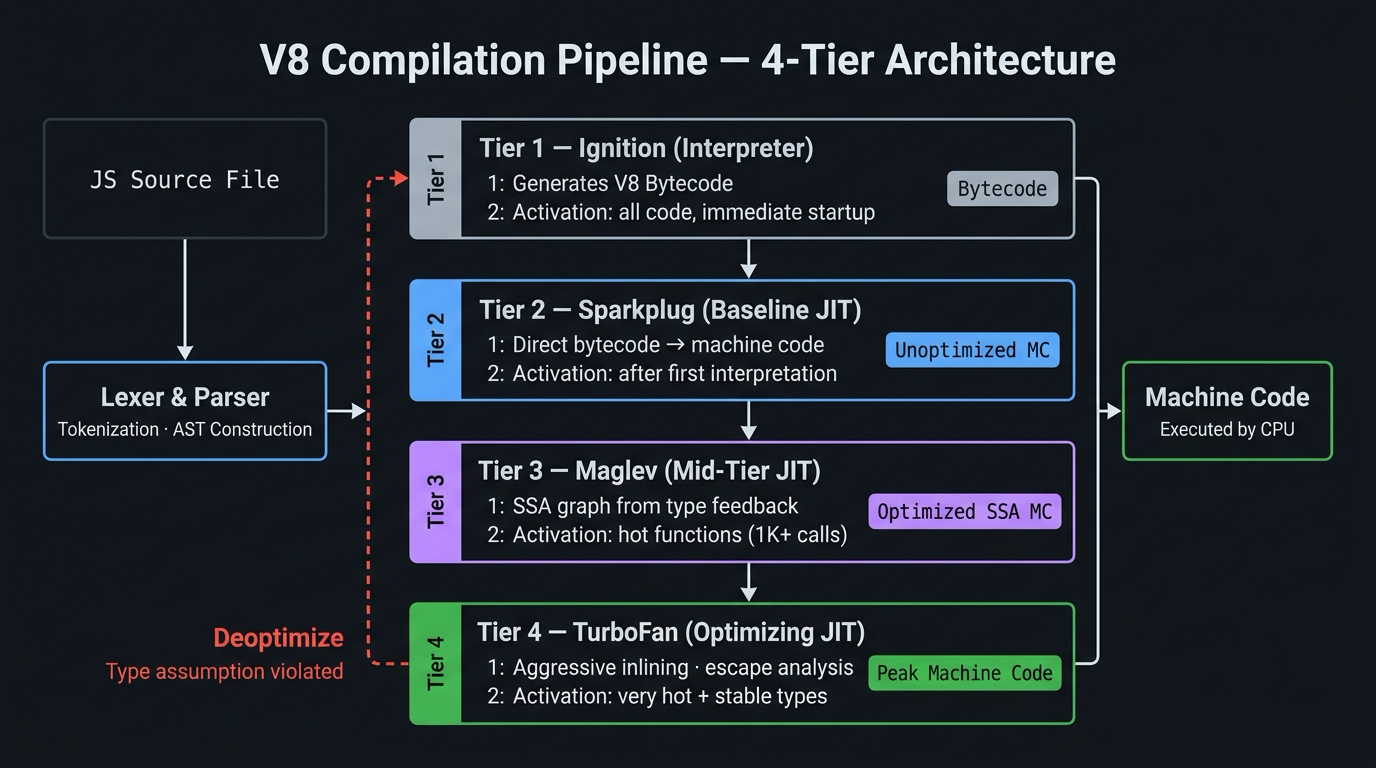
V8 uses four distinct execution tiers, each trading startup cost for peak performance. The engine moves code up the tiers as it identifies hot paths and collects enough type feedback to justify optimization.
2.1 Ignition — The Interpreter (Tier 1)
Ignition translates the AST into V8 bytecode — a compact, register-based instruction set that is far lower-level than JavaScript source but higher-level than machine code. Bytecode is then executed by the Ignition interpreter.
Why not go straight to machine code? Two reasons:
- Startup time: Generating machine code is expensive. For code that runs once (configuration loading, initialization), the compilation cost exceeds the execution savings.
- Type information: TurboFan's optimizations require knowing what types flow through each expression. Before Ignition runs the code and observes real values, those types are unknown.
While executing bytecode, Ignition profiles the code: it tracks which object shapes appear at property accesses, which types appear at arithmetic operations, and which branches are taken. This feedback is stored in Inline Cache (IC) slots and used by the optimization tiers.
2.2 Sparkplug — The Baseline JIT (Tier 2)
Sparkplug is a non-optimizing JIT compiler that generates machine code directly from the bytecode — one bytecode instruction at a time, with no analysis or optimization. It does not even build an intermediate representation; it is essentially a direct translation.
Sparkplug's value is speed of compilation: it generates machine code much faster than TurboFan, trading peak performance for reduced interpreter dispatch overhead. Code moves from Ignition to Sparkplug after its first interpretation pass.
2.3 Maglev — The Mid-Tier JIT (Tier 3)
Maglev, introduced in V8 v12.0 (Chrome 113, Node.js 22), fills the gap between Sparkplug and TurboFan. It generates a Static Single Assignment (SSA) graph from bytecode using the type feedback Ignition collected, then emits optimized machine code from that graph.
Maglev's key insight: most "hot" functions do not need TurboFan's full optimization suite. They need basic type specialization — knowing that add(a, b) always receives integers — without the compilation latency of TurboFan's deep analysis. Maglev provides 80% of TurboFan's performance in roughly 10% of the compilation time.
Maglev uses type feedback from Ignition's ICs to speculate on types. If a function always receives numbers, Maglev emits machine code that assumes numbers — with a guard that deoptimizes back to Ignition if a non-number ever appears.
2.4 TurboFan — The Optimizing JIT (Tier 4)
TurboFan is V8's peak-performance compiler. It performs aggressive global optimizations on code that is both very hot (called thousands of times) and has stable type feedback (always receives the same types). Its optimization passes include:
- Inlining: replacing a function call with the function's body — eliminates call overhead and enables further optimization across the inlined boundary
- Escape analysis: if an object is allocated but never leaves the function's scope, TurboFan can stack-allocate or eliminate it entirely
- Loop peeling and unrolling: duplicating loop bodies to enable better register allocation
- Constant folding: replacing
Math.PI * 2with the computed constant at compile time
TurboFan's machine code is the fastest JavaScript can execute. But it is also the most fragile — any deviation from the assumed type profile triggers deoptimization.
3. Inline Caches and Hidden Classes
The performance of the entire JIT tier depends on a mechanism called Inline Caches (ICs). Understanding ICs requires first understanding hidden classes (also called maps in V8's source).
3.1 Hidden Classes
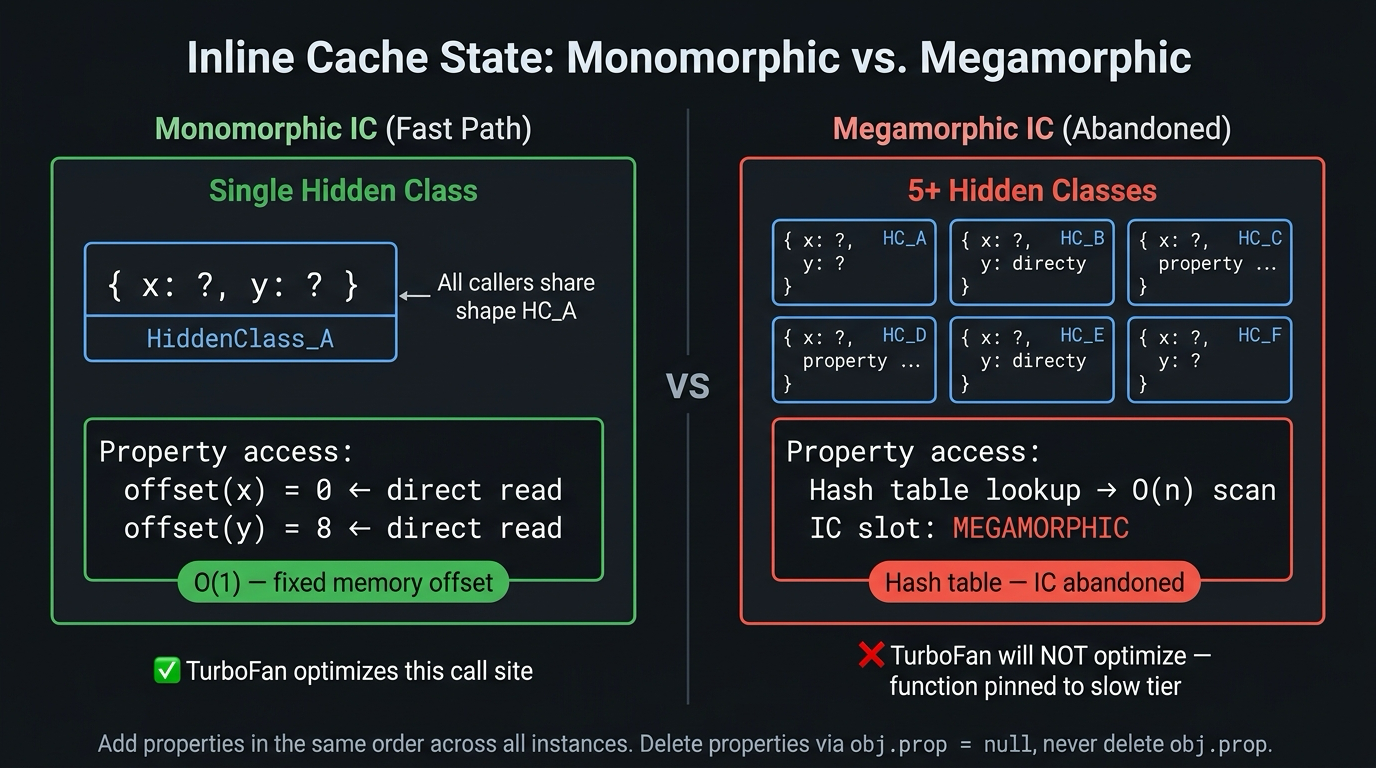
V8 does not store object properties in a hash table — that would require a hash lookup on every property access. Instead, V8 assigns each unique object shape a hidden class that records the property names and their memory offsets:
3.2 Inline Cache States
An IC starts in the uninitialized state and transitions through:
| State | Condition | Performance |
|---|---|---|
| Uninitialized | First access — no data yet | Slowest (full runtime lookup) |
| Monomorphic | All accesses have the same hidden class | Fastest — direct memory offset |
| Polymorphic | 2–4 different hidden classes seen | Fast — small linear search |
| Megamorphic | 5+ different hidden classes seen | Slowest — hash table lookup, IC abandoned |
A megamorphic IC is a permanent downgrade for that call site. TurboFan will not optimize functions with megamorphic ICs — the function stays in Sparkplug or Maglev tier. You can observe this in Chrome DevTools under JavaScript Profiler → look for functions marked as "megamorphic."
4. Deoptimization
Deoptimization is V8's safety net. When TurboFan generates machine code based on type assumptions, it inserts guards at every assumption point. If a guard fails at runtime, V8 deoptimizes the function:
- TurboFan's machine code is discarded for that invocation
- Execution falls back to Ignition's bytecode (or Maglev's code)
- Execution resumes from the point of the assumption violation
- V8 records the violation in the feedback vector and may attempt re-optimization later with updated assumptions
4.1 Deopt Triggers to Avoid
5. Profiling Deoptimizations in Practice
V8 exposes deoptimization events via Node.js flags:
In the browser, Chrome DevTools → Performance tab → record a profile → look for the JavaScript profiler view's "deopt" annotations on function frames.
The --allow-natives-syntax Node.js flag enables V8 intrinsic functions like %GetOptimizationStatus(fn) and %OptimizeFunctionOnNextCall(fn) — powerful tools for writing micro-benchmarks that verify a specific function is being optimized by TurboFan.
Summary
| Concept | Rule |
|---|---|
| Lazy parsing | Inner functions are pre-parsed (syntax check only) — body is deferred until first call |
| AST | The single IR that feeds all 4 compilation tiers |
| Ignition | Bytecode interpreter — fastest to start, slowest to execute at peak |
| Sparkplug | Direct bytecode → machine code translation — eliminates dispatch overhead, no optimization |
| Maglev | SSA-based mid-tier JIT — 80% TurboFan performance at 10% compilation cost |
| TurboFan | Peak optimizing JIT — requires stable type feedback, aggressive inlining and analysis |
| Hidden class | V8's internal shape descriptor — same properties in same order = same hidden class |
| Monomorphic IC | Single hidden class at a call site — direct offset read, fastest possible access |
| Megamorphic IC | 5+ hidden classes — IC abandoned, TurboFan will not optimize this call site |
| Deoptimization | Type assumption violated — execution falls back to Ignition, TurboFan code discarded |
What's Next
In Part 2, we go deeper into the runtime: how the execution context and scope chain resolve identifiers, what V8's generational Orinoco GC does to objects across their lifetime, and how closures — the most misused feature in JavaScript — can silently retain entire modules in memory. Part 2 → Execution Context, GC & Closures
References
This article was developed with AI-assisted deep search, specification cross-referencing, and technical research synthesis.