Pragmatic UML & Visual Architecture as Code
Academic UML is bureaucratic overhead, but lean class diagrams and asynchronous sequence lifelines written in Mermaid.js are the most efficient way to communicate low-level design in teams and interview loops. This article teaches the 20% of UML notation that delivers 80% of clarity, plus a 30-minute LLD sketching framework for interview time pressure.
TypeScript Low-Level Design & Object-Oriented Architecture
Pragmatic UML & Visual Architecture as Code
In TypeScript 5+, OOP is an architectural contract, not an inheritance tree: enforce domain invariants at compile time, encapsulate mutation strictly within aggregates, and invert dependencies so high-level business policy never couples to execution details. But a contract no one can read is not a contract — it is a private note. The ability to communicate that architecture visually, precisely, and quickly is what separates engineers who design well from engineers who design well and lead effectively.
Academic UML is a bureaucratic discipline invented for software tools of the 1990s. The full UML 2.5 specification spans 796 pages of notation that no practitioner uses in day-to-day engineering. What teams and LLD interviewers actually need is a ten-notation subset that can be written in a text editor, rendered by any modern markdown renderer, and committed alongside the code that implements it. Mermaid.js is that tool — and this article teaches the 20% of it that delivers 80% of architectural clarity.
1. The Anti-Pattern Graveyard: The Sprawling PNG Screenshot Diagram
Here is the workflow that every engineering team has experienced at least once:
The core failure is that the diagram lives outside the repository. It cannot be reviewed in a PR diff. It cannot be automatically rendered. No one knows it is wrong until someone acts on it.
The fix is diagrams-as-code: Mermaid.js blocks embedded directly in Markdown files, committed to the repository, and rendered automatically by GitHub, GitLab, and every major documentation platform.
2. Class Diagram Syntax: The Practical Subset
2.1 Visibility Modifiers and Members
Mermaid's class diagram syntax maps directly to TypeScript's access model:
| Mermaid Prefix | TypeScript Equivalent | Visual in Diagram |
|---|---|---|
+ |
public |
Plus sign before member |
- |
private |
Minus sign |
# |
protected |
Hash |
~ |
Package / internal (no TS equivalent) | Tilde |
$ |
static |
Underlined member name |
* |
Abstract method | Italicized |
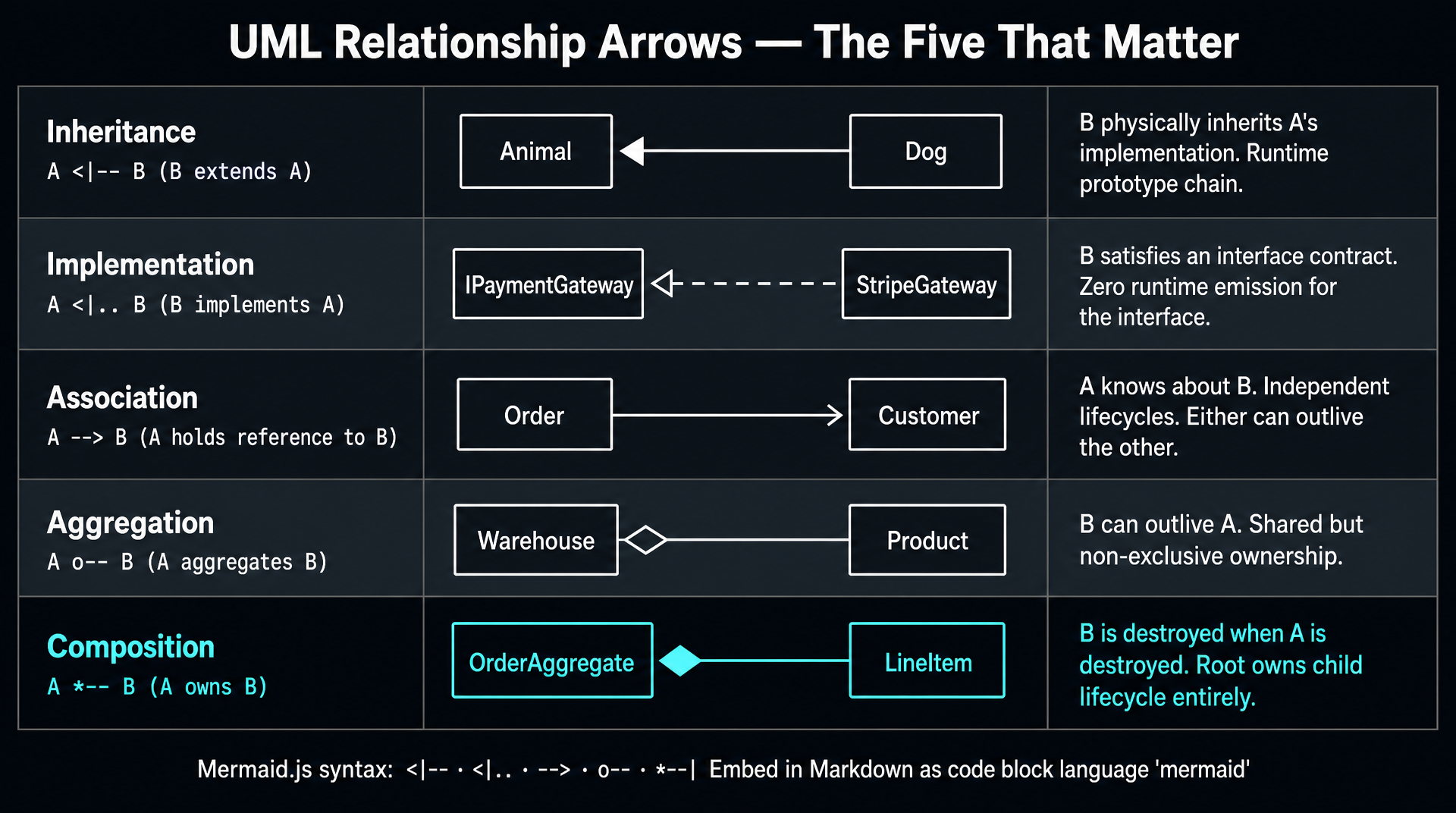
2.2 Relationship Arrows: The Five That Matter
Mermaid uses specific arrow heads to encode the five relationship types from classical UML. These are the five your team and interviewers use — nothing else is required:
| Relationship | Mermaid Syntax | Meaning |
|---|---|---|
| Inheritance | A <|-- B |
B extends A |
| Implementation | A <|.. B |
B implements A (dashed) |
| Association | A --> B |
A holds a reference to B |
| Aggregation | A o-- B |
A aggregates B (hollow diamond) |
| Composition | A *-- B |
A owns B (solid diamond) |
2.3 Stereotype Annotations
Add <<interface>>, <<abstract>>, <<aggregate>> labels to clarify architectural intent:
3. Sequence Diagram Syntax: Modeling Async Lifelines
Class diagrams model structure. Sequence diagrams model behavior over time. In the fintech domain, every payment flow involves multiple actors, async boundaries, and failure branches — sequence diagrams are how you communicate these precisely.
3.1 Basic Sequence Diagram Anatomy
| Notation | Meaning |
|---|---|
->> |
Synchronous call (solid arrow) |
-->> |
Response / return (dashed arrow) |
actor |
External user or system |
participant |
Internal component |
autonumber |
Auto-number each step |
3.2 Failure Branches with alt
The alt block is Mermaid's conditional branch — analogous to an if/else. This is the most important block for modeling payment flows where success and failure paths diverge:
4. The Fintech Domain: A Complete Mermaid Sketch
Here is the full class diagram for the Enterprise Fintech Ledger & Order Fulfillment domain as it exists after Parts 1–4. This is the reference diagram for the rest of the series:
5. The 30-Minute LLD Interview Sketching Framework
In a 60-minute LLD interview, the first 30 minutes are almost always more important than the second 30. The candidate who produces a clear class diagram and sequence diagram in the first 20 minutes controls the interview — they are setting the scope, naming the entities, and demonstrating architectural thinking before writing a single line of code.
5.1 Step-by-Step: 0–20 Minutes
Minutes 0–5: Clarify Requirements
Minutes 5–15: Sketch the Class Diagram
Minutes 15–20: Sketch the Critical Sequence Diagram
5.2 The LLD Interview Question: "Design a Payment Ledger"
Here is a complete 5-minute Mermaid sketch for this common interview prompt:
In an LLD interview, the interviewer is evaluating three things with your class diagram:
- Naming — are the entities named after domain concepts, not technical ones?
- Relationships — do you understand the difference between composition and association?
- Interfaces — have you inverted the dependencies so the domain doesn't couple to infrastructure? If your diagram passes those three tests, you are demonstrating senior-level architectural thinking.
6. Asynchronous Boundary Modeling
A common source of architecture diagram failures is treating async operations as synchronous. In a Node.js fintech service, every database call, every external API call, and every event emission is asynchronous. Sequence diagrams must make this explicit.
6.1 Modeling the Node.js Event Loop Boundary
Always label the async boundary explicitly in sequence diagrams with a Note block. Without this, a reader cannot tell where the synchronous request-response cycle ends and where background processing begins.
7. Diagram Anti-Patterns to Avoid
| Anti-Pattern | Problem | Fix |
|---|---|---|
| Everything in one class diagram | Unreadable — 40+ nodes with crossed arrows | Split by bounded context; one diagram per aggregate cluster |
| No stereotypes or labels | Readers cannot tell interface from class from aggregate | Always add <<interface>>, <<abstract>>, <<aggregate>> |
| Synchronous arrows for async calls | Misleads readers about blocking behavior | Use Note over blocks to mark async boundaries |
| Skipping the failure path | Shows only happy path — critical for LLD review | Always add at least one alt/else failure branch |
| Private implementation details | Diagrams become maintenance burden | Show only public contracts and key state fields |
| No reading direction | Readers scan randomly — mental map is unclear | Always set direction LR or direction TB intentionally |
Summary
| Concept | Rule |
|---|---|
| Diagrams as code | Mermaid in Markdown — committed to the repository, reviewed in PRs |
| Class diagram | Model static structure: entities, interfaces, relationships, cardinalities |
| Sequence diagram | Model dynamic behavior: actor lifelines, async boundaries, failure branches |
| Relationship arrows | <|-- (inheritance) · <|.. (implementation) · --> (association) · o-- (aggregation) · *-- (composition) |
alt/else |
The single most important Mermaid block for LLD interviews — models conditional flows |
| Interview framework | 0–5 min: clarify · 5–15 min: class diagram · 15–20 min: sequence diagram · 20+ min: code |
| Async boundaries | Always mark with Note over — never draw async operations with synchronous arrows |
What's Next
In Part 6, we move from drawing architecture to enforcing it. SOLID principles are not abstract ideals — each one has a mechanical, compiler-enforced expression in TypeScript 5+. Part 6: SOLID Principles: Structural Foundations (S, O, L) dismantles the 60-line payment switch statement, builds type-safe strategy registries with
satisfies, and proves Liskov violations at compile time with--strictFunctionTypes.
This article was developed with AI-assisted deep search, specification cross-referencing, and technical research synthesis.